

“That hollow little creak when you squeezed the back of your Nokia 3310 to pop it off and swap the battery. You remember that sound, right?”
There was a rhythm to it. Phone face down on the table, thumb on the notch, a tiny flex of plastic, then that click as the back cover came free. No fear. No anxiety. No thought like, “If I drop this, will the glass shatter and cost half my rent to fix?”
Fast forward to the phone in your pocket right now. High refresh screen, more cameras than your first digital point-and-shoot, and a back that looks gorgeous in product photos. But once it is in your hand, wrapped in a case 24/7, that shiny glass back might as well not exist. You still baby it. You still flinch when it slides off a couch arm. You still think about repair prices you do not want to see.
Maybe that is the twist no one talks about. The old plastic backs we laughed at in spec sheets are starting to feel smarter now that phones cost as much as laptops. That original creaky cover suddenly has a very modern question hiding inside it: is plastic actually better for phones than glass?
The forgotten comfort of plastic phones
Back in the mid-2000s, your phone was a chunk of ABS plastic, maybe with a metal frame if you were fancy. It felt light in the hand, almost toy-like. You could drop it on tile and the sound was more “clack” than “crunch”. The worst outcome was a flying battery and a back cover sliding under the couch.
“User Review from 2005: ‘Dropped my Sony Ericsson K750i again. Back popped off, battery flew across the room. Snapped it back on. Still works. LOL these things are tanks.'”
That was normal. You did not need a case. A screen protector was overkill. You tossed it onto your bed, your desk, sometimes your car dashboard. The plastic might get scuffed, but it would rarely crack.
That material choice had a physical presence. The phone felt lighter. The edges were softer. The texture had grip. Many backs were matte or slightly rubberized. Your hand recognized them without thinking. You could pull the phone from your pocket without doing a mental risk calculation.
Then the glass era showed up.
Manufacturers wanted phones to look premium. Shiny. Reflective. They wanted them to match the marketing shots. Glass backs gave you wireless charging and a glossy, jewelry-like finish. It looked slick under lighting. It looked high-end on a shelf.
But real life is not a product render.
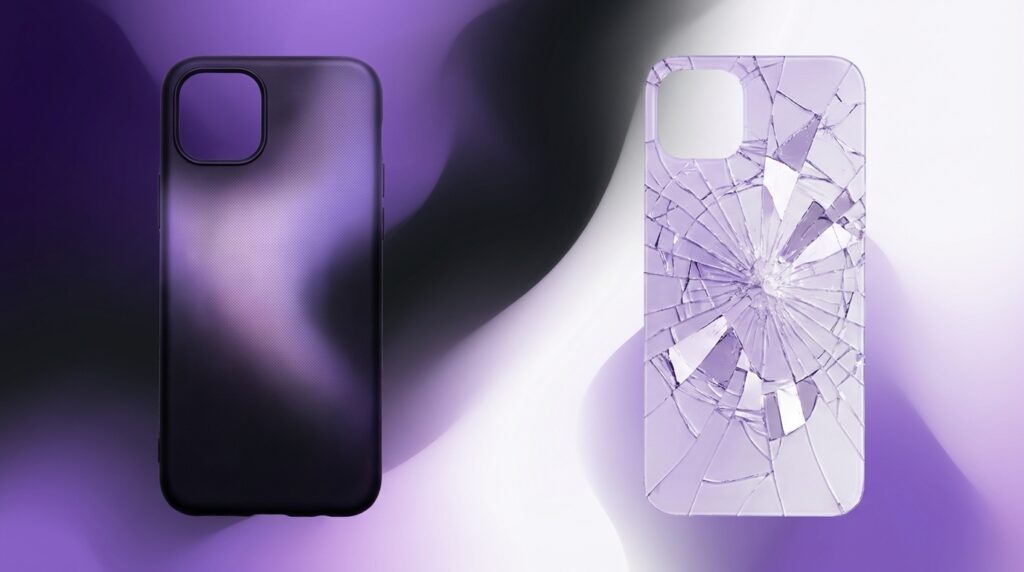
You grip your glass phone a little tighter. You get a case. Maybe a skin. You baby it. And the funny part is that to keep it safe, you wrap that beautiful glass… in plastic.
Then vs now: plastic backs against glass slabs
Let us stack an early-2000s plastic icon against a modern flagship with glass on both sides. Numbers paint a pretty clear picture of how far phones have gone, and where plastic still punches above its weight.
| Spec | Nokia 3310 (2000) | iPhone 17 Pro (modern glass flagship) |
|---|---|---|
| Back material | Removable plastic shell | Textured glass over metal frame |
| Weight | 133 g | ~200 g+ |
| Repair cost for back | Buy a new shell for a few dollars | Back glass repair often over $300 |
| Drop worry level | “Will the battery pop out?” | “Will the back or camera glass crack?” |
| Grip | Matte, textured plastic, low slip | Smoother glass, higher slip risk |
| Wireless charging | No | Yes, enabled by glass back |
| Customization | Swap shells, colors, printed art | Mostly cases and skins |
The modern iPhone 17 (or any flagship like it) crushes the 3310 in raw specs: OLED, cameras, CPU, storage, everything. No contest.
But if you strip away performance and look only at day-to-day handling, the cheap plastic brick is not as dumb as it looked. You could argue that for actual human use, a good plastic back is more honest than a fragile glass panel that almost no one uses naked.
The tactile truth: what your hand actually wants
Modern flagships are dense. Pick one up and you feel the weight. Metal frame, multiple camera modules, bigger batteries, complex cooling, wireless charging coils, glass front, glass back. It all stacks up.
Plastic does something very simple here: it cuts weight. A plastic back shaved off tens of grams from early smartphones. Even today, phones with plastic backs often feel more balanced and less fatiguing to hold for long sessions. That matters if you scroll, game, or watch content for hours.
There is also the texture. A plastic back can be:
– Matte and soft touch
– Slightly rubberized
– Micro-textured for grip
Your thumb tells the difference right away. That texture means you can use the phone one-handed with less fear. Glass can be etched or frosted for grip, but it still has that cold, smooth feel. The physics of glass on skin and fabric also make it more prone to slow sliding off couch arms or car seats.
“Retro Specs: The Sony Ericsson W810i weighed about 99 g with a plastic housing and had a soft, grippy back that felt almost like a tiny MP3 player in your palm.”
That feel is underrated. It encourages direct interaction. You do not feel like you are holding a fragile object. You feel like you are holding a tool.
Plastic and durability: what actually breaks
When you drop a phone, several things can happen:
– External shell can crack or scuff
– Internal frame can bend or warp
– Screen can shatter
– Camera glass can crack
– Internal connectors can loosen
Glass backs spread the force differently than plastic. Glass is rigid. Under impact, if it does not flex enough, it cracks. Plastic is more forgiving. It flexes and absorbs some of that shock. The back might scratch or gouge, but it tends to keep the phone structurally intact.
Plenty of early smartphones and feature phones from the 2000s still power on today after years in drawers, bags, and glove boxes. Their plastic backs are scuffed, glossy in spots from wear, maybe yellowed, but still fully usable.
That is a form of endurance modern glass phones struggle to match. You might still own a glass flagship from five years ago, but ask yourself: is the back pristine because you are careful, or because you wrapped it in a case on day one?
Repair and cost: plastic wins the “oops” test
Think back to the last time you saw someone drop a glass phone in slow motion. You could almost hear the money leaving their wallet before it hit the ground. Today, rear glass repair through official channels sits in the “maybe just replace the phone” range for many users.
Plastic backs handled this very differently.
On older devices:
– You could buy a full replacement housing online for not much.
– You could swap it at home with almost no tools.
– Even small shops could fix cosmetic damage fast.
No heat guns. No specialized adhesives. No complex disassembly before you even touch the back.
A modern glass-backed phone often integrates wireless charging coils, antennas, and adhesives in a way that turns that pretty rear panel into a delicate sandwich of parts. That complexity raises labor costs. It also raises the barrier for small repair shops.
If you zoom out, plastic backs supported a culture of casual repair. Crack or scratch your housing? You could change the entire look of your phone for the price of lunch. That frictionless repair experience is something we quietly lost while chasing luxury materials.
Customization: plastic as a personal canvas
Smartphones in the early and mid-2000s were billboards for personality. If you owned:
– A Nokia 3220 with those crazy LED bumpers
– A Sony Ericsson Walkman phone with bright orange accents
– A Motorola V3 with colored shells
you remember how easy it was to change looks. Third-party housings were everywhere. Clear shells, printed shells, branded shells from your favorite bands. It was normal to see the same model with ten different identities.
Plastic backs enabled that. Their manufacturing and mounting methods made it cheap and straightforward for third parties to offer replacements. Then came sticker culture: vinyls, decals, glitter backs.
“User Review from 2005: ‘Got a transparent blue housing for my Nokia 6600. Installed it in 15 minutes. Everyone at school wants the same one, lol.'”
With glass, cosmetic customization mostly shifted to:
– Cases
– Thin skins
– Screen themes
The phone itself rarely changes. You are essentially hiding the device you paid for, then customizing the shell you bought separately. That might be practical, but it disconnects you from the object underneath.
A plastic back phone, on the other hand, was the thing you customized, not the thing you hid.
Heat, radios, and the science side of plastic backs
There is also a technical layer to this conversation. A smartphone is a radio and a small computer living in a tight envelope. Materials matter.
Signal behavior
Radios like to pass through plastic. Glass also lets radio waves through, but metal does not. When smartphones first went all-metal, engineers had to carve antenna lines or use plastic segments. When glass backs came, they solved some antenna problems by turning the back into a radio-friendly surface.
But plastic backs already had that advantage. They:
– Let LTE, 5G, Wi-Fi, and Bluetooth signals pass with fewer tricks.
– Made antenna placement simpler and cheaper.
– Reduced the need for complex internal structures.
This kept some cost and design complexity down, especially in mid-range and budget devices.
Heat management
Glass has different thermal properties than plastic. It conducts and distributes surface heat in a way that can feel more even under your hand. That can make a hot phone feel less “hot in one spot” and more uniformly warm.
Plastic, being more insulating, can trap heat inside if the design does not manage it well. But modern plastic-backed phones often pair plastic shells with internal graphite sheets, heat pipes, or vapor chambers that move heat away from cores and into frames.
For budget devices without all those extras, plastic still offers a nice trade-off: you may feel hot spots less aggressively in your palm because the shell insulates you from them.
Both materials have quirks here. There is no single hero. The key point is simple: plastic is not a technical dead end. It is a valid choice that still supports complex radio and cooling setups without forcing glass on both sides.
Premium feel vs practical use
Marketing loves glass. It catches light. It looks sharp in macro shots. It suggests luxury because your brain associates it with high-end watches and jewelry. Compare that to “plastic”, a word people link with toys or cheap accessories.
That mental bias has shaped how we talk about design:
– Metal and glass: “premium”
– Plastic: “cheap”
But ask someone who has used phones for 15+ years which devices stressed them less, and you will see another metric surface: peace of mind.
A plastic back:
– Scuffs gracefully instead of cracking sharply.
– Often hides micro-scratches in matte textures.
– Gives better grip, especially with slightly rubberized finishes.
– Lets you go caseless without deep anxiety.
There is also the weight factor again. A lighter phone is easier on wrists over years. Plenty of people who move from a heavier glass flagship to a lighter plastic-backed mid-ranger quietly enjoy the decrease in strain, even if no one shouts about it in reviews.
Maybe it is nostalgia talking, but there is a sort of down-to-earth honesty in a good plastic phone. It is not pretending to be jewelry. It is saying, “You are going to throw me in a bag. I am ready for that.”
Plastic in modern phones: not just “cheap” anymore
You still see plastic backs in a big slice of the market:
– Mid-range Android phones
– Budget 5G devices
– Some rugged or gaming models
– Foldables with hybrid or partial plastic components
The design language has evolved:
– “Glasstic” composites: plastic treated to look like glass with depth and reflections.
– Textured plastic: micro patterns for grip and visual flair.
– Gradient finishes: color-shifting coats and matte-gloss combinations.
These phones aim to split the difference. They want the practical benefit of plastic with some of the visual flair of glass. They also keep costs low enough for markets where drops and repairs are not minor inconveniences but major expenses.
From a pure product strategy angle, plastic backs are almost like a hidden feature for people who actually use their phones hard: field workers, students, parents, anyone who does not want a fragile status symbol but still wants modern performance.
Cases: the silent admission that glass has limits
Think about this: if you need to put a case on day one, can you really call the original material “practical”?
The smartphone accessory market exploded alongside glass-backed phones. Big brands would never say it, but the moment rear glass became standard, a bunch of behaviors followed:
– People walked out of stores with case and screen protector bundled.
– YouTube review comments filled with “How fragile is it without a case?”
– Drop test channels boomed.
We normalized turning a thousand-dollar phone into a plastic-and-rubber brick. That is not because people love cases. It is because they do not trust the raw object to survive real use.
Plastic-backed phones short-circuit that whole conversation. You might still case them, but if you do not, you feel less exposed. The material already aligns with the rough, human reality of clumsy hands, crowded spaces, and hard floors.
Scratches vs cracks: the damage trade-off
No material is perfect. Glass and plastic fail in different ways.
Glass:
– Resists small scratches better, especially with treated or etched surfaces.
– Fails catastrophically when impact exceeds limits: cracks, chips, spiderwebs.
– Sharp edges can form at impact points.
Plastic:
– Picks up micro-scratches and swirls over time.
– Wears into a patina: glossy spots where your fingers rest, dull spots in others.
– Rarely “fails” suddenly. It deforms and scars instead.
Here is the trade-off your brain quietly makes every day:
Would you rather have a slightly worn-looking back that still fully works, or a pristine-looking phone that can shatter from one twist of bad luck?
Your answer might depend on how much you care about resale value or aesthetics. For many users, the safe, boring, scratchable plastic back is a better match for real life than the fragile, shiny glass that looks great until the first bad drop.
Environmental angle: plastic is not simple, but glass is not pure either
Plastic is a loaded topic when it comes to environmental questions. There is no simple story where plastic backs are automatically saintly. But glass phones are not angels either.
Consider:
– Mobile devices with glass backs often use more adhesives and integrated assemblies, which can complicate disassembly and recycling.
– A cracked glass back can push more people to replace the entire phone instead of repairing it, which leads to more e-waste.
– Plastic backs that are modular and replaceable can extend a phone’s usable life. A cosmetically ruined phone that still works electronically is much more likely to stay in service if its shell can be swapped cheaply.
From a longevity perspective, any design that encourages you to keep your phone for an extra year or two is already doing something positive. That might mean:
– Easier repairs.
– Less fear of normal wear.
– Lower cosmetic decay pressure.
Plastic backs can help there by making minor damage cheap and easy to live with or fix. That alone can keep thousands of devices out of drawers and landfills.
Retro phones, modern use: why plastic still feels “right”
Pull an old plastic-backed phone out of a drawer, charge it, and hold it next to your primary glass flagship. The size difference is one thing, but the feeling in hand tells you something subtle:
– You are less scared to drop the old one.
– You do not handle it like a fragile artifact.
– You treat it more like a tool, less like a display piece.
“Retro Specs: The Motorola RAZR V3 had an aluminum shell with plastic inner components, weighed about 95 g, and could survive pocket abuse that would make a modern glass-backed device cry.”
This mental shift matters if we are honest about how people use phones now:
– In the gym, propped against a dumbbell.
– In the kitchen, near sinks and counter edges.
– On bikes, clipped to handlebars.
– In crowded trains, passed between hands.
Modern life is not gentle. A design that expects gentleness is out of sync with reality. Plastic might not win beauty contests in glossy ads, but in those real scenarios, it is often the better partner.
Wireless charging, the glass excuse, and what could change
One of the main arguments you hear against plastic backs today is wireless charging. “We need glass backs so Qi coils work properly.”
This is not entirely accurate. Wireless charging can work through plastic. Many plastic-backed phones, especially mid-rangers, skip wireless charging not because plastic blocks it, but because:
– It raises BOM (bill of materials) costs.
– It requires careful internal design.
– It is still treated as a “premium” feature to upsell flagships.
Glass just made it easier for companies to package wireless charging as part of the luxury aesthetic story: “Shiny glass, advanced charging, premium feel.”
In practice, nothing stops a brand from building a phone with:
– A high-quality plastic back.
– Good grip.
– Wireless charging compatible design.
Some rugged phones and niche models already do variations of this. If user sentiment shifts more strongly toward practicality, we could see more of it.
Why plastic backs are actually better for most people
When you strip the marketing away and look at how phones exist in the real world, plastic nails several core needs:
– Comfort: Lighter, often more ergonomic, less slippery.
– Durability: Less likely to crack catastrophically, handles drops with scuffs instead of shatters.
– Repairability: Cheaper, quicker repairs and replacements for the shell.
– Customization: Swappable housings, easier cosmetic changes.
– Mental ease: Less anxiety in daily handling, less pressure to keep it pristine.
Glass has its place:
– It looks luxurious.
– It helps sell devices in stores.
– It works well with certain radio and wireless charging designs.
– It resists fine scratches better.
But if your priority is a phone that lives with you rather than one you are afraid of, plastic has an edge that spec sheets and marketing slides rarely highlight.
“User Review from 2005: ‘My old plastic Samsung survived the beach, the club, the bus, and my little brother. My new phone looks nicer, but I do not trust it outside a case.'”
The digital archive part of your brain remembers this contrast. Those old, plastic-backed devices might not impress in benchmarks, but they fit human hands and human habits in a way that shiny glass slabs occasionally forget.
That creak of a removable back, that soft flex when you pressed too hard, that scuffed corner that never stopped working… those were not just quirks. They were hints that a “cheap” material sometimes understands real life better than a luxury one.
