

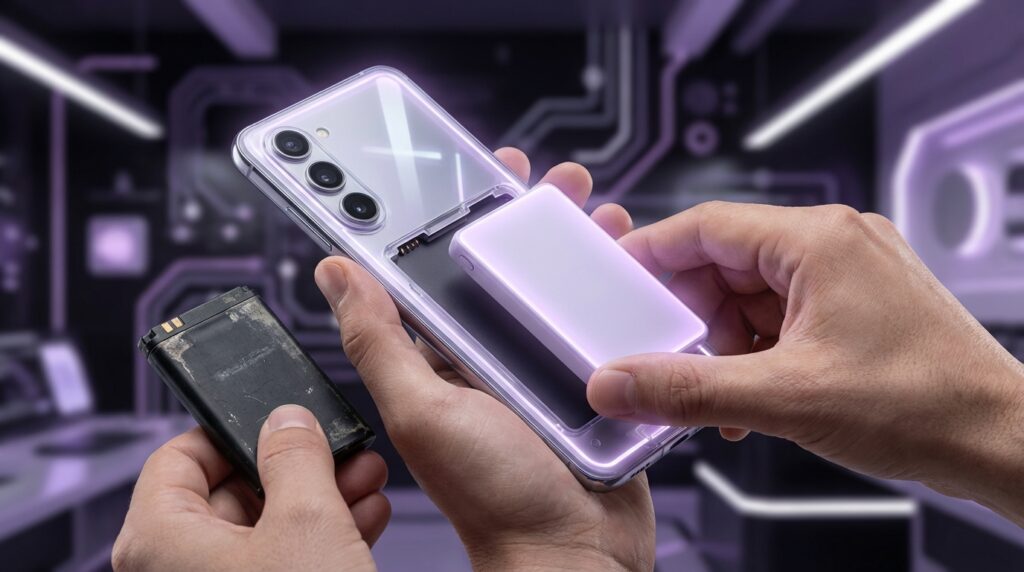
“That tiny plastic back cover made the softest snap when you pried it off with your thumbnail. Under it, a chunky black rectangle with ‘NOKIA’ stamped on it, warm from a long call, waiting to be pulled and swapped.”
You remember that sound, right? The little crackle as the phone’s back cover flexed, the slight give before it popped off. You did not need a repair toolkit. You did not need a heat gun. You needed a fingernail and maybe, if it had seen better days, a bit of stubbornness. That was your battery compartment. That was power you could touch.
Fast forward to the phone in your pocket right now. It feels like a glass slab glued to a metal frame. Sealed. Polished. You can hold it for a year and still not know what the battery actually looks like. There is no “pop off the back and swap it.” Instead, there is “find a repair shop” or “book a service” or “start watching battery percentage like it is a countdown timer.”
The gap between those two experiences is not just nostalgia for old phones. It connects straight into how we think about ownership, repair, and even anxiety around tech. Back then, your phone died at 4 percent, you shrugged, grabbed a charged spare from your bag, and you were back at 100 in ten seconds. Today, the equivalent is carrying a chunky power bank, a cable, and a quiet sense of dread when you hit 15 percent and the low battery warning glows at you.
Maybe it was just nostalgia talking, but the physical act of pulling a battery felt like control. Your phone froze, you yanked the battery, counted to five, and jammed it back in. Hard reset, no key combo, no “hold the side button and volume up.” The battery was not a mysterious sealed component. It was a part, like a toy car’s wheels. Replaceable. Swappable. Yours.
Now we live with glued backs, security screws, adhesive pull tabs, and factory-sealed “do not remove” vibes. So how did we get from nail-friendly plastic covers to sealed glass sandwiches? Why did removable batteries disappear when people clearly still talk about them, still want them, still sign petitions for “Right to Repair” and keep old phones alive just because they can swap cells in seconds?
To answer that, we need to go back to the era of T9 keypads, VGA cameras, and thick user manuals that smelled like new plastic and printer ink.
The Age Of The Pop-Off Back Cover
“User Review from 2005: ‘Picked up the extra battery pack for my Samsung D500. Best decision. One in the phone, one charging. I just rotate them. Phone never dies on me on night shifts.'”
If you pick up an older phone like a Nokia 3310 or a Sony Ericsson K750i, the first thing you notice is the weight and texture. These things feel like dense plastic bricks. They have that slightly rough, grippy back. No glossy glass, no brushed aluminum. You can close your fingers around them without worrying about smudges or cracks.
Under that shell, the battery was king.
You pressed a small latch or just slid the back shell down. The movement had friction. You felt the internal clips unlock. Underneath sat a rectangular lithium-ion battery, often with a sticker showing model number, capacity, and a row of tiny metal contacts at one edge. You could smell a faint “electronics” scent if the phone had run hot.
That battery did so much more than hold charge:
– It gave you a kind of modular phone. Drop your phone in a puddle? People would rush to tell you: “Quick, pull the battery, don’t turn it on.”
– It gave you backup power without any electronics. No cables. No power bricks. Just spare cells in a pocket.
– It gave you cheap upgrades. You could buy higher capacity packs from random brands and see if you could push one more day of life out of that old handset.
Battery swapping was not a niche feature. It was normal. Manufacturers listed spare batteries right in the box documentation. Phone stores had racks of them. The accessory walls in malls were lined with colorful covers and stacks of OEM and aftermarket cells.
The hardware design fit that approach. Phones had thicker bodies, removable backs, and frames that allowed room for a battery pack to slide in. The camera sensors were small. Screens were tiny by modern standards and often not touch-sensitive. You did not have glass covers glued edge to edge. You had bezels, plastic mid-frames, and snap tabs.
So what changed?
The Design Shift: Thinner, Sleeker, Sealed
“Retro Specs: Nokia 3310 (original) – 84 x 48 pixel monochrome display, 115 g, 900 mAh removable battery. iPhone 17 (hypothetical) – multi‑camera array, 120 Hz OLED, sub-8 mm thickness, multi-thousand mAh sealed cell.”
Smartphones did not kill removable batteries overnight. Early Android phones like the HTC Desire, Samsung Galaxy S, and even the Galaxy S5 still shipped with removable backs. The iPhone line, on the other hand, went sealed from the very start.
As screens got larger and phones got thinner, designers wanted uninterrupted surfaces. Big slabs of glass on the front. Fewer seams. Fewer moving parts. That clean edge-to-edge look you see now does not play well with a back cover you can pry off in two seconds.
To hit those thin profiles and squeeze in bigger displays, manufacturers started to bind everything tighter:
– The frame became structural, often metal or a rigid composite.
– The back panel went from flexible plastic to glass or tightly bonded plastic.
– Internal spaces were packed more tightly. No more simple “slot the battery in, pop the cover on.”
Removable batteries require space around the pack for the plastic shell, the connector, and the mechanical clearance needed for you to remove it. A sealed pack can be shaped to fit the internal cavity almost perfectly. You can curve it. You can stack cells. You can pour glue into every gap.
This shift was not only about looks. It was also about specs that sold phones:
– Thinner profiles in marketing photos.
– Higher battery capacities in the same or smaller footprint.
– Stiffer bodies with less flex and creak.
The moment brands started showing side profile shots in their posters, the removable battery was in trouble.
Why Manufacturers Moved Away From Removable Batteries
This is where the story moves from “back in my day” to actual trade-offs. There are several reasons sealed batteries became the default.
1. Space, Density, And Design Freedom
Inside a phone, every cubic millimeter matters. A removable battery:
– Needs a rigid shell so it does not deform while you remove it.
– Needs a connector that can withstand repeated insertions.
– Needs side clearance so human fingers can grab and pull it out.
– Needs a back cover with clips or latches that add thickness.
A sealed battery:
– Can be a soft pouch shaped exactly for the internal cavity.
– Can use flat contacts and tape rather than a reinforced plug.
– Can share structural support from the chassis and back panel.
You end up with more battery volume in the same space. That means more mAh without making the phone thicker. When you are fighting for marketing headlines like “all-day battery,” that extra volume matters.
Manufacturers also wanted thinner bezels and stronger frames. Glued backs helped lock the whole phone into a stiff slab. You get less flex, which is handy when there is a huge glass panel on the front begging to crack if the chassis twists.
2. Water Resistance And Dust Protection
The moment phones started getting IP ratings, removable batteries faced another hit. A removable back cover means:
– A large seam running around the back.
– Multiple contact points where water could seep in.
– Thin plastic clips that wear and loosen with time.
Gluing the back and sealing it with gaskets makes it much easier to keep water out. You only need to protect buttons, the SIM tray, speakers, and ports. There is no major access hatch around a big hot component.
Can you build a removable battery phone with water resistance? Yes. Manufacturers tried some hybrids where you could open a smaller hatch just for the battery or the SIM. The engineering gets complex and cost goes up. Every removable panel needs gaskets, more testing, and tighter tolerances.
Sealed designs are simpler in that sense. Less mechanical complexity. Fewer potential leak points. You see that in the trend where phones lost headphone jacks and microSD slots too. Every hole is a risk.
3. Structural Strength And Durability Claims
Remember those videos of people bending early thin phones? That stuff haunts design teams. The back of a phone is not just cosmetic anymore. It works like a stressed member of the structure.
With a sealed back:
– The glass or plastic is bonded to the frame.
– The adhesive layer acts almost like a structural component.
– Impacts distribute across a larger surface.
With a clip-on plastic back over a removable battery, you have more flex. The inner frame does more of the work alone. You get creaking, tiny gaps, and sometimes weird behaviors over time as clips wear out.
Manufacturers love to claim “premium feel.” A sealed back with glass or a high quality composite gives that solid, no-rattle experience. Your old Nokia had charm, but it also had a tiny bit of wobble if you pressed on the cover.
4. Cost, Warranty, And Control
When users can replace a battery easily:
– They can buy cheap third-party packs.
– They might use low quality cells that swell or overheat.
– They might blame the brand when those packs fail.
Sealed batteries channel most repairs through authorized centers. That:
– Lets manufacturers control which parts go into the phone.
– Gives them revenue through repairs or extended warranties.
– Reduces variables, at least from their perspective.
From a support point of view, a sealed design also removes the “user did something weird with the battery” factor. There are fewer user-serviceable parts, so fewer calls to support about bad aftermarket cells.
Of course, this also makes you more dependent on the brand or repair shops. That is exactly why “Right to Repair” has become such a talking point.
5. Safety And Certification
Lithium-ion batteries are picky. A puncture or internal short can mean swelling, venting, or fire. Certification tests cover everything from drop tests to crush tests.
When you design a battery to be user-removable:
– The pack needs extra protection layers to handle rough handling.
– The shell needs to be tougher.
– The contacts must be designed to avoid shorts when partially inserted.
A sealed pack is not automatically safer, but it is easier to control the mechanical environment:
– The pack is taped and held firmly in place.
– The surrounding shell and frame can be tuned for impact behavior.
– Users are less likely to stab it accidentally with something sharp.
Again, safety is possible with removable designs. Laptops manage it. Some older phones did too. It is just more work and takes up more space and design effort.
Why We Miss Removable Batteries So Much
Now flip to the user side. If sealed is so “convenient” for design teams, why do so many people still talk longingly about removable batteries?
1. Instant Refuel vs Slow Charging
Imagine you are at 3 percent, standing at a train station in 2008. You reach into your pocket, pull a spare battery, pop the back, swap them, press power, and within seconds you are back at full charge. No cable. No waiting.
Today, the modern version is “fast charging.” You plug your phone into a high wattage adapter, watch it jump from 5 percent to 50 percent in 20 minutes, and that is impressive. But it is not instantaneous. You still need:
– A charger that supports the right protocol.
– A decent cable.
– Access to a socket or a big power bank.
Removable batteries gave you a truly modular way to extend uptime. Keep two, three, four batteries if you are a heavy traveler or field worker. Charge them in a dock at home. Rotate like camera batteries.
You do not get that flexibility with a sealed design, unless you strap external power to the phone.
2. Phone Lifespan And Value
If you ever kept a phone for more than three years, you know the pattern. The phone is still fast enough, the camera still acceptable, the screen still intact. But battery life has fallen off a cliff.
With a removable battery:
– You order a fresh OEM or compatible pack.
– Swap it in at home.
– Your old device feels refreshed overnight.
With a sealed battery:
– You deal with glued backs and risky heat application.
– Or you pay a repair service, which might not be cheap.
– Or, most common, you shrug and buy a new phone earlier than you wanted.
That single component is often what pushes people into upgrades. A battery that used to give you a full day now limps to dinnertime. Apps themselves might still run fine. The silicon inside the phone usually ages quite gracefully.
People miss the feeling of not being forced into an upgrade because the fuel tank wore out.
3. Real Ownership And Repair Culture
There is a psychological side here too. Holding a phone that you can open gives a different vibe. You feel like the device is yours, not on permanent loan from a brand.
– You can inspect the inside.
– You can swap parts if they fail.
– You feel less nervous about damage because parts can be replaced.
With a sealed phone, many users are afraid to even crack the back. The inside is a black box. That shapes behavior. It also shapes how people treat tech: like consumables, not long-term tools.
This feeds into the broader push for “Right to Repair.” Phones with sealed batteries become harder and more expensive to service, which often means they get tossed or sold off sooner. You end up with drawers full of half-alive handsets and a big e-waste problem.
4. Nostalgia For A Simpler Relationship With Tech
There is also that small but strong nostalgic tug. The act of pulling a battery and seeing the bare contacts, the sticker, the model number, gave you a sort of handshake with the device.
Maybe it was just nostalgia talking, but it felt honest. You knew what powered the phone. You saw it. You could hold it. It was not hidden away behind a glossy unibody.
Pulling a battery to fix a frozen phone, or swapping one during a road trip, became tiny rituals that mark a certain era of mobile use. People remember that feeling, and when modern phones feel locked down or fragile, that memory gains weight.
Then vs Now: The Battery Story In Specs
To really see what we traded, it helps to compare an old classic with a current flagship approach. Numbers never tell the full story, but they give a good snapshot.
| Feature | Nokia 3310 (Original) | Modern Flagship (e.g. iPhone 17 class) |
|---|---|---|
| Battery Type | Removable Li-Ion pack | Sealed Li-Ion / Li‑Po pack |
| Capacity | About 900 mAh | Roughly 4,000-4,500+ mAh |
| Access | Pop off back cover by hand, lift out battery | Requires tools, heat, and adhesive removal |
| Replacement Time | 10-20 seconds | 30-60+ minutes for a trained technician |
| Extra Power | Carry spare batteries in pocket | Carry power bank and cable |
| Water Resistance | Low; not IP-rated | Often IP67 / IP68 rated |
| Phone Thickness | About 22 mm at thickest point | Under 8 mm body |
| User Control | Hard reset by battery pull, user-driven upgrades | Software reboot only, service center battery swap |
You can see the trade. We got huge jumps in capacity, standby time with data, and water resistance. We lost instant swapping and easy renewal.
Special Cases: Phones That Tried To Keep Removable Batteries Alive
Removable batteries did not vanish in a single year. Some brands tried to stretch their lifespan.
1. Samsung’s Last Stand
Samsung stuck with removable backs longer than most big players. Devices like:
– Galaxy S2, S3, S4, and S5
– Note series up to the Note 4
These phones had:
– Plastic backs you could peel off in seconds.
– Replaceable batteries that enthusiasts loved.
– Spare batteries and external chargers sold in official accessory lines.
The Galaxy S5 was a sort of crossroads device: water resistant, with flaps on ports, and still a removable back. You could feel the tension in the design. The gasketed back cover had to be pressed firmly all around after a battery swap, or you risked leaks.
After that, Samsung went with metal and glass unibodies. People who loved removable batteries still talk about the Note 4 like it was some kind of last hero.
2. LG’s Modular Experiments
LG took a different swing with devices like the LG G5:
– The bottom chin of the phone detached.
– You slid the battery out of that chin module.
– In theory, you could attach different modules (better audio, camera grip).
On paper, it was creative. In practice:
– The mechanism added complexity and slight wobble.
– Module adoption was low; people did not buy many add-ons.
– The market was already getting used to sealed phones.
LG later abandoned the modular idea. Their newer phones went sealed, chasing thinness and glass backs like everyone else.
3. Niche And Rugged Devices
You can still find phones with removable batteries today, just not in the mainstream high-end crowd.
Look at:
– Some rugged phones aimed at field workers.
– Simple feature phones sold in developing markets.
– Niche brands catering to repair advocates.
These devices often trade sleekness for practicality. Thick rubber bumpers. Screw or latch-based back covers. Chunky frames. The batteries are swappable because their users care more about uptime and field service than curved glass aesthetics.
They serve as proof that removable batteries are not impossible. They just do not match the current mainstream design goals of ultra-thin, glass-heavy, premium-styled slabs.
Regulation, Right To Repair, And New Battery Rules
“User Review from 2005: ‘Phone started dying in the afternoon after a year, picked up a new battery at the kiosk downstairs and I’m back to 3 days on one charge. No need to change phones yet.'”
The disappearance of removable batteries sparked more than just nostalgic rants. Lawmakers and repair advocates pushed back against sealed designs that shorten device lifespans and send more electronics to landfills.
In some regions, regulators started pushing:
– Requirements for easy battery replacement on certain devices.
– Pressure on brands to provide parts and manuals.
– Measures targeted at reducing e-waste.
The idea is simple: if the battery is the main wear part, people should have a clear and low-friction way to replace it. That would let phones and other gadgets stay in use longer, which is better for wallets and for the planet.
Manufacturers responded in different ways:
– Improving fast charging so that aging batteries feel less painful for longer.
– Offering official battery replacement programs at fixed prices.
– Designing internal layouts that are a bit more repair-friendly, with pull tabs and modular parts, even if the battery is still sealed.
You see some phones now that are technically “replaceable battery” friendly, but only if you are comfortable opening the device or using a repair service. It is not the same as your fingernail-on-plastic days.
Still, the pressure is there, and it might bend design back slightly in favor of repair.
Could Removable Batteries Come Back To Mainstream Phones?
Here is the big question people ask: if so many users want removable batteries, could we see them return in high-end phones?
From a pure engineering point of view, yes, it is possible. Imagine a modern flagship with:
– A slightly thicker body to allow a sturdy battery compartment.
– A metal frame with a gasketed back door for the battery and SIM.
– Smart latching systems to keep water and dust out.
– Standardized battery modules that are replaceable.
The trade-offs:
– Some increase in thickness and maybe weight.
– More complex assembly and higher production cost.
– Tougher IP rating targets.
For most brands, that is a tough sell. The average buyer in a store sees:
– Thinner device that fits pockets better.
– Sleeker look with glass and metal.
– Promised water resistance.
That sells faster than “you can replace the battery yourself in 20 seconds,” even though hardcore users and people who keep phones for five years care deeply about that feature.
Maybe it was just nostalgia talking, but there is space for at least one major player to lean into a different story:
– “This phone is built to last.”
– “You can open it yourself, no glue wars.”
– “Swap the battery after three years and keep going.”
We see hints of this in some repair-friendly designs and in collaboration with independent repair brands. If regulations keep pushing, we might see “user-replaceable battery” appear again as a selling point, especially in regions where rules force easier replacement.
What We Actually Want When We Say “Bring Back Removable Batteries”
When people say they want removable batteries again, they often mean more than just a pop-off back. They are asking for a certain relationship with their devices.
It is about:
– Control: The ability to fix or refresh a phone without a service center.
– Longevity: Not tossing a perfectly good device because one wear part aged.
– Predictability: Being able to carry spare power instead of hunting outlets.
– Transparency: Knowing the device is not a glued puzzle that breaks if you pry too hard.
The sealed battery era brought real strengths: fast charging, denser packs, IP ratings, sleek pocketable hardware. That progress has value. But it also hid the main consumable part of your phone behind glue and screws.
“Retro Specs: Typical Removable Battery Era Phone – plastic snap-on back, clear battery model number, simple contacts. Modern Flagship – glass back glued to metal frame, battery hidden under layers, specialized pentalobe or Torx screws.”
On this archive shelf of mobile history, removable batteries sit there as more than a technical spec. They represent a mindset where you could take the back off your phone, see its heart, swap it out, and keep going.
The history is still being written. Regulations are shifting. Repair culture is getting louder. Users are asking sharper questions about longevity and waste. Whether we ever get true, mainstream, pop-off-back removable batteries again or not, the memory of that simple snap and swap keeps influencing what people ask from modern tech.
The old click of a T9 keypad is gone, the chunky packs in your pocket have turned into sleek power banks, and batteries vanish behind black adhesive strips. But the desire for control, repair, and that feeling of “this thing is really mine” has not gone anywhere.
