

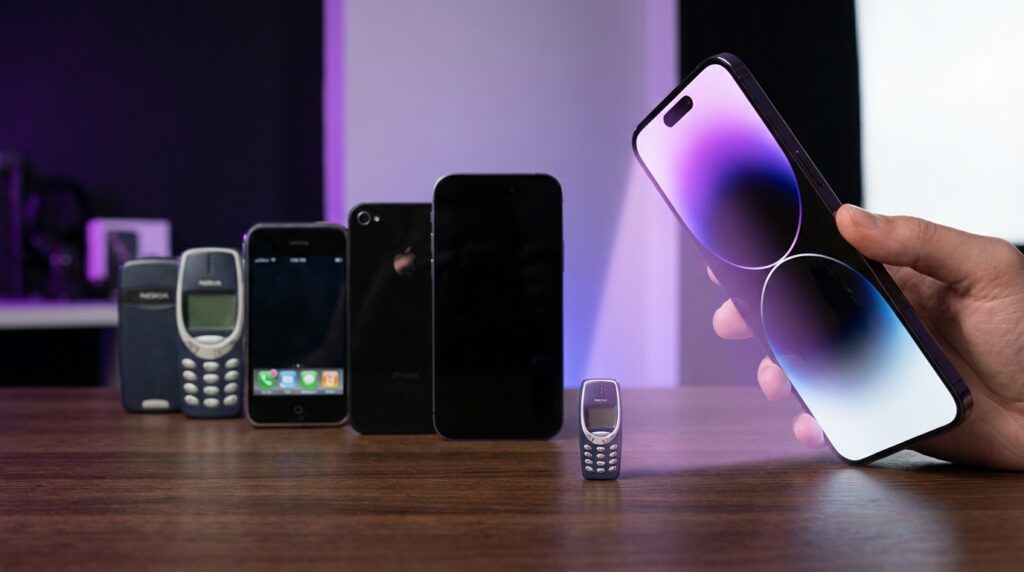
“The clack of a tiny slider phone snapping shut on a call you did not want to have in the first place. That sharp plastic click, like a full stop you could feel in your hand.”
You remember that sound, right? That little brick or slider that actually disappeared in your jeans pocket. The phone you could fish out with one hand in a crowded bus, thumb on the T9 keys, hammering out a text without ever looking at the screen. Now compare that to the slab in your hand today. It is basically a small TV that just happens to make calls. Big, bright, thin, slightly slippery, wrapped in a case so it does not turn into glass confetti when gravity wins.
The story of how we went from compact phones to giant screens is not a random quirk. It tracks with our own behavior shift. We stopped buying “phones” and started buying pocket computers that happen to sit on our faces during calls. That old flip with the 1.8 inch screen could survive a weekend without a charger. The thing you carry now pulls more power than your old laptop did and spends most of its time streaming, scrolling, and recording instead of ringing.
So when you ask why compact phones faded out and why screens keep getting bigger, you are really asking: when did portability lose to productivity, entertainment, and status in our heads?
The era when small was cool
Back in the early 2000s, “small” felt like progress. Each new model shaved a few millimeters here, a few grams there. Specs pushed battery life, standby time, ringtone polyphony, and that glorious “vibration and ringing” combo that felt like sorcery.
Phones had weight. A Nokia 3310 sitting in your palm felt like a smooth pebble: solid, curved plastic shell, rubbery keys with deep travel. The display was a postage stamp of green or gray with chunky pixels that almost looked like they had been drawn with a marker. You held it up and it just worked, under harsh sunlight, in the dark, in the rain.
Manufacturers bragged about compact size in TV ads. We got razor-thin flip phones, tiny candybars, and sliders that hid their keypads like a secret compartment. Marketing leaned into words like “slim,” “minimal,” and “compact,” because at that point phones were still just communication tools. Fitting better in a pocket or a small purse was a tangible gain.
The hardware designers had a simple job description: make it smaller, make the battery last, keep call quality stable. Camera sensors, if they existed, were tack-ons. Screens had no real duty beyond showing contacts, SMS threads, and the occasional pixel snake eating pixel food.
“Retro Specs: Nokia 3310 (2000)
84 x 48 pixel monochrome screen, about 1.5 inches.
133 g weight.
Removable 900 mAh battery.
Physical T9 keypad with 12 main keys.
No camera, no Wi-Fi, no app store. Just signal bars and that classic ‘Nokia tune’.”
In that world, compact phones made sense. Your thumb only needed to reach a handful of keys. Screen size did not limit much because the phone’s job was simple.
The pivot from talking to tapping
The pivot started before the first iPhone, with devices like the BlackBerry and early Symbian smartphones. Those chunky QWERTY keyboards ate up half the phone, but they did something crucial: they invited users to write more. Emails, longer texts, even early web browsing. The more text-heavy and app-heavy the experience became, the more real estate the screen demanded.
Then came the true touchscreen era. One slab of glass, no physical keyboard, all interaction through taps and swipes. That design choice hit compact phones from two angles:
1. You removed keys, so the screen needed to handle both display and input.
2. Touch targets needed to be big enough for human fingers.
Suddenly, that 1.8 inch screen that worked fine for T9 texting was torture for typing on a virtual QWERTY keyboard. You mis-tapped letters, your thumbs collided in the center, and any web page felt like a postage stamp version of the real thing.
“User Review from 2007:
‘i love this phone but the keyboard is tiny. my thumbs feel fat. browsing is like looking through a keyhole. wish the screen was bigger but then it wouldnt fit in my jeans pocket.'”
The more capable phones became, the more screen size shifted from a luxury to a constraint. You wanted to:
– Read longer emails
– Scroll social feeds
– Watch YouTube clips
– Type on-screen without swearing at auto-correct
All of that pulled screen sizes upward, even if nobody came out and said “goodbye compact phones” in those early product cycles.
Then vs now: the numbers tell the story
At first glance, nostalgia makes those old phones seem incredibly “portable.” They were short, fairly narrow, and they slid into any pocket. But lay the specs side by side and you see how extreme the shift really is.
| Spec | Nokia 3310 (2000) | Flagship iPhone 17-style phone (mid 2020s) |
|---|---|---|
| Screen size | ~1.5 inch, monochrome | 6.7 inch OLED, color, high refresh |
| Resolution | 84 x 48 pixels | ~2796 x 1290 pixels |
| Weight | 133 g | ~200 g |
| Thickness | 22 mm (chunky plastic) | ~7-8 mm (glass + metal) |
| Battery | 900 mAh removable | ~4500 mAh sealed |
| Primary use | Calls, SMS, basic games | Streaming, gaming, camera, social, work |
| Interaction | T9 keypad, hardware buttons | Multi-touch screen, gestures, limited buttons |
The modern phone is longer, wider, and clearly screen-first. Yet weight has not climbed as much as you might expect because plastic got traded for slim layers of glass and metal, and internal space got rearranged around a huge battery and camera modules.
We did not just get slightly bigger screens. We turned the entire front of the phone into a screen and then stretched it to the edges. Bezels shrank, aspect ratios changed, and diagonals pushing 7 inches stopped being rare.
The silent death of the compact flagship
For a while, there was a middle path. Brands flirted with “mini” or “compact” versions of their flagships. Same chipset, smaller body, smaller screen. On paper, that sounded perfect for people who wanted a powerful phone without the hand-stretch.
Those models did not sell in large numbers.
Here is what repeatedly happened:
– Users praised the idea of compact phones online.
– In stores, they picked the bigger screen once they held it.
– Reviewers highlighted better battery in the larger model.
– Streaming and gaming pushed people toward more display area.
There is a gap between what people say they want and what they reach for with their wallets. Many users loved the memory of a small phone. Then they tried watching Netflix on a 5 inch screen next to a 6.7 inch screen. The choice made itself.
Phone makers read that data and reacted. Compact flagships vanished from many lineups, replaced by:
– Standard large flagships
– Even larger “Plus” or “Ultra” variants
– Foldable phones aiming to be small in the pocket, big when opened
The rare “small” phones that stuck around had trade-offs: weaker cameras, smaller batteries, midrange chips. That pushed power users away, which signaled to manufacturers that compact just did not pull enough revenue to justify flagship R&D.
Why screens keep growing: 6 real drivers
1. Phones replaced other screens
Think about what used to live in your bag or on your desk:
– A point-and-shoot camera
– A basic camcorder
– A pocket gaming device
– A media player
– A small GPS unit
– A printed map
– Photo albums
Phones swallowed all of that. Every time another device died, your phone got more work piled onto it. Navigation feels better on a larger screen. Framing video with more space around the subject feels more precise. Editing photos needs room for sliders and controls.
Big screens are not just about vanity. They clear space for UI elements, controls, and content at the same time. That kind of load would crush a tiny 3.5 inch display.
2. Touch ergonomics and fingers that do not shrink
Physical keys were forgiving. The raised bumps and clear borders meant your thumb knew which number it was on. With touchscreens, everything is flat. The only guidance is visual. If icons get too small, you mis-tap. If keyboard keys get too tight, typing speed and accuracy crash.
Human finger size has not changed in twenty years. Icon grids and keyboard layouts hit a lower limit under which they just feel cramped. To pack more features into apps without burying everything in menus, designers rely on bigger canvases.
App interfaces also grow more complex. Floating buttons, gesture zones, notification bars, camera viewfinder tools. All of that needs to sit somewhere without covering the main content. A larger display gives UI designers breathing room so you are not constantly scrolling or closing overlays.
3. Battery life and the physics tax
Modern phones are power-hungry, with:
– High refresh rate displays
– 5G modems
– High-end processors running console-level games
– Camera stacks that do multi-frame processing every time you snap
To sustain that without forcing you to recharge three times a day, phones need bigger batteries. Bigger batteries take space. Once you pack a 4500 mAh or 5000 mAh cell inside, the footprint naturally widens and lengthens. If you already have that volume, phone makers might as well stretch the screen to fill the face.
Smaller compact phones have small batteries. That means shorter screen-on times, more throttling under heavy loads, and more user complaints. Brands learned that it is easier to sell a big phone that lasts all day than a small phone that dies at 5 p.m.
4. Cameras became primary features
You can argue about notch shapes all day, but camera islands on the back tell you where designers spent their mechanical budget. Big sensors, larger lenses, periscope modules for zoom, optical stabilization hardware. None of that fits nicely in a razor-thin, tiny chassis.
A compact phone either:
– Sacrifices camera quality
– Adds a huge bump that feels silly on a tiny device
– Thickens the whole body, which kills the slim feel anyway
For many buyers, the camera is the reason they upgrade. Social feeds are flooded with photos and vertical video. That is where a lot of attention goes. The trade-off is clear: better cameras win over smaller bodies.
5. Content and social norms rewarded bigger screens
Look at the content you use every day:
– Vertical video that fills as much of the screen as possible
– Stories, Reels, Shorts, live streams
– Long-form video from services that used to live only on TVs
– High-res photos and carousel posts
– Mobile games with detailed HUDs
Creators assume a certain minimum screen size in their design decisions. UI designers for social apps assume thumbs will have room to swipe, like, react, comment, and share while video plays. That feedback loop between creator choices and smartphone design keeps nudging diagonals upward.
Then there is the social status side. Phones are visible objects. People lay them on tables, hold them near their faces, shoot in public. Larger sleek slabs with thin bezels signal “latest model” in an instant. That silent signal has weight in purchasing decisions.
6. The pocket and hand size myth
There is a common argument that phone makers ignore users with smaller hands or tight pockets. That has some truth, but it also misses how bodies adapt.
Our grip style changed. With compact phones, you wrapped your whole hand around the body and typed with your thumb. With giant phones, people often:
– Use two hands for typing
– Rest the phone on a pinky for support
– Use one hand for scrolling only, not heavy typing
Clothing shifted too. Athleisure, jackets with larger pockets, bags for everyday carry. People made room for bigger slabs because the trade-off felt worthwhile. Jeans brands even widened pockets in some lines. So while a compact phone still feels nice to hold, it no longer has the same practical advantage it once did.
Why compact phones that do exist feel nostalgic but niche
There is still a devoted group of users who love smaller phones. They want:
– Less wrist strain
– True one-hand reach from corner to corner
– A device that fits front pockets without printing a clear rectangle
Pick up a genuinely small smartphone today and you get a rush of that old comfort. It feels almost weightless, less intrusive. The glass does not hang over your palm like a plank. Maybe it is just nostalgia talking, but there is a sense of control that large phones sometimes lack.
The problem starts when you begin using that small phone as your main device:
– The keyboard feels cramped during long chats.
– Watching video for an hour strains your eyes.
– Battery drains faster because there is less room for cells.
– Web pages and apps that assume bigger screens feel squashed.
Compact phones often get framed as “second phones” for travel or as “light mode” devices for people trying to reduce screen time. That is not accidental. It is hard to sell them as primary devices when so much of everyday usage is screen-heavy.
“User Review from 2005:
‘this little phone is perfect. i can reach every key with my thumb. i dont want one of those giant pda bricks. i just want to call and text.'”
That line says everything. Back then, calls and texts defined the product. Today, the same sentence would probably swap “call and text” for “photo and video” or “stream and scroll.” The job description changed, so the body shape followed.
How phone makers tried to cheat physics
The industry did not wake up one morning and collectively decide: “From now on, every phone must be huge.” There have been attempts to square the circle and keep phones convenient in the hand while still delivering a big screen.
Taller aspect ratios
One of the quiet tricks came from aspect ratio. Early smartphones often sat around 16:9. Modern phones drifted toward 19:9, 20:9, and beyond. That means:
– Phones got taller but not as wide.
– You can still wrap your fingers around them.
– One-hand grip feels more stable, even if reaching the top is harder.
This shape allows a 6.5 inch or 6.8 inch diagonal without feeling like holding a tablet. Browsing and feeds benefit from the extra vertical space, while thumb travel sideways still feels reasonable.
Edge-to-edge and punch-hole designs
Shrinking bezels let manufacturers grow screen size without massively increasing the phone’s footprint. Remove a chin here, carve a notch or punch-hole for cameras there, and you gain diagonal inches while the body length only creeps up.
It is a clever trick, but it reaches physical limits. You cannot keep shaving bezels forever. Eventually you hit the edge of what fingers can grip without accidental touches.
Foldables and flippers
Foldable phones try to offer “big when you want it, small when you do not.” Two main ideas:
– Book-style foldables: small outer screen, big tablet-like inner display.
– Flip-style: tall inner screen that folds down into a smaller square footprint.
Flip phones echo the old clamshell nostalgia. They feel good to snap shut. They are closer to compact when closed, but when you open them, you are still staring at a tall, large display. The decline of compact phones in actual usage scenarios continues, even if the outer package shrank.
Book-style foldables solve the “small tablet in pocket” problem but not the desire for a classic one-hand compact. When opened, they are massive. When closed, they are often thicker and heavier than regular slab phones.
Foldables show that manufacturers are aware of physical limits and user fatigue, but they also show that almost all the energy is going into giving more screen, not less.
Why the market punishes truly small phones
From a business angle, every phone design is a bet. Compact phones face a few rough odds:
1. **Component constraints**: Shrinking the body multiplies engineering headaches. Heat dissipation, antenna placement, and battery packaging all get harder.
2. **Profit margins**: Smaller bodies with custom layouts can cost more to design and produce, while selling to a smaller audience.
3. **Marketing synergy**: Big phones take better photos, run games better, and show content better. Those are easy things to show in ads and influencer posts.
If a compact phone sells poorly, brands see the data in brutal clarity. Shelf space, online listing performance, carrier demand. After a few cycles, product people push resources to the big sellers, which are literally the big phones.
It is not that compact phones are technically impossible. It is that they rarely bring in enough revenue or attention to justify flagship-level investment. So they slide into midrange slots or disappear.
Nostalgia vs actual usage: our brains conflict with our behavior
There is a cognitive clash that shows up in forums, comments, and everyday conversations:
– People say they “miss small phones.”
– People also binge video, game, work, and create content on phones.
– When offered two choices side by side, they pick the bigger screen most of the time.
That mismatch explains a lot of the emotional tone in discussions about compact phones. The memory of a small device feels comforting. The reality of daily modern usage leans heavily toward screens that feel like mini tablets.
Think about your own habits:
– How often do you watch long-form video on your phone vs a laptop or TV?
– How long are your chat threads, with photos, clips, and voice notes mixed in?
– How many apps do you keep open that expect a wide viewport?
Each one nudges you toward appreciating the extra inches, even if your fingers complain at the phone’s reach.
Maybe it was just nostalgia talking when you picked up that old slider and thought, “This was perfect.” It was perfect for what you needed at the time. The job has changed.
What would it take for compact phones to return?
If you are hoping for a strong comeback of truly compact phones, it helps to ask: what conditions would favor small screens again?
A few possibilities:
1. Offloading screens to other devices
If wearables, smart glasses, or ambient displays absorb more of the “viewing” and “interaction” work, the phone in your pocket could shrink back into more of a hub:
– Glasses show navigation, messages, and media overlays.
– Voice and gesture take over more commands.
– The phone body becomes mostly battery, radios, and storage.
In that world, a compact phone starts to make sense again because the main viewing canvas lives elsewhere.
2. Different input methods that beat touch
Touch locked us into a minimum target size. If input shifts further to:
– Voice that actually works in noisy contexts
– Stylus with fine control for precise input
– Contextual shortcuts powered by on-device intelligence that reduce tapping
Then screens could stop growing without hurting usability. Right now, though, touch and visual UI dominate, and they reward more surface area.
3. A cultural swing toward “less screen” living
There is a small but growing interest in “light phones,” e-ink displays, and distraction-minimized devices. If that attitude spread widely, the desire for a large display might drop.
In that scenario, people might accept:
– Limited media playback
– Simplified apps
– More reliance on other devices for heavy content
Compact phones could then pitch themselves as deliberate choices: tools that encourage shorter interactions. For now, that remains a niche compared to the mainstream appetite for video, social content, and high-end gaming in your pocket.
So why do screens keep getting bigger?
Because we kept asking our phones to do more.
The phone stopped being the thing you used between moments. It became the place where you:
– Watch full seasons
– Shoot and edit vacations
– Run side projects
– Join video calls
– Play games that once needed a console
– Consume long articles and e-books
– Capture and share entire parts of your life in photos and clips
Every new job called for more space. Text needed to be readable. Buttons needed to be tappable. Video needed to be watchable for hours. Cameras needed room for larger sensors and lenses. Batteries needed headroom to handle all that load.
The compact body that felt perfect when signals were bars on a tiny monochrome screen simply could not keep up with that expanded workload. The industry did not just chase fashion. It followed physics, ergonomics, and our own hunger for more display in our pockets.
“Retro Specs: ‘Premium’ smartphone circa 2010
3.5-4 inch LCD, 480 x 320 or 800 x 480.
Plastic body, 120-140 g.
Single rear camera, no ultrawide or periscope.
Removable battery around 1500 mAh.
Physical home button, thick bezels.
Marketed as ‘large screen’ at the time.”
Hold that against your current phone in your mind. The device that once seemed large now looks modest. The curve from “tiny monochrome compact” to “glass slab TV” is not just a story about phones. It is a mirror of how we changed the way we live, work, and entertain ourselves through a screen that followed us everywhere.
