

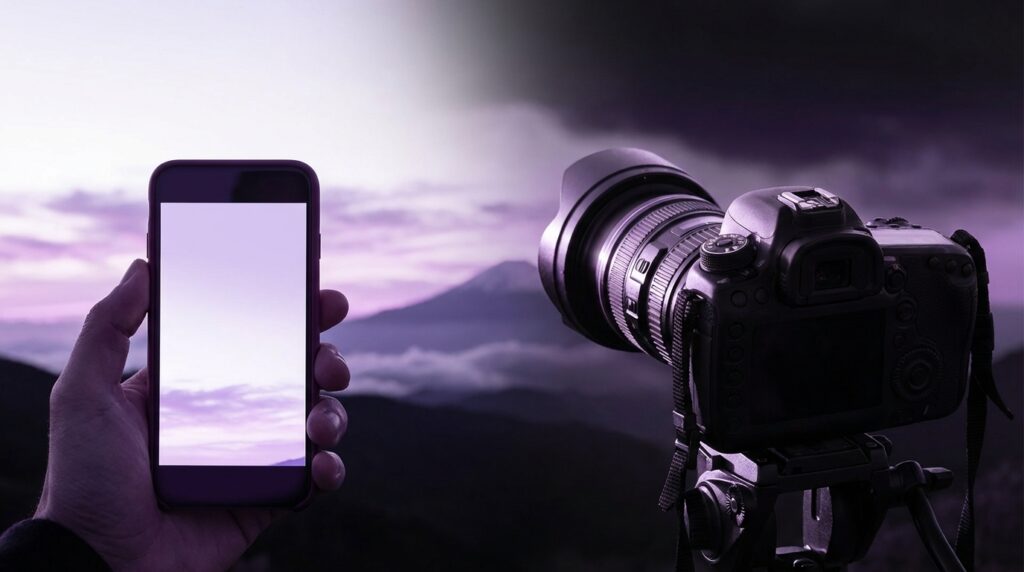
“The fake shutter sound from my Sony Ericsson K750i still lives in my head. You pressed the side key, the tiny lens cover slid down with a little click, and the 2-megapixel camera pretended it was a DSLR.”
You remember that moment, right? Squinting at a tiny 176 x 220 pixel screen, framing your friend at the bus stop, and thinking, “This looks sick.” Fast forward to now: 50 megapixel sensors, RAW on your phone, Night mode that somehow turns near-dark into Instagram gold, and a camera app that feels more like Lightroom than a toy. So the question hits harder than ever: can a phone actually beat a DSLR, or are we all just hypnotized by convenience and clever software?
The fun part is that this is not a simple “phone bad, camera good” story. This is more like watching a scrappy underdog grow from a VGA camera on a candybar phone to something that can shoot a brand campaign, a short film, and your grocery list in the same afternoon. The gap between “click a blurry MMS” and “submit to a global mobile photography award” got compressed into less than twenty years. That is wild.
Back in the early 2000s, camera phones felt like party tricks. You had sensors measured in fractions of a megapixel, no autofocus, and compression so heavy you could practically see the JPEG blocks grinning at you. Still, those photos felt magical because they were instant and in your pocket. No CF card, no lens, no camera bag. Just open, snap, send. Even if the colors looked like someone spilled lemonade on them.
Then the megapixel arms race took over. 2 MP, 3.2 MP, 5 MP with Carl Zeiss branding on Nokia flagships. Autofocus arrived. LED flashes tried their best. But if you printed those images large, you could still tell: a “real” camera did the job better. The glass was bigger, the sensor was larger, and the physics did not care about convenience.
Now the script has changed. You have phones winning categories in mobile photography awards that used to be dominated by mirrorless setups. Photographers shoot weddings, magazine covers, and even billboard campaigns on phones. At the same time, DSLR and mirrorless cameras keep getting smarter, faster, and more specialized. It is this crossover that makes the “phone vs DSLR” question so interesting right now, not as a hot take, but as a practical decision every creator has to make.
So before we talk about awards and judges and categories, we need to ground this in two different experiences: the weight of a chunky DSLR body hanging from your neck, and the light, almost slippery feel of a glass slab that somehow packs three or four lenses into a camera bump that still snags on your pocket.
“Retro Specs: 2005 camera phone bragging rights – 1.3 MP, 4x digital zoom (a fancy word for crop), and ‘photo light’ instead of a real flash. We still flexed those shots on MSN and MySpace like they were National Geographic material.”
The physics problem: tiny phone vs big camera
You cannot talk about whether a phone can beat a DSLR without talking about physics. Not feelings, not marketing claims, just light and glass.
A DSLR (and now, more often, a mirrorless camera) has two big advantages: sensor size and lens options.
A typical DSLR or mirrorless camera in the “serious but not Hollywood-level” segment uses either an APS-C sensor or a full-frame sensor. Those are large pieces of silicon compared to what fits in a phone. Bigger sensor equals more light per pixel, richer color depth, better low-light performance, and more natural background blur. Phones use smaller sensors with very tiny pixels, then throw a ton of software at them to compensate.
Lens size matters too. The glass on a DSLR lens is thick, heavy, and physically large. That gives you sharpness across the frame, real optical zoom, and control over depth of field. On a phone, you have to stack tiny lenses in a shallow module and hope that computational photography can clean up some of the compromises.
So if you are asking “can a phone beat a DSLR” in a lab, purely on physics, the answer leans toward the DSLR every time. But you do not shoot photos in a lab. You shoot on busy streets, at birthday parties, in dim restaurants, during last light at the beach. You are juggling time, comfort, friction, and social situations. You are posting to social feeds where people see your work for two seconds, not hanging it in a gallery at 2 meters wide.
That is where things start to get interesting for phones.
Then vs now: Nokia 3310 vs iPhone 17
Let us anchor the conversation with a small time warp. Yes, the Nokia 3310 did not have a camera, but it is a good cultural anchor. People still remember its weight, that indestructible case, and the fact that its main visual output was Snake.
Below is a very rough comparison of a legend from the early 2000s and a fictional high-end phone like an iPhone 17 class device you would see winning mobile photography awards now.
| Feature | Nokia 3310 (2000) | iPhone 17-class phone (mid 2020s) |
|---|---|---|
| Camera resolution | None | 48-200 MP main sensor (with pixel binning) |
| Lens options | Not applicable | Ultra-wide, wide, 3x-5x tele, sometimes periscope 10x |
| Screen | 84 x 48 pixels, monochrome LCD | High refresh OLED, QHD+ or close, HDR support |
| Storage for photos | Also not applicable | 256 GB to 1 TB internal |
| Photo editing | None | On-device RAW editing, multi-layer apps |
| Sharing | SMS only, no images | Instant upload to social, cloud backup, AirDrop-style sharing |
| Weight | About 133 g, thick plastic, chunky in hand | 180-220 g, glass and aluminum or titanium, camera bump. |
The jump from “no camera at all” to “pocket computer with a pro-level camera pipeline” happened in under three decades. That arc explains why mobile photography awards even exist. Phones did not just add cameras as accessories. They turned the camera into a core feature.
The rise of mobile photography awards
Once phones started to produce real images, not just fuzzy thumbnails, something changed in the photo world: accessibility. You did not need a DSLR kit, you just needed a phone worth a few hundred dollars, often less on contract. The barrier to entry dropped, and the number of people who saw themselves as “someone who takes photos” exploded.
Awards followed that shift. Instead of treating phone shots as “lesser,” entire contests formed around them. Categories like:
– Street and candid
– Portrait
– Travel
– Architecture
– Abstract and experimental
– Night photography
– Macro
These awards did not care if you shot RAW or JPEG, if you used the stock camera app or something third-party. They cared about impact, composition, story. Judges saw phones capturing scenes that DSLRs missed simply because the phone was already in hand when something happened.
Phones turned out to be sneaky tools for authenticity. You can point a phone at someone on a subway and they relax. Point a DSLR with a chunky lens at them and everything stiffens. That is a real advantage for documentary and street categories.
“User review from 2005: ‘The camera is good enough for me. I only send the pics as MMS.’ That same user now complains if a phone camera smears detail at 300 percent zoom in Lightroom.”
Where phones beat DSLRs in the real world
Now to the practical side. When a judge looks at a mobile photography award entry, they are usually looking at a file on a calibrated monitor, not a 1.5-meter gallery print. This context favors phones more than you might think.
1. Always-on, always-ready creativity
The best camera usually is the one you have with you. Not as a motivational poster, but as a constraint. You miss 100 percent of the shots your DSLR bag is not there for.
Phone cameras wake near instantly, focus quickly in good light, and fire multiple frames a second. With AI-based scene detection, they expose pretty well out of the gate. That means more usable frames and more attempts, which matter a lot for things like street, kids, pets, and fleeting moments.
A DSLR can do all of that too, but you need intent. You have to pack it, carry it, and lift it to your eye. With a phone, intent can come after the fact. Your friend laughs, you react, tap, and now you have something worth posting and maybe submitting.
2. Computational photography as a secret weapon
Phones cannot grow larger sensors without turning into bricks, so vendors leaned into the one spec they could scale: processing power.
Features that used to take serious knowledge and post-production time now sit behind one button:
– HDR blending that merges multiple exposures with smart local tone mapping
– Multi-frame noise reduction that stacks bursts to clean up shadows
– Portrait modes that simulate lens blur and even bokeh shapes
– Night modes that align many frames in near-dark for cleaner, brighter images
– Super-res zoom that upscales with AI to counter tiny optics
In award entries, especially at normal viewing sizes, these tricks can level the playing field. You can shoot a handheld night street scene on a recent phone that looks cleaner and more colorful than a sloppy, high-ISO DSLR shot from someone who did not expose very well.
Of course, under a pixel-peeping microscope the DSLR file still holds more raw data. But judges rarely zoom to 400 percent. They ask: does this image hit me? Is the light interesting? Does the story land?
3. Shoot, edit, share in one pocket
One of the most underrated advantages: the closed loop. You shoot, edit, export, submit. All from the same glass rectangle.
A mobile photographer can shoot in a city, grab coffee, sit down, and do a full edit in an app like Lightroom Mobile, VSCO, Snapseed, or something similar. Selective tools, masking, curves, split toning, film-style presets, all with your finger. Then the award submission form is one browser tab away.
Compare this with a DSLR workflow: pull the card, import to laptop, cull, edit in Lightroom or Capture One, export, upload. That process is powerful, but also heavy in both hardware and time.
In award contexts that set tight submission windows around events, photo walks, or challenges, the phone gives an unfair-seeming advantage: you can shoot and submit from the field.
4. Social feedback as free practice
Phones plug straight into social platforms. That constant loop of shoot, post, get feedback, adjust, shoots your learning curve up.
You see what your friends react to, what settings worked in Night mode, which edits went overboard. Over time, that shapes taste and technique. The more frictionless the process, the more reps you get. Reps matter more than gear in the long run.
In this sense, mobile photography awards are picking from a training pool of thousands who learned directly on their phones, forming a kind of native mobile style that is different from classic DSLR-driven photography.
Where DSLRs still hold the crown
That said, phones are not magic. If anything, they are very good at hiding their weak points under layers of clever engineering. A DSLR or mirrorless body still holds several clear advantages, especially in award settings that care about print size and technical excellence.
1. Low light with motion
Phones with Night mode look impressive when scenes are static: cityscapes, architecture, still life, people who can hold still for a second or two. The phone fires several frames, combines them, and cleans things up.
Add motion and things get messy. Kids running, dancers, moving cars, water splashes. Long Night exposures blur subject detail, and burst stacking can produce ghosting.
A DSLR with a fast lens and a large sensor at ISO 6400 or 12800 can freeze motion in light conditions where a phone has to slow the shutter into blur territory.
So for awards that involve action, sports, or fast-moving subjects in marginal light, DSLRs still give you more keepers.
2. Real depth of field control
Phones simulate depth of field with portrait modes, using depth maps from dual pixels or multiple lenses. It works well until it does not.
Look closely at hair, glass edges, or objects that overlap in complex ways, and you can often see edge detection artifacts. Bokeh shape can also look strange because it is algorithmic instead of optical.
A DSLR with a fast prime lens at f/1.4 or f/2.0 gives you optical blur that behaves consistently, with natural falloff and realistic highlights. In portrait categories, judges can still spot the difference, especially on large displays or prints.
3. High dynamic range without tricks
Phones lean heavily on HDR, sometimes even when you do not want it. Sky pulled down, shadows lifted, everything flattened a bit. Many phone makers tweak this to meet mainstream taste, which leans toward bright and colorful.
A DSLR file from a good sensor at base ISO holds serious dynamic range in a single RAW shot. You can recover highlights and shadows in post without combining multiple frames. This leads to more natural-looking textures and contrast when handled well.
In award entries with complex lighting, that extra latitude from a large sensor can translate to richer, more controlled images.
4. Handling, control, and specialized lenses
The body of a DSLR or mirrorless camera is built for shooting first, everything else second. Physical dials, dedicated buttons, viewfinders that show you the world clearly even in harsh light. That matters during long sessions or fast-paced environments.
Then you have lenses: ultra-wide, tilt-shift for architecture, macro lenses for real 1:1 magnification, long telephotos for wildlife and sports, specialized portrait glass with unique rendering. Phones simulate some of this with software and multiple fixed lenses, but they cannot cover the full range with the same optical quality.
So for niche categories in awards, like macro fine art or wildlife, dedicated cameras still have a very real advantage.
“Retro Specs: 2008 DSLR owner review – ‘Why would anyone use a phone for serious work? My 12 MP DSLR blows those 2 MP phone toys away.’ Somewhere out there, that same person now edits mobile RAW in a coffee shop between sessions.”
Then vs now: DSLR vs flagship phone
To make this more concrete, let us line up a mid-2010s DSLR against a recent high-end phone from the mid 2020s. This is the kind of pairing you might see on a shoot where someone says, “Let us try both and compare.”
| Feature | Mid-2010s DSLR (e.g., Canon 80D type) | Modern flagship phone |
|---|---|---|
| Sensor size | APS-C (~22 x 15 mm) | 1/1.3 inch or similar (~9.6 x 7.2 mm) or smaller |
| Resolution | 24 MP | 48-200 MP (using 12 MP binned) |
| Lens options | Interchangeable, primes and zooms available | Fixed lenses: ultra-wide, wide, tele, periscope |
| Low-light performance | Strong at high ISO with clean RAW | Good with multi-frame stacking, weaker in motion |
| Depth of field | True optical blur control | Simulated portrait blur with depth mapping |
| Editing workflow | Card to computer, full desktop editors | On-device apps, cloud sync, instant sharing |
| Size & weight | Body plus lens, 800-1500 g or more | Single device around 200 g |
| User skill required | Higher: settings, exposure, lenses | Lower: smart auto, AI-based scenes |
Look at that table through the eyes of an award judge. If both tools can produce a sharp, well-framed, emotionally strong image at screen size, the gear becomes a secondary question. That is why, in some categories, mobile can absolutely beat DSLR entries, not by outclassing the sensor, but by making it easier for a human to be in the right place, at the right time, with less friction.
How mobile entries win against DSLR work
So how does a phone shot actually beat a DSLR shot in a real competition? Let us walk through a few scenarios.
Scenario 1: The perfect street moment
You are walking in a city, phone in hand, no bag, no straps. Ahead of you: a shaft of late afternoon light cuts between buildings, hitting a crosswalk. A couple steps into the light at the same time a cyclist zips by with a bright red jacket.
With a phone, you are already at chest level. You lift, tap, and grab a burst. Your brain is focused on timing, not aperture. The camera exposes decently, pulls some highlight protection with HDR, sharpens faces, and you walk away with a keeper.
A DSLR user behind you is still waking their camera or changing from a zoom to a prime for “better quality.” They might get a frame, but they also might miss it. In a judging room, the phone shot with great timing and strong light can crush a technically perfect but less engaging DSLR frame.
Scenario 2: Social portraits with natural reactions
At a small gathering or cafe, phones feel casual. You hold one up, people keep talking, laughing, moving. With modern portrait modes and 2x or 3x lenses, you stand back a bit, tap to focus, and the phone adds a gentle blur behind the subject. You can fire many shots in seconds without breaking the moment.
Bring out a DSLR with a chunky lens and people become aware of the “photoshoot.” Expressions change, poses stiffen, and you get images that look more staged, less candid. The technical quality is higher, but the emotional quality can drop.
For portrait and lifestyle categories in mobile awards, that emotional authenticity is often what wins.
Scenario 3: Post-processing with a clear voice
Phone photographers who take this seriously build entire editing workflows in their pocket. Presets, color styles, grain choices, consistent framing. Over time, they develop a look that becomes recognizable.
When they enter awards, the judges do not just see single images, but coherent portfolios in some cases: a style that carries across multiple works. And all of that is created through touch, while commuting or during short breaks.
DSLR users have the same power, of course, but they need to sit down at a desk more often. Time matters. Phones slide into the cracks of a day.
Where awards still draw lines between phone and DSLR
Some competitions treat “mobile” as its own category, separate from “open” or “professional.” That already reveals something: judges know phones can compete, but also recognize that the tools differ enough to deserve their own lane.
Print size and technical scrutiny
In contests that produce large prints for exhibitions, small sensor limitations show up more clearly:
– Edge detail can fall off faster on phone lenses.
– Fine textures like foliage or hair can look smudged after heavy noise reduction.
– Aggressive sharpening halos show up around contrast boundaries.
DSLR files, especially from full-frame sensors and good lenses, hold together better at those scale levels. The noise looks more like film grain, less like smearing.
So if the award centers around big prints on walls, dedicated cameras still tend to lead, even if phones produce surprisingly good results at smaller sizes.
Heavily backlit scenes with complex motion
Think of a concert shot: bright stage lights, haze, musicians moving fast, crowd shifting, phones waving in the air. Phones can expose and capture something usable, but the combination of motion, extreme contrast, and colored lights can break their multi-frame tricks.
A DSLR with a fast lens, well-handled manual exposure, and maybe some flash work can handle that chaos with more control. That is why you still see pro concert photographers rely on dedicated cameras.
In award categories related to live events, stage performance, or chaotic action, phone entries can look impressive, but often lose to well-handled camera work.
The emotional side: nostalgia vs progress
If you have ever picked up an older DSLR, maybe something like a Canon 40D or Nikon D90, there is a certain weight and grip memory. Your fingers fall on the shutter, your thumb reaches for the dial, the optical viewfinder shows a bright, lag-free world. That experience still feels “serious” in a way tapping a glass screen does not always match.
The phone, on the other hand, feels like air. Smooth glass, rounded edges, barely-there buttons. Its weight gathers near the camera bump, you feel it snagging your jeans pocket when you sit down. It does not scream “camera” to most people, which can be good for candid work.
Maybe it is nostalgia speaking, but there is still something satisfying about hearing a real shutter, feeling that mechanical click, swapping lenses with a bit of a clack as the mount locks in. On phones, you change focal length with a quiet tap in the UI. Both flows can be satisfying in their own way.
And that tension shows up in award culture too. Some jurors grew up on film and DSLRs and carry those reference points. Others started on phones and learned everything on touchscreens. The same image can read differently through those two lenses of experience.
So can a phone beat a DSLR?
If the question is, “Can a phone completely replace a DSLR in every scenario,” the answer is no. Physics does not bend that far. Sensor size, glass, and ergonomics still matter for many types of work.
If the question shifts to, “Can a phone beat a DSLR entry in a photography award,” the answer becomes more interesting:
– For web-sized, screen-judged competitions: absolutely, and it already happens.
– For categories centered on moments, story, and access: often, the phone might even have an edge.
– For large-format, heavily technical categories: DSLRs and mirrorless bodies still rule.
The story of mobile photography awards is not really about “phones vs DSLRs” as enemies. It is about reach. More people can create compelling work now, using what they have on them every day. And sometimes, that pocket camera will outshoot the big rig, not by breaking physics, but by amplifying timing, presence, and consistency.
The digital archive running in your pocket started with that choppy fake shutter from the K750i, the crunchy 640 x 480 shots from early camera phones, the photos that could barely survive being printed on cheap glossy paper. Now you can shoot RAW, grade like a pro, and send your frame into a global competition from the back of a bus.
Somewhere in a judging room, a group of people looks at that image on a high-end monitor. They do not see the phone in your hand. They see light, composition, and story. At that moment, the line between “mobile” and “real camera” becomes a lot thinner than it used to be.
