

“The soft vibration of a Nokia 3310 on a wooden desk, the green backlight flickering as a tiny envelope icon blinked on screen.”
Back then, that little envelope felt private. Your message lived in those 160 characters, stored on a chunky SIM card, inside a phone that felt like a plastic brick in your pocket. No read receipts, no blue ticks, no typing bubbles. Just you, the keypad, and a faintly squeaky “OK” button. Fast forward to now and we are arguing about end‑to‑end encryption protocols, metadata retention, and whether you should trust Signal or WhatsApp with your late‑night confessions and family photos.
The funny part is, the goal did not really change. You still want to send a message to one person or one group, and you want everyone else to stay out. The tools shifted from SMS over 2G to encrypted messages hopping between data centers, but the intent feels the same. The big question today is not “Can I send this text?” but “Who can read this, and what happens to it once I hit send?”
That is where the Signal vs WhatsApp debate sits. Same core feature on the surface: secure messaging. Completely different stories underneath. One owned by a giant advertising company. One run by a non‑profit. Both say they care about your privacy. They even use the same core encryption protocol. But everything around that protocol, from backups to metadata to growth strategy, tells a different story.
You remember that sound, right? The muffled click of a slider phone snapping shut after a text. That click felt like privacy. Once the phone closed, the moment ended. There was no cloud backup waiting to spill your messages into a restore screen. No automatic sync across three devices. Modern messengers took that simple action and wrapped it in a mess of convenience features. The tradeoff is not always obvious.
From T9 Texts To Encrypted Chats
Before we argue Signal vs WhatsApp, it helps to step back to where this started: plain SMS on tiny screens.
Those early phones had screens you could count the pixels on. Literally 84 x 48 pixels on a Nokia 3310. The screen glowed a soft green. The plastic shell felt slightly rough, with tiny molding lines running along the side. The phone weighed enough that you felt it in your jeans pocket when you sat down. When you typed a message, every press of the T9 keypad made a solid, physical “click”. No software keyboard, no predictive AI, just a simple dictionary and your thumb.
There was almost no privacy model. Your operator could see the message. The network could store it for a little while if the receiver was offline. Your phone stored messages in a tiny memory bank you could fill in a week if you were chatty. But the attack surface was simple. No push notifications on lock screens, no cross‑device mirroring, no web clients.
Modern messengers blew that world wide open. Now, your “phone” app is also a camera hub, a payment channel, a contact manager, and a social graph. Your messages sync across devices, live in the cloud, and talk to servers all over the world. Encryption became the only realistic way to keep that flow of data private.
Signal and WhatsApp both sit on top of that journey. They speak encryption fluently. They feel modern. They replace SMS for a lot of people. But they come from different roots.
The Shared Core: The Signal Protocol
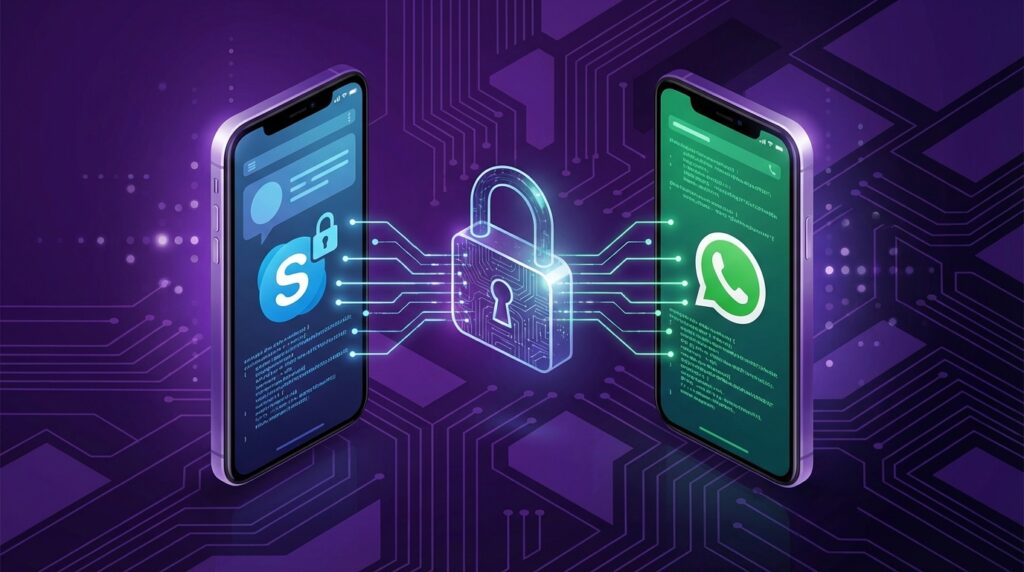
Here is the part many people miss: both Signal and WhatsApp use the Signal Protocol for end‑to‑end encryption. Same basic cryptographic engine.
The Signal Protocol uses a mix of:
– A “double ratchet” system that constantly rotates keys.
– Pre‑keys that let you start secure conversations even when the other user is offline.
– Forward secrecy so old messages stay protected even if a key leaks in the future.
– Post‑compromise security so the system recovers from some attacks on keys.
When you send a message in either Signal or WhatsApp, that text gets encrypted on your device with keys that only your device and the recipient’s device know. The server passes around ciphertext. It is not supposed to see your raw message, your photos, your voice notes.
So if the underlying math is similar, why the argument? Because real‑world privacy is not just math. It is also metadata, backups, account systems, corporate incentives, and government pressure.
Retro Specs: If WhatsApp And Signal Shipped In 2005
“User Review from 2005: ‘Signal feels like that friend who refuses to post on MySpace because they “don’t trust it.” WhatsApp feels like the friend who has 500 contacts and knows all the gossip.'”
If you dropped early‑2020s Signal and WhatsApp into the 2005 phone world, they would look like alien software with very different personalities.
Signal would be the app that barely fits into the small phone storage, asks you for a PIN, syncs almost nothing, and complains each time you screenshot a chat. It would feel serious, a little stubborn, kind of “paranoid” to anyone used to simple SMS.
WhatsApp would be the one your friends already use because it runs on cheap phones, sends images over slow connections, and has bright green icons and fun sounds. The app would quickly become the default group chat for school, work, and family.
That is basically what happened, just on better screens, with faster processors and touch keyboards instead of T9.
Who Owns What: Business Model And Trust
Signal: Non‑profit, donations, no ads
Signal is built and run by the Signal Foundation, a non‑profit based in the US. It is not selling ads. It says it does not sell your data. It leans on donations and some large funding injections from its founders and supporters.
That model shapes design choices:
– No broad data collection “for targeting”.
– Features take longer because they do not have a giant product team racing to hit growth targets.
– Many choices lean toward privacy first, growth later.
Signal only needs enough data to run the service: your phone number (for now), some limited metadata like when your account was created, the last time you connected, and who has blocked you. Even that is minimized and often stored in ways that the server cannot query it easily for profiling.
WhatsApp: Owned by Meta
WhatsApp started as a paid app, then dropped the fee and scaled hard, and eventually got acquired by Facebook (now Meta). The business model sits inside a company that makes its money from ads and data on other platforms.
Meta says WhatsApp messages are end‑to‑end encrypted by default. It also says it does not read your messages. That core encryption is real, and independent audits support that.
Still, the economic incentives for Meta look very different from the incentives for a non‑profit. Metadata, contact networks, how and when people use the app, and how WhatsApp ties into Facebook and Instagram businesses all matter for the larger corporation.
So even if the cryptography engine is the same family, you are plugging your communication habits into very different ecosystems.
Then vs Now: Old SMS vs Encrypted Apps
Here is a quick side‑by‑side to ground this:
| Then: Nokia 3310 SMS | Now: Signal / WhatsApp | |
|---|---|---|
| Screen | 84 x 48 monochrome, green backlight, blocky fonts | High‑dpi color touchscreens, smooth fonts, media previews |
| Input | T9 keypad, loud plastic clicks, 160 characters per SMS | Software keyboard, gesture typing, long messages |
| Security | No real encryption, operator can read messages | End‑to‑end encryption by default (Signal Protocol) |
| Storage | SIM or tiny phone memory, often limited to dozens of messages | Local app database, optional cloud backups, multi‑device |
| Metadata | Carriers log sender, receiver, timestamp | Apps log some metadata; level and retention differ |
| Business model | Carrier fees per SMS | Non‑profit donations (Signal) vs big tech platform (WhatsApp) |
The transition from that chunky Nokia to a modern phone did not just upgrade your screen. It changed who sits between you and your contacts, and what they can learn from your behavior.
Signal vs WhatsApp: What “Secure” Really Means
End‑to‑end encryption: A shared strong point
For 1‑to‑1 and group chats:
– Both apps encrypt messages on your device and decrypt only on recipient devices.
– Both protect calls with encryption.
– Both protect media shared inside chats the same way.
So if someone grabs messages from the server directly, they see ciphertext. That part is good in both cases.
The real distinction shows up outside that narrow path.
Backups: The weak link for WhatsApp
For years, WhatsApp’s biggest security hole was simple: unencrypted backups in Google Drive or iCloud. Even after adding optional encrypted backups, many users still have older unencrypted archives sitting in cloud storage.
Signal made a very different call:
– No cloud backups on third‑party services.
– Local backups are optional and encrypted, and you hold the password.
– New device setup uses a device‑to‑device transfer or a PIN‑guarded profile system.
If someone gets access to your iCloud or Google account and you used WhatsApp backups without encryption, they can potentially read years of chats. If they get your Signal backup and not the password, they see noise.
So in real daily life:
– Security conscious users can lock down WhatsApp backups.
– Average users often do not touch settings. That is where Signal’s default is safer.
Metadata: Who you talk to, when, and how often
Metadata is often more revealing than message content. It covers:
– Who you talk to.
– How often you talk.
– When you usually connect.
– Where you might be located (from IPs and device info).
Signal tries to keep metadata tiny. It uses a system called “sealed sender” so servers cannot see who is messaging whom as easily. When law enforcement has requested account data from Signal, the widely shared examples show minimal info: account creation date and last connection date.
WhatsApp, inside Meta’s larger structure, holds more metadata. It collects:
– Phone numbers in your contact list (hashed, but still signal for relationships).
– Info about your groups.
– Usage data.
– Device and connection details.
End‑to‑end encryption protects message content, but not all metadata around it. For privacy beyond content, Signal stands stronger.
Retro Specs: Old‑School User Reviews
“User Review from 2005: ‘If Signal were an old Nokia, it would be that black and silver model with no games installed, just “Messages” and “Contacts.” WhatsApp would be the one loaded with Snake, Space Impact, and every downloadable ringtone you can find.'”
That is basically the UX tradeoff. Signal cuts features that leak data or complicate security. WhatsApp tries to keep privacy on but still goes heavy on reach and features.
Phone Numbers, Identities, And Contact Discovery
Both apps are built around your phone number as the primary ID. That design is simple: install app, confirm SMS code, done. No usernames to remember. Your existing address book makes it trivial to see who is already on the platform.
But phone numbers carry problems:
– They are tied to your real‑world identity and often your name and address through carriers.
– They can be SIM swapped.
– They do not age well for long‑term identity. You can lose your number.
Signal has been moving toward better identity protection with features like:
– Private contact discovery so the server does not see your full contact list in plain form.
– Plans for user names that hide your main number from contacts.
WhatsApp leans on phone numbers deeply. That makes onboarding super convenient, especially in countries where WhatsApp equals “the internet” for many people. It also means your account sits close to your real‑world paperwork trail.
If you want a messenger that does not lean as heavily on a phone number identity model, Signal’s direction looks a bit friendlier, even if the current reality still depends on SIMs.
Feature Set: Everyday Use vs Privacy Ceiling
WhatsApp daily comfort
WhatsApp wins in places where comfort and mass adoption matter:
– Almost everyone uses it, so switching is social, not technical.
– Polished voice notes, status updates, stories, and group features.
– Strong media handling with auto‑compression and previews.
– Business features that let you talk to stores or service providers.
Group chats on WhatsApp feel like the “main road” of communication in many regions. If your family group, school group, and work group already live there, you face real friction moving away.
Signal daily comfort
Signal has grown from a “nerd tool” to a fairly complete messenger:
– Encrypted groups, calls, and media.
– Stories / status type features.
– Basic stickers and reactions.
– Voice and video calls.
Still, it feels more focused around chat, less around feed‑like features. You will not find an integrated business ecosystem or many integrations from other apps. In some regions, it may feel quiet, because your circle has not moved.
Maybe that is part of the charm. Less noise, fewer distractions, more direct communication.
Then vs Now: Nokia 3310 vs iPhone 17 (Hypothetical)
To frame how much changed in a short time, look at a classic 3310 compared with a modern flagship that runs these apps:
| Nokia 3310 | iPhone 17 (conceptual) | |
|---|---|---|
| Weight | About 133 g, dense plastic body | Around 180-200 g, glass and metal slab |
| Connectivity | 2G GSM, SMS and calls only | 5G, Wi‑Fi 6/7, always‑on data for Signal/WhatsApp |
| Screen | Small monochrome, visible pixels | High‑resolution OLED, smooth animations |
| Security model | SIM lock at best, no message encryption | Secure enclave, biometrics, encrypted messengers |
| Data on device | Dozens of messages, a few contacts | Years of chats, media, tokens for multiple services |
| Main messenger | Native SMS app | Signal, WhatsApp, and other encrypted apps |
The move from a rough plastic keypad to a glass slab changed the economic value of each message. What used to be a simple text now sits inside a big data environment. That is exactly where the Signal vs WhatsApp choice starts to matter.
Cross‑Platform, Desktop, And Web Clients
Signal’s device model
Signal keeps the phone as the “anchor” but pushes hard on security in multi‑device setups:
– Desktop app pairs with your phone through QR code and encrypted link.
– Messages sync through end‑to‑end encrypted channels.
– Every device holds keys; there is no central key escrow.
The pairing process feels slightly more manual than popping open a web client. But that friction supports the security story.
WhatsApp’s device model
WhatsApp started with a web client that mirrored your phone. The phone had to be online; the browser talked to it like a remote screen. That was weaker, since your browser session’s security affected the privacy of your chats.
Newer WhatsApp versions have proper multi‑device support:
– Each device has its own keys.
– They can receive messages without the phone being online.
– Initial linking still runs through your primary device.
Meta had to rebuild quite a bit of its infrastructure to support this. It also meant more metadata on their side about what devices you use and how you connect.
Signal leans toward “few devices, tight control”. WhatsApp leans toward “many devices, broad access”.
Group Privacy And Safety
Messaging apps are not just about 1‑to‑1 secrets. Group behavior matters.
Signal groups:
– Encrypted with group management data protected.
– Admin tools with a focus on preventing spam and abuse.
– No public group discovery in the app by default; groups feel more private.
WhatsApp groups:
– Easy to create and share via invite links.
– Often used for communities, schools, local markets.
– Admin roles and tools, but groups can leak phone numbers to many strangers in large communities.
If you value a private group where members only know what they need, Signal’s posture is stronger. If you want broad community reach and fast viral growth, WhatsApp handles that world easily.
Retro Specs: Security Mindset
“User Review from 2005: ‘Signal is like setting a strong PIN on your Nokia and erasing every message before you lend it to a friend. WhatsApp is like letting them scroll your inbox because “you have nothing to hide.”‘ “
Maybe it is nostalgia speaking, but that habit of cleaning out old SMS threads every few days was not just about saving memory. It was also a kind of instinctive privacy hygiene. You did not keep everything.
Signal’s auto‑delete timers and decision to keep less on the server feel like a digital version of that instinct. WhatsApp can do message disappearing now, but the rest of its ecosystem wants to store and connect more.
So Which One Is “Best” For Security?
Signal wins on:
– Minimal metadata collection.
– Safer default backup model.
– Non‑profit governance and funding.
– Privacy oriented features like sealed sender and limited data retention.
– A culture that treats growth as secondary to privacy.
WhatsApp is strong on:
– Widespread adoption; your contacts already use it.
– Solid end‑to‑end encryption for content using the Signal Protocol.
– Better polished UX in some areas and richer feature set for mainstream users.
– Easier path if you cannot convince anyone to install a second app.
If your main question is “Which messenger keeps my content more private by design, even when I do not tweak advanced settings?”, Signal is the answer.
If your main question is “Which encrypted messenger can almost everyone in my phonebook actually use right now?”, WhatsApp still holds that spot.
The Human Side: Habits, Tradeoffs, And Real Use
Security on paper and security in real life are not always the same thing.
You can install Signal, set a strong PIN, enable registration lock, turn on disappearing messages, and keep backups local and encrypted. That gives you a very high privacy ceiling. If most of your contacts refuse to switch and keep sharing sensitive info in plain SMS or unencrypted apps, your actual risk stays high.
You can stay on WhatsApp, enable encrypted backups, tighten your device security with strong passwords and biometrics, and reduce how much metadata you generate by limiting giant public groups and status usage. That does not give you Signal‑level privacy, but it can still be a big improvement over unencrypted channels.
The weight of the issue feels similar to holding that thick old Nokia. You feel it, literally. These days you feel it more in your gut than in your pocket. Which app you open for that sensitive conversation matters more than which ringtone you pick.
Maybe the real “best” secure messenger is the one you can actually move your most sensitive chats to, while still keeping your daily social connections running. For many people, that means running both: Signal for the conversations that really matter, WhatsApp for the people who will never move.
The history of messaging went from noisy key clicks and pixelated screens to quiet glass slabs running encrypted protocols. The next step is not about new buzzwords. It is about how normal it becomes to care where your messages live, who holds your keys, and which app actually deserves that green notification bubble on your lock screen.
