

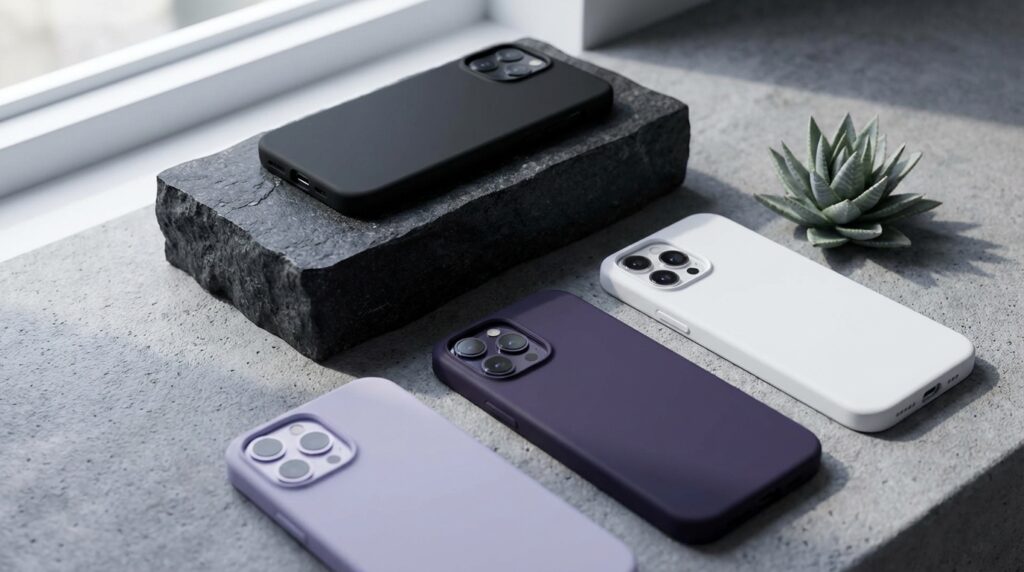
“The first time you snapped a Nokia 3310 faceplate back on, that hollow plastic click sounded like armor locking into place.”
You remember that sound, right? The case was the phone. Blue one week, translucent green the next. You threw that thing across the room, it bounced, you laughed, and the phone kept going. Fast forward to now: you have a slab of glass and aluminum that costs more than your first laptop, and you are searching for a case that gives you Nokia confidence without turning your pocket into a brick.
That is the tension behind minimalist phone cases. We want that naked-phone feel, the satin edge under our fingers, the way an iPhone or a Pixel sits flat on a desk with no wobble. At the same time, we have learned the hard way that physics always wins when a phone slides off a lap or bounces off concrete.
Minimalist cases try to walk this line: thin, almost invisible, but still tough enough that you do not panic every time your phone grazes a countertop. In a way, we are trying to get back to that 3310 feeling of “this thing can take a hit,” while still letting all that modern design breathe.
“Retro Specs: Nokia 3310, 2000 launch. 113 mm tall, 133 g, 84 x 48 pixel display, and user-replaceable faceplates that doubled as fashion and armor.”
Back then, you did not search for “protective case.” The shell itself was replaceable. Scratched it? Buy a new cover from a mall kiosk with bad fluorescent lighting and a cardboard stand of printed logos. The phone was thick enough that everyday drops were just… normal.
Now, phones push for thinner frames and larger displays. The glass covers almost every part you touch. Edges curve. Bezels shrink. The devices look better, feel lighter, and somehow feel more fragile at the same time. So the case, which used to be an afterthought, becomes a core part of the experience.
Minimalist cases sit right in the middle of this evolution. They are the modern faceplate, just smarter: tuned plastic blends, rigid backs with flexible sides, tiny lip measurements measured in tenths of a millimeter, all designed for that balance of “feels nearly naked” and “I am not holding a raw egg.”
Maybe it is just nostalgia talking, but every time I snap on a good thin case, it feels like clicking on that 3310 shell again, only now the stakes are way higher and the gear much prettier.
The thin-but-tough paradox
Pick up your phone without a case for a second and actually look at it. The bare metal edges, the glass camera island that sticks out just enough to catch on jeans, the weight shifting in your hand when you tilt it. Modern phones are not heavy by spec sheets, but they are dense. You feel every gram when it lands on tile.
Now think about what “minimalist case” really means in practice:
– Thin enough that you still feel the original device shape
– Light enough that you do not change the phone’s balance
– Strong enough to handle common drops and bumps
That is a tricky combo. Every fraction of a millimeter you shave off the case is a little less shock absorption. Every gram you remove is less material to spread impact. At the same time, too much case, and you lose that sleek glass-and-metal feel that you paid for.
This is where material science, and a bit of old-school plastic engineering, shows up in your pocket, whether you think about it or not.
From hard plastic shells to hybrid skins
Those early snap-on covers for candybar phones and flip phones were usually one hard material. ABS plastic. Polycarbonate. They resisted scratches but transferred impact straight through to the device. The phones survived anyway because they had thick housings and small screens.
Modern minimalist cases learn from that, but they cannot rely on a chunky phone body underneath. So brands mix materials:
– Polycarbonate or similar plastics for rigid backs
– TPU (thermoplastic polyurethane) for softer, grippy edges
– Sometimes a micro-fiber or soft lining to avoid micro-scratches on the phone itself
The magic of that “thin but tough” feeling is often in the edges. A well designed minimalist case will be just thick enough at the corners to compress a bit during impact without looking bulky, while the back plate spreads the force.
You can think of it the same way old car bumpers evolved from pure chrome bars to layered plastic with crush zones. Only here, the “bumper” is half a millimeter thick and also has to look good on Instagram.
How we got from faceplates to featherweight armor
“User Review from 2005: ‘Dropped my 6610 down the stairs again. Case cracked but phone is fine. Guess I’m buying another blue shell this weekend.'”
In the early 2000s, you could literally walk into a kiosk and pick a new “case” that replaced your entire phone exterior. Function and fashion were fused. The inner electronics were the precious part, the outer shell was semi-disposable.
Then smartphones showed up.
Touchscreens took over. Device shells turned into design statements. Curved aluminum, glass backs, polished stainless steel. You no longer wanted to hide your phone. You wanted to show it off. At the same time, everything became more fragile. A cracked resistive screen on an old PDA was annoying. A cracked OLED on a flagship phone is financial pain.
So users split into two camps:
– Full armor: thick cases, integrated screen protectors, belt clips, the “this thing could survive a drop off a ladder” crowd
– Naked phone: no case, maybe a skin, “I want to feel the design” crowd
Minimalist cases emerged almost as a peace treaty. Something that could:
– Respect the original design lines
– Add grip
– Add just enough “sacrificial” material to handle common daily drops
They took cues from those replaceable shells, but instead of bright printed flames, you got semi-transparent tints, frosted finishes, and soft-touch coatings.
What “tough” really means for a thin case
When you hear “tough,” your brain might picture extreme drop-test videos from warehouse rooftops. For a minimalist case, that is the wrong yardstick. The right question is: what are the realistic failure moments in normal life?
Think about these scenarios:
– Pocket height drops to hard floors
– Sliding off a car seat when you brake
– Edge impacts from missing a table edge
– Micro drops from waist height when you fumble the phone
A thin case does not try to make your phone indestructible. It tries to make it survive the common stuff without visible scars.
That usually comes down to 3 design decisions:
1. Corner reinforcement without visual bulk
2. A slight “lip” around the screen and camera bump
3. Materials that do not crack on first impact
If a case nails those three things, it will feel thin but still give you that “I can relax a bit” confidence.
Then vs now: phones and their armor
To see how far we have come, it helps to compare a classic “I do not care if this drops” phone with a modern “please do not slip” flagship, and then factor in the role of cases.
| Feature | Nokia 3310 (circa 2000) | Modern Flagship + Minimalist Case (e.g. iPhone 17) |
|---|---|---|
| Weight | 133 g phone, no extra case | ~190 g phone + ~15 g thin case |
| Thickness | ~22 mm body, no external case needed | ~7.5 mm phone + ~1 mm case |
| Screen | 84 x 48 pixel monochrome, recessed | 6+ inch OLED, edge-to-edge glass |
| Body material | Thick plastic shell, replaceable | Aluminum/titanium & glass, sealed |
| Drop survival | High from almost any angle with no extra case | Medium without case, higher with well designed thin case |
| Customization | Swap-on covers in bright colors | Minimalist cases in clear, matte, or simple tints |
| Grip | Textured plastic, chunky in hand | Slick glass/metal improved by grippy thin case |
That row on thickness tells the story. The 3310 was twice as thick as most modern phones, and no one complained. That body gave natural shock absorption. Now we chase thin frames, then add a millimeter back in case form so we can live with the device day to day.
The minimalist case is not just protection. It is a subtle course correction on modern design: a bit more grip, a bit more raised edge, a bit more sanity.
What actually makes a minimalist case “good”
Walk through any online marketplace and search for “slim case” or “ultra thin case,” and your screen fills with lookalikes. Clear TPU, frosted plastic, barely-there shells. Some cost less than a coffee, some cost as much as budget earbuds. On the surface they all claim the same thing.
The differences show up when you hold them, and even more after you have used them for three to six months.
1. Material feel vs real world wear
Take two clear cases out of their boxes. Fresh, they both look similar. They feel flexible, they hug the phone. Fast forward.
– Cheap TPU tends to yellow and become sticky with UV exposure and hand oils
– Higher grade blends keep clarity longer and resist that “old car headlight” look
Then there is grip. A good minimalist case walks this line where the sides feel grippy enough to resist sliding, but not so rubbery that they drag on pockets.
Run your thumb across the edge of a premium thin case and you often feel very fine texturing or a satin finish. On cheaper ones, it is just glossy plastic. Gloss slides. Satin holds.
2. Fit: the millimeter game
Billions of phones ship with identical dimensions on spec sheets, but tolerances add up. So do design changes from one model year to another. A strong minimalist case maker spends actual engineering time on:
– Button feel: press should feel crisp, not mushy
– Port and speaker cutouts: no covering microphones or tight cable fits
– Camera island: enough lift that lenses do not touch flat surfaces
The lip depth around the screen is especially telling. Too low, and face-down placement risks scratching the display. Too high, and you start to feel like you are using a tray.
Most people never grab a ruler, but your hands feel this stuff instantly.
3. Drop philosophy: corner focus
If you look closely at many respected slim cases, the corners are slightly thicker or shaped differently. That is not random.
Phones rarely land perfectly flat. They catch an edge or a corner, which concentrates force. So a smart minimalist case:
– Reinforces corners with more material
– Uses small air pockets or cut channels inside corners to deform on impact
– Curves edges just enough to redirect shock
From the outside, it still looks thin. Inside, that geometry is what gives you the “tough” part without feeling like a rugged case.
Minimalist case types: thin, thinner, thinnest
Not all “minimalist” cases target the same point on the spectrum. Think of them as three rough classes.
1. Everyday thin protective
This is the sweet spot for most people. Think:
– 1 to 1.5 mm thickness
– Soft edges, hard or semi-hard back
– Noticeable lip around screen and camera
They add visible protection while still feeling light. You know there is a case on, but it is not trying to be a tank.
These work well if:
– You commute, move around a city, or work at a desk
– You want to avoid damage from standard shoulder-height drops
– You like a bit of grip and do not mind a slightly thicker profile
2. Barely-there shells
These are the “case for people who hate cases.”
– 0.3 to 0.6 mm thick
– Often polycarbonate, sometimes frosted
– Minimal lip, mostly scratch protection
They are great at:
– Preventing micro-scratches on the back and sides
– Keeping the look and feel as close to naked phone as possible
– Making the device slide less on flat surfaces
They are not great at serious impact protection. Think of them more as skins with a bit of structure.
3. Hybrid minimalist armor
These creep toward protective cases but still try to keep a slim profile.
– 1.5 to 2 mm thickness
– Extra corner structure
– Often tested for higher drops
They are for people who want:
– Protection close to a “rugged” case
– A profile that still slides into pockets without snagging
– A cleaner design without crazy textures or flaps
They sit at the edge of what most people would still call minimalist, but they fit the “thin but tough” label well.
Minimalist case vs naked phone: the sensory trade-offs
“User Review from 2005: ‘Got a silicone cover for my Sony Ericsson. Phone feels weird now, but at least it won’t launch across the room when it rings on vibrate.'”
Touch is a big part of why people hesitate about cases in general. Part of you wants to feel the raw material: polished titanium, cool glass, those micro chamfers along the edges. A case always shifts that experience.
The trick is noticing what you gain in return.
Grip and confidence
Bare phones, especially with glass backs, slide. On sofa cushions. On car dashboards. On any slightly tilted table.
A good minimalist case:
– Adds micro texture that your fingers catch
– Softens edges slightly, so they press better into your palm
– Reduces those slow “creep” slides that end in a silent fall
That grip translates into simple confidence. You do not feel like you have to baby the device every time you stand up with it in hand.
Pocket feel
Early silicone cases for feature phones were sticky and grabbed pockets so hard that they turned everyday use into a tug of war. Modern slim cases learned from that.
The best thin cases use:
– Smooth backs with just enough friction
– Softer but less sticky sides
– Rounded corners that slip, not snag
You can test this at home. Set your phone on your jeans, tilt your leg a bit. Naked phone: slides quickly. Glossy thick case: may catch and then drop suddenly. Quality thin case: moves slowly or stays put.
Click and snap: the micro rituals
Remember the sound of removing a back cover to change a battery? That little plastic crackle, then the pop. Cases give us a new version of that ritual.
Snapping on a slim case has its own sensory cues:
– A soft pop as the last corner locks in
– Gentle flex when you remove it that tells you it will not crack easily
– Edges that do not bite your fingers when you press them to pull the case off
These details sound small. They are. But our brains build trust from them.
Minimalist cases and modern features: MagSafe, wireless, cameras
Modern phones are not just phones. They are magnet arrays, wireless charging coils, and multi-lens camera blocks wrapped in glass. A thin case has to work around all of that.
Wireless charging and magnetic systems
Flip on wireless charging. You drop the phone on a pad and expect it to line up. A thick case with cheap materials can:
– Misalign the coil
– Add too much distance
– Trap heat
Minimalist cases have an advantage because they add less distance by default. Many current models also:
– Integrate magnetic rings that match the phone’s magnets
– Use plastics that handle warmth from charging without warping
So you can snap on a MagSafe wallet or charger and still feel that firm magnetic click through the case.
Camera protection without photo problems
Camera bumps grow every generation. Sensors get bigger. Lenses stack. The “bump” turns into a full island.
A good thin case raises the area around the camera by a fraction of a millimeter more than the lens height. Enough that:
– Lenses do not touch flat surfaces
– Wobble on tables is reduced
– Lens housings avoid scratching when you slide the phone around
At the same time, it avoids flaring or shadowing near the flash. Cheap cases sometimes have thick or badly shaped cutouts that reflect flash back into the lens. On darker shots you see a foggy ring. The better minimalist designs pay attention to that.
Clear, matte, or opaque: how minimal do you want the look
Minimalist does not mean “only one look.” It is more about how much visual noise you add.
Clear cases
Clear thin cases are the closest visual match to a naked phone. They:
– Show off original color
– Highlight logos and metal edges
– Often work nicely with skins underneath
Trade-offs:
– Cheaper ones yellow over time
– Glossy clear finishes show smudges easily
Higher quality clear minimalist cases might use anti-yellowing additives and add a slight frost on the sides for grip.
Matte and frosted cases
Frosted or matte finishes:
– Hide minor scratches better
– Reduce fingerprint smears
– Give a softer, almost silky touch
They also diffuse reflections from the back glass, which can look clean and understated. You see the phone color but softened.
Solid color minimal shells
Opaque minimalistic shells focus on simple, flat color: black, dark blue, light gray, sometimes a muted red or green.
These:
– Make the device look more like a single object
– Hide logos if you dislike branding
– Often pair well with minimalist homescreen setups and widgets
They feel especially “modern” when you match or contrast them with watch bands, laptop covers, or desk accessories.
Why thin cases matter more as phones age
Phones, like people, wear in over time. The way you treat a brand new device is not the way you treat a two-year-old one you know you will replace soon.
Minimalist cases slot into that lifecycle in a smart way.
Early life: protect the investment
First few months:
– You care a lot about resale value
– You want to avoid scratches and big dings
– You are still getting used to the phone’s size and weight
A slightly thicker minimalist case with corner protection and good lips acts like insurance without making the phone feel alien.
Midlife: comfort and routine
After a year:
– The first tiny marks appear
– Your brain relaxes about perfection
– Grip and comfort start to matter more than pristine condition
Some people move to an even thinner case or a different finish. Maybe from a grippier matte case to a smoother, clearer shell.
End of life: passing it on
When you are getting ready to sell, trade in, or hand down a phone, the years of case use show up on the device:
– Sides with fewer nicks
– Camera lenses that are less scratched
– Back glass that still looks clean
That is where the “tough” part of thin cases pays back. Not because you watched it fall off a roof and survive, but because it quietly absorbed thousands of micro bumps and scrapes you never noticed.
Minimalist cases vs skins and no-case purism
For some people, cases of any kind are a compromise too far. If that is you, your options tend to be:
– No protection at all
– Vinyl or nano skins that add grip and scratch resistance
Skins are great for:
– Texture changes
– Style
– Preventing back scratches
They are not great for:
– Drop protection
– Camera lip height
– Protecting vulnerable corners
Minimalist cases sit right above skins on the protection ladder:
– Skins: mostly cosmetic and scratch control
– Thin shells: small boost for grip, scratch protection, very light impact help
– Everyday minimalist cases: real drop help for normal heights
You pick the rung based on your risk tolerance and how you actually use the phone.
Little design details that signal a strong minimalist case
When you are scrolling through product pages or standing in a store aisle, a few quiet signs hint that the case is more than a generic mold.
Raised buttons, not just cutouts
Some cheap cases just leave a hole where the power or volume buttons live. That exposes the metal directly, which:
– Breaks protection
– Lets dust and grit scratch around buttons
– Often feels sharp to the touch
Better thin cases mold flexible buttons over the phone’s buttons. The best ones keep a crisp click feel. They sometimes add:
– Micro texture on the power button so you can find it blind
– Different textures between power and volume
These sound minor until you use them daily.
Lanyard holes and strap support
Phones are too large and too expensive to juggle carelessly. A small but growing number of minimalist cases now include:
– Discreet lanyard holes in corners
– Support for wrist straps or crossbody slings
That bit of extra security blends well with the thin-but-tough idea: add a subtle safety net without turning your phone into outdoor gear.
Interior finish
Flip a case inside out and check the inside:
– A blank, glossy interior can stick to the back glass and cause rainbow marks
– A light micro texture or microfiber lining prevents that, and also avoids micro-scratches
Even small anti-shock patterns printed inside, like tiny dots or hex shapes, can help distribute force a bit better.
The nostalgia thread: from swappable covers to stealth armor
“Retro Specs: Sony Ericsson T610, 2003. 95 g, aluminum-like trims, T9 keypad, optional clip-on shells that snapped around the body and squeaked over time.”
Those old clip-on shells and covers used to squeak, wiggle, and sometimes crack. You bought them for color, not protection. Protections was a side effect of thickness and cheap plastic, not design.
Now, we are weirdly back at the same idea, just more grown up. You buy a thin case to change the feel and look a bit, and you get engineered impact behavior as a side effect of design.
Thinking about minimalist cases through that lens makes them more interesting than “just an accessory.” They are the new faceplates:
– Thin, light layers that personalize the device
– Swappable based on style or season
– Engineered to interact with the phone’s structure and tech
Maybe it is just nostalgia talking, but snapping a clean, matte, perfectly fitted minimalist case onto a flagship phone feels like sliding a fresh 2000s-era faceplate over a trusty brick. The stakes are higher. The materials are better. The price tag of the thing underneath is scarier.
Yet the feeling is the same: that little click of confidence when tech meets a bit of armor and suddenly feels ready for real life.
