

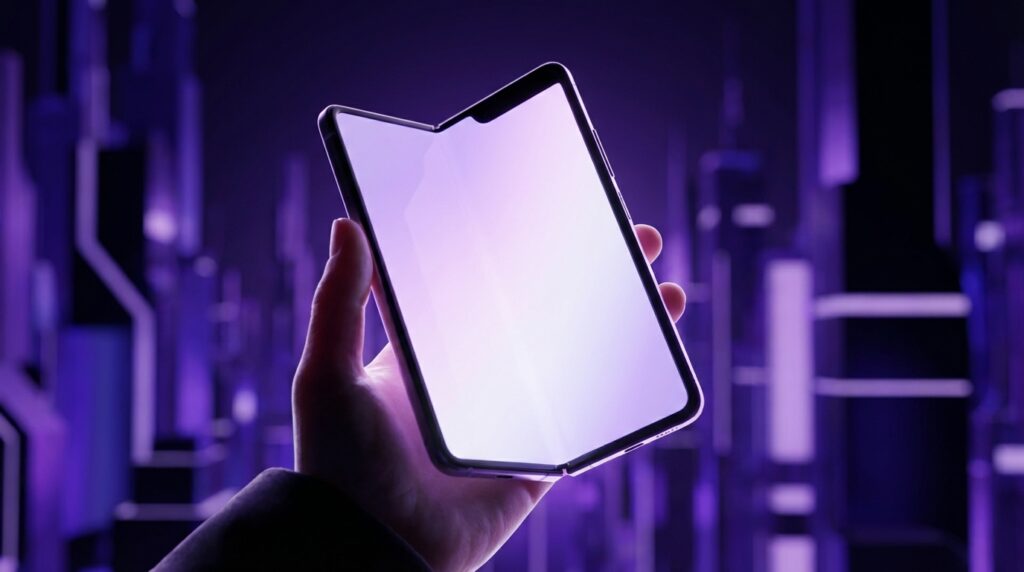
“The soft snap of a flip phone closing in your palm, that tiny thud as plastic met plastic, and the call was over. No red button. Just a satisfying click and a little puff of air between the hinges.”
You remember that sound, right? It was final. It had weight. Hanging up on someone with a Motorola V3 felt different from tapping a glass rectangle. It was more than a UI choice. It was physical.
Fast forward. Now you are looking at foldable phones in 2025 and wondering if they are the new version of that feeling or just another weird dead-end like 3D TVs. We went from candybars to sliders to flips, then flattened everything into one uniform slab. Now the screen itself folds, bends, creases. You unfold a modern foldable and the software stretches, icons jump apart, refresh rates adjust in real time. It is the same story: a hinge, a screen, and a question.
Is this all just nostalgia wearing OLED, or is this where phones are actually going?
That tiny flip from the early 2000s and the book-like fold of a 2025 flagship live on the same timeline. The same itch: make something compact that opens into something larger. The difference is what happens after you open it. In 2005, you opened a phone to see a 2 inch screen with maybe 176 x 220 pixels and a wallpaper of your pet with visible squares for eyes. In 2025, you open to a 7.8 inch OLED, 120 Hz, HDR, and a spreadsheet, a movie, or three apps pinned like tiles.
Maybe it is just nostalgia talking, but the first time you unfold a modern foldable and drop a full desktop-style browser view into your pocket, it feels like the tech finally caught up to the fantasy we had back when we were swapping polyphonic ringtones over infrared.
From T9 Hinges to Ultra Thin Glass
“Retro Specs: Motorola RAZR V3, 2004
13.9 mm thick when closed, 95 g, 2.2 inch internal display at 176 x 220 pixels, VGA camera, 5 MB internal storage. Sold as ‘the thinnest flip phone’ in glossy magazine ads, usually next to a perfume bottle.”
Back then, a hinge meant two things: smaller pockets and more attitude. The classic flip phone was basically a phone that wore sunglasses indoors. It took the same basic tech as a candybar Nokia, then folded it like a compact mirror. The inside was all plastic, metal accents, and that very real mechanical snap.
The screens were tiny. You could count the pixels if you looked close. The hinge was chunky, sometimes squeaky, and no one worried about “crease visibility” because the screen and hinge were separate parts. LCD here, speaker there, ribbon cable through the middle.
Fast forward to the first wave of modern foldables around 2019-2020. Same idea: closed for compact, opened for full use. Different problem: the screen and the hinge now had to act as a team. No thick plastic bezel in between. No safe gap. Just one long piece of flexible display tech, often plastic, stressed every time you opened it.
In those early days, everything felt a little fragile. Baby your foldable. Protect it from dust. Watch the crease. You probably saw videos of early units cracking at the fold or collecting dust near the hinge. It felt experimental, like a dev kit with a beautiful wallpaper.
By 2025, that vibe has changed. Hinges have evolved from clunky mechanical frames into multi-part systems with tiny gears, water-drop folds that hide the crease, and better dust resistance. Screens now use ultra thin glass with plastic layers on top, combining a rigid base with a flexible outer shell that can bend thousands of times.
The core idea, though, is still very RAZR: big thing that becomes small, small thing that becomes big.
The Three Big Shapes: Fold, Flip, and Weird In-Between
The Book-Style Foldable
The book-style foldable is the one you see in productivity ads. Closed, it looks like a chunky standard phone. Open, it turns into something close to a small tablet.
You feel the weight first. Around 260-280 g in many cases, which is more than those 95 g RAZR days and more than most standard flagships. It fills your hand. You notice the thickness too. Where a modern slab might hover around 7-8 mm, a folded book-style device often lands closer to 12-14 mm. It is pocketable, but you know it is there.
Once you unfold it, the whole experience changes. Instead of one tall canvas, you get a wider panel, around 7.6-8.2 inches. That extra width is where the magic kicks in. Two-column layouts wake up. Email apps show both the inbox and the reading pane. Spreadsheets give you more columns before forcing you to scroll. This is where the “is this a gimmick” question meets real use cases.
You can run three apps at once. Drag a video player to the top right, chat app left, browser bottom. Use a stylus across the entire surface. Fold halfway and turn it into a mini laptop, with a keyboard on the bottom half and content on top. None of that feels like purely marketing copy when you are actually on a long flight or couch browsing.
The Flip-Style Foldable
The flip-style foldable flips vertically like the old clamshells, but the whole interior is one long modern screen. Closed, it feels compact and slightly dense, around 180-210 g, but shorter than a normal phone. The outer display has grown by 2025 from a tiny notification window into a serious screen that can show maps, camera preview, widgets, and sometimes full apps.
Open it and you get a standard tall phone layout, around 6.7-6.9 inches. This line is less about productivity and more about pocket comfort and style. You still get some neat tricks: hands-free video calls with the phone half-open on a table, low-angle shots with the camera propped at ninety degrees, quick selfies using the outer screen.
Compared to a book-style foldable, this shape answers a different problem: “My phone feels too big in my pocket” rather than “My phone screen feels too small for my work.”
The Experiments
By 2025, you also see hybrids: triple-fold designs that go from phone to tablet to something in between, foldables with rollable sides that extend like a scroll, and phone-tablet-laptop mashups that blur categories.
Some of these feel like pure concept car energy, like the phone equivalent of gull-wing doors. Impressive in demos, rare in actual usage. Others will quietly evolve into something that might replace either laptops or tablets for many people.
Still, the daily reality for most buyers comes down to a simple choice:
– Thick phone that turns into tablet
– Small flip that turns into normal phone
That is where the “gimmick or new standard” argument lives.
Then vs Now: A Quick Spec Reality Check
“User Review from 2005:
‘The screen is so sharp I can actually read emails on the go now. The camera is good enough that I do not need to bring my digital camera to parties.’
Phone used: 1.3 MP camera, 176 x 220 display, 4x digital zoom, no autofocus.”
Time has a sense of humor. That 2005 user thought they had reached the peak. Today, 1.3 MP sounds like a security camera in a dark basement. To place foldables in context, it helps to see how far the “normal” phone came first.
Here is a simple then vs now snapshot:
| Feature | Nokia 3310 (2000) | iPhone 17-style Flagship (2025 era) |
|---|---|---|
| Display | 1.5 inch monochrome, 84 x 48 pixels | 6.3-6.8 inch OLED, around 120 Hz, 2500+ nits peak, 2500 x 1200+ pixels |
| Weight | 133 g | 190-210 g |
| Storage | KB-level, for SMS and ringtones only | 256 GB to 1 TB |
| Battery | 900 mAh removable | 4500-5000 mAh, fast charging, often 30-65 W |
| Camera | None | Triple or quad array, 48-200 MP sensors, advanced computational photography |
| Network | 2G GSM | 5G, Wi‑Fi 7, satellite messaging in some models |
| Price at launch | Low to mid, mass market | High-end, premium range |
For foldables, you usually take that 2025 flagship spec sheet, add a hinge, a folding display stack, and a price bump. You rarely lose on CPU or GPU performance. You might see some compromises around battery size, camera modules, and thickness.
The question is not “Are foldables powerful enough?” That part is covered. The real puzzle is: are the trade-offs and benefits balanced enough that this shape becomes what we call “a normal phone”?
Where Foldables Actually Win
Screen Real Estate Without a Backpack
When you open a book-style foldable, the first impression hits your eyes, not your brain. Your fingers feel the ridge of the hinge, the slight resistance near the end of the motion, the faint crunch of tiny hinge parts settling into place. Then the UI stretches.
Maps show more area. Timelines in video editing apps become more usable. Ebooks feel closer to a paperback, with bigger fonts and fewer page turns. Browsing the web feels less like peering through a door slot.
You can run two apps side by side in a way that does not feel cramped. Imagine a note-taking app on the left, a tutorial video or PDF on the right. You can drag text, drop images, move content in a way that starts to echo laptop workflow, even if nothing fully replaces a good keyboard for serious writing.
When you go back to a flat phone, you notice the squeeze. The big difference: you now expect a portable device to give you that extra viewing space whenever you ask for it. That is a shift in what “standard” feels like.
Better Use of Dead Time
Long commutes, flights, waiting rooms. A slab phone already fills this space with video and games. Foldables push that further.
– Watching movies or series on a book-style foldable really does feel closer to a mini tablet.
– Cloud gaming and remote desktop apps use that extra area to show more interface elements.
– Productivity apps that were painful on small screens become tolerable or even comfortable.
None of these tasks are new. The difference is that the device lives in your pocket, not your backpack. You do not decide “I should bring my tablet today.” You just always have it.
The Flip Factor: Size and Style
Flip foldables live in a slightly different world. The main benefit is physical. Closed, they occupy less vertical space, which works better in smaller pockets or bags.
You can:
– Throw it into a small clutch or front pocket without a glass slab sticking out.
– Use the half-open mode for videos, recipes, or video calls without a stand.
– Snap it shut to decline a call in a gesture that feels oddly satisfying.
Here, the hook is not always rational. It is a mix of style and practicality. The phone becomes an accessory again, not just a flat black rectangle.
Where Foldables Still Struggle
“User Review from 2005:
‘The hinge feels solid but I do not know how long it will last. I open and close it all day. What happens after a year?’
Spoiler: that hinge outlived several SIM cards.”
Durability Anxiety
Ask any foldable owner about their device and sooner or later you hear something like: “I love it, but I am careful with it.”
The moving parts and layered screen stack create a mental tax. You worry about:
– The crease becoming more visible with time
– Dust getting into the hinge
– A minor drop causing more damage than it would on a standard slab
– Screen protectors that cannot be replaced easily at home
Manufacturers have made huge strides. Many 2025 foldables are rated for hundreds of thousands of folds under lab conditions. Water resistance has improved. Hinge designs have grown more compact and better sealed.
Still, the idea of paying flagship-plus money for something that feels even slightly more fragile slows adoption. People remember how long their old Nokias lasted. They remember swapping faceplates and throwing phones across beds during arguments without thinking about micro scratches on ultra thin glass.
Thickness, Weight, and Battery Trade-offs
Physics never forgot about foldables. To fit dual batteries, hinge components, and multiple camera units into a foldable chassis, designers juggle trade-offs.
– Book-style foldables often have slightly smaller batteries than you would expect for their size.
– Camera modules sometimes lag behind the best non-folding flagships, especially for periscope zoom.
– The extra thickness makes some grips awkward for long sessions.
For flip foldables, the small vertical profile creates tight space. You get clever battery splits and stacked PCBs, but something has to give, usually either battery capacity or camera hardware.
For heavy users, these differences are not theoretical. They show up at 7 pm when the battery warning slides in earlier than on a slab phone, or when the camera underperforms in a low light shot compared to a top-tier non-foldable.
Price and Perception
In 2025, foldables tend to sit above standard flagships in price. Even when component costs come down, the design complexity and lower production volumes push retail prices up.
This shapes perception: foldables feel like premium experiments instead of default choices. Buyers ask: “Why should I pay extra for something that might be less durable and has some compromises?”
Until price gaps close, it is hard for foldables to be the new standard for everyone. For that leap, you either need comparable prices or visible must-have benefits that justify the difference.
How Software Catches Up To The Hardware
The first foldables felt like regular phone software stretched awkwardly. Single-column lists on giant screens, apps thinking in portrait or landscape but not both, gestures breaking near the hinge zone.
By 2025, app developers and OS designers have woken up to the idea that a screen can change shape during use.
– Multi-window modes are smoother, with drag-and-drop between halves and floating windows.
– Keyboard layouts adjust better, for example splitting into thumb-friendly sides on big internal screens.
– Camera apps use the fold angle as input: tilt to adjust time-lapse or framing.
– Games start offering special layouts for wider interiors, with separate controls and panels.
The real progress shows up in tiny details: how your video call moves from outer screen to inner display when you open the phone, how a podcast app shifts controls to the bottom half in laptop mode, how the OS remembers app layouts when you go from closed to open and back.
When the software respects the hardware shape changes, the device stops feeling like a novelty and starts feeling natural. You open it because of what you are doing, not just because it looks cool.
Are Foldables Headed For “Normal” Status?
This is the big question: are foldables the next standard, like how full touchscreens replaced T9, or are they a side branch like slider phones with spring-loaded mechanisms?
To answer that, it helps to look at three forces: habit, price, and use case.
Habit: What Feels Normal In Your Hand
Habits sneak up on you. There was a time when swiping on glass felt odd. People missed physical keys, the tactile map under their thumbs.
Now, if you hand a teenager a T9 keypad, they stare for a second before pecking at keys like a new language. The slab touchscreen won because:
– It gave obvious benefits: bigger screen for web, photos, apps
– It made software more flexible: keyboards, layouts, controls could change per app
– Prices fell until almost every tier used the same basic design
For foldables to hit that level, opening a screen must feel as default as rotating from portrait to landscape did a decade earlier.
We see hints of that already. Power users who spend most of their time on email, documents, and calls grow attached to the extra inside space. Flip users form habits around the compact size. They start expecting these features.
The question is not “Does everyone need this?” but “Will enough people see this shape as normal that other shapes start to feel dated?”
Price: When the Fold Becomes Boring
New standards rarely feel special. They feel boring and everywhere. The moment you stop bragging “My phone folds” and start complaining about something else, that is the sign of mainstream status.
For that, foldables have to come down in price bands over time:
– Flagship foldables at the high end, matching or just above flat flagships.
– Mid-range foldables that bring decent chips and cameras at accessible prices.
– Maybe even budget foldables that do not feel like prototypes.
Once you can walk into a regular carrier store and see foldables across multiple price tiers, they stop looking like sci-fi props and start looking like just another option. That shift was already starting by mid-2020s, and it continues as manufacturing yields improve.
Use Case: What They Do That Slabs Cannot
If foldables only matched what flat phones did, just with a hinge, they would stay novelties. The hinge has to unlock moves slabs just cannot pull off cleanly.
Several already stand out:
– True multi-app productivity on a pocket device
– Built-in stand for video calls and content
– Larger canvas for stylus work without carrying a separate tablet
– More flexible camera positions thanks to folding angles
As these features improve and become expected, the gap widens. Think of it this way: once a big enough group of users decides they cannot go back to a flat phone for their daily tasks, we are past “gimmick.”
The Nostalgia Loop: Why Foldables Feel Familiar
“Retro Specs: Samsung SGH-E700, 2003
Clamshell, 256K color internal display, tiny external display, integrated VGA camera. Dual-screen life before it was cool.”
One reason foldables hook people emotionally is that they tap into the old flip and clamshell era rhythm:
– Closed: private, off-duty, protected
– Open: public, engaged, active
A slab phone blurs that line. Screen always visible, always on the edge of your attention. With a foldable, you get a soft boundary back. Phone closed, notifications limited, screen covered. Phone open, you are “in.”
Some users start treating the closed state almost like a lighter mode: music controls, quick replies, time and calendar, glanceable stuff. Open state becomes deep work or deep scrolling. That kind of physical state change mirrors old habits from flip phones, just with modern apps behind it.
Maybe that is nostalgia, but it also gives structure. And structure often sticks.
Where Foldables Sit In The Bigger Device Family
Think about everything with a screen you might use in a day:
– Phone
– Tablet
– Laptop
– Smartwatch
– TV
Most people do not want more devices. They want fewer that do more. Foldables sit at an interesting crossroad:
– Book-style: Phone + small tablet
– Flip-style: Phone + compact fashion accessory
For some, a foldable replaces the small tablet outright. For others, it becomes their main entertainment screen outside the home. For frequent travelers or people who work on the go, the line between “I need my laptop” and “I can finish this on my foldable” keeps shifting.
Are foldables the one device to rule them all? Probably not. Laptops still matter. External keyboards still matter. But foldables clearly push phones into some of that territory.
So, Gimmick Or New Standard?
If you define “standard” as “what the majority of people use,” then in 2025 foldables are not fully there yet. Most buyers still carry a flat slab in their pocket. Price, durability fears, and habit keep that status intact.
If you define “gimmick” as “feature with no real lasting benefit beyond looks,” foldables have already moved past that label. The extra utility is real for many users.
The more honest answer sits between:
– Foldables in 2025 are the early touchscreen era all over again.
– They work, they help, and they still have rough edges.
– Some people will not switch until the hinge feels invisible, the crease almost gone, and the price sits right next to non-folding flagships.
From a digital archivist point of view, they also close a loop. We started with devices that opened and closed, moved to rigid glass plates for a decade, and now we are back to opening and closing, but the screen itself bends. The plastic feel of early flips has been replaced with layered glass that quietly flexes every day.
The next few years will tell you which shape wins: flat, fold, or a mix. For now, every soft snap of a foldable closing carries a faint echo of that old clamshell thud, just with more pixels, bigger batteries, and a very different idea of what your pocket computer should do once it wakes up.
