

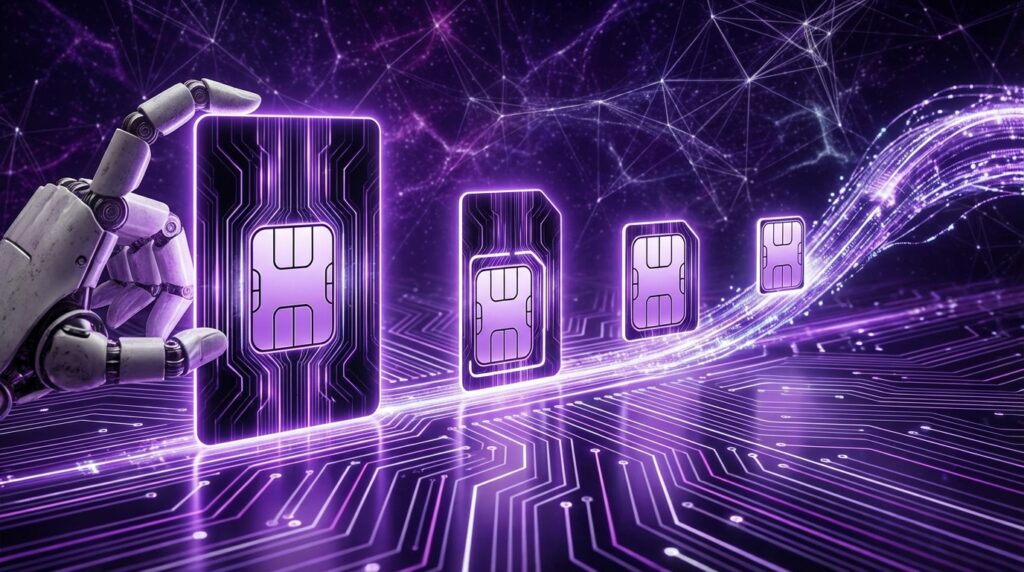
“The soft click of the SIM tray ejector, that tiny metal pin bending a little, your heart stopping for a second as the card wobbled in mid air.”
You remember when swapping numbers meant swapping plastic, not scanning a QR code. That tiny gold rectangle in your hand felt like power. Your identity, your contacts, your texts, all locked inside something lighter than a paperclip. Now you look at eSIMs, dual SIM phones, and QR activations, and it feels almost unreal that we once carried SIMs the size of credit cards.
The story of the SIM card is really the story of how our phones stopped being “phones” and turned into personal networks we carry in our pockets. That first clunky card in your Nokia or Ericsson was not just a piece of plastic. It was the contract between you and the network. As the hardware around it shrank, changed shape, and picked up more antennas, the SIM quietly followed, shrinking from a card you could not miss in your wallet to something you can sneeze on and lose under the keyboard.
You might be thinking about your first phone right now. Maybe a candybar Nokia, maybe a silver Motorola flip phone. You remember pressing your thumb against that rough plastic back cover and sliding it off with a muffled scrape. The battery had weight. You could feel the cells inside. Under it, a small rectangular recess with a metal contact array. That was the SIM slot. That is where this story starts.
The first SIMs: when your “SIM card” was an actual card
“Retro Spec: GSM Phase 1 SIM cards were literally credit card sized. 85.6 mm x 54 mm. You could file paperwork with them.”
In the early 1990s, when GSM was still new and most people thought mobile phones were for executives with briefcases, the SIM card was huge. The original form factor, defined by the GSM standard, matched a standard bank card. Roughly 85.6 by 54 millimeters, about 0.76 millimeters thick.
You did not slide it into the side of a sleek phone. You slotted it into hulking handsets that looked more like landline phones with antennas. Many early SIMs were used like access passes. Sometimes the phone body stayed in the car or office, and the SIM card traveled with you, like a security badge.
The feeling of those first SIMs was very different. They had a more rigid body, more like a credit card than the thin punch-out cards you know. The gold contact area was still small, about the size you recognize today, but surrounded by a lot of plain PVC. Functionally, though, the core idea was the same as what sits inside your phone now.
Inside that plastic:
* An integrated circuit that stored your IMSI (International Mobile Subscriber Identity)
* The secret key used to authenticate to the network
* Some space for SMS, contacts, and network preferences
* A basic operating system that followed GSM 11.11 and related standards
No matter how heavy the phone, how long the pull-out antenna, the brains of your subscription sat on that removable card. It meant one crucial thing: the network recognized you, not the device. Swap card, swap identity.
From full-size to mini SIM: the birth of the “normal” SIM
If you picked up a SIM starter kit in the early 2000s, you probably remember the shape: a big plastic frame, and inside it a pop-out rectangle with a gold contact patch. That inner rectangle, 25 by 15 millimeters, is the “mini SIM” form factor. Most people just called it a SIM. This is the size that took over the world.
“User review from 2005: ‘Lost my phone, borrowed my cousin’s, stuck my SIM in, everything worked. Same number, same texts. Felt like magic.'”
By the late 1990s and early 2000s, as phones like the Nokia 3210, 3310, and Ericsson T28 gained traction, manufacturers needed smaller components. Boards were still chunky. Screens had chunky bezels. Batteries needed room. Shaving down the SIM’s plastic made sense.
The mini SIM kept the same contact layout and chip size. It was mostly about removing unused plastic. This is why you could punch the mini SIM out of a full-size plastic card: the electronic part did not change.
If you held one in your hand, you felt a light, slightly flexible rectangle. The plastic would bend just enough that you worried it might snap, but it rarely did. The contacts had a matte or shiny finish, sometimes with a visible pattern of memory blocks underneath if you tilted it toward the light.
The experience around mini SIMs shaped a generation of mobile users:
* Traveling abroad with a cheap local SIM tucked behind your phone battery
* The small “SIM card holder” pockets in wallets
* Prepaid SIM packs hanging on hooks in convenience stores
* The anxiety of dropping a SIM on the floor and crawling around trying to find it
Technically, the mini SIM still ran the same basic logic. GSM authentication, contact storage (often limited to 100 or 250 entries), SMS storage, some network apps using SIM Toolkit menus like “Check balance” or “Mobile banking.”
The real change was social. Swapping phones became as simple as sliding off a plastic back, lifting the battery, and moving that little card. The phone itself became more like a shell.
Then vs. now: Nokia 3310 vs iPhone 17
Even though the SIM is the star of this story, it helps to see how the host devices changed around it.
| Feature | Nokia 3310 (2000) | iPhone 17 (hypothetical modern flagship) |
|---|---|---|
| SIM Type | Mini SIM (2FF), under battery | eSIM only or Nano SIM (4FF) in side tray |
| Weight | 133 g | ~190 g, glass and metal body |
| Screen | 84 x 48 pixels, monochrome | ~2800 x 1300 pixels, OLED, millions of colors |
| Battery Access | Removable, slide-off plastic back cover | Sealed, internal, no user access |
| Network | 2G GSM | 5G, eSIM, multi-band, VoLTE, VoWiFi |
| Contacts Storage | Often on SIM (100-250 contacts) | Phone/cloud-based, thousands of contacts |
| Ringtone Style | Monophonic/polyphonic MIDI | Hi-res audio, streamed music, custom tones |
The SIM shrank. The phone grew in complexity. Your identity moved from a tiny card and a local address book to a mix of SIM data, device IDs, and cloud accounts. But in that Nokia, the SIM card felt like the center of your digital life.
The micro SIM era: smartphones start to squeeze
By the late 2000s, something shifted. Screens grew. Keypads faded. Data became the main course instead of SMS. Phones slimmed down and moved from chunky plastic to brushed metal and glass. Inside, every square millimeter had a job.
“User review from 2010: ‘Just upgraded to a new smartphone and had to get my SIM cut. Scariest five minutes of my tech life watching the guy line it up with scissors.'”
The micro SIM, also called 3FF (third form factor), measured 15 by 12 millimeters. Once again, the chip stayed almost identical in size. The frame around it shrank. Engineers wanted to free board space. Apple pushed this hard with the iPad and iPhone 4, and other manufacturers followed.
If you held a micro SIM next to a mini SIM, the family resemblance was clear. Same gold contact pattern, just closer to the edge. Many users did not want to visit a carrier store, so “SIM cutters” appeared. These devices looked like small staplers or hole punches. You would slide your old mini SIM in, line up some marks, and press down with a loud metallic snap. Out came a micro SIM.
Sometimes it worked perfectly. Sometimes it sliced too close to the contacts and killed the card. There was a slight thrill to it, like modding hardware with basic tools. It felt like you were hacking the system, when really you were just trimming plastic.
Micro SIM marked a couple of turning points:
* SIM trays started to move to the side of the device
* Ejector pins became a common accessory
* Sealed batteries became more common, so SIM access had to move away from under the battery
The tactile ritual changed. Instead of peeling off a creaky back cover and lifting a warm battery, you now push a metal pin into a tiny hole. There is a small, clean click as the tray pops out. The SIM lies flat in a sculpted metal bed, almost like jewelry.
Nano SIM: when only the chip matters
By the early 2010s, phone designers were shaving fractions of a millimeter everywhere. Thinner bodies, smaller bezels, more stacked components. The SIM still had room to shrink. Enter the nano SIM, 4FF, 12.3 by 8.8 millimeters, and crucially, thinner than its older siblings at about 0.67 millimeters.
This time, the plastic was barely there. In your hand, a nano SIM feels fragile. Your fingers cover most of its surface. You can feel the tiny step between the plastic edge and the gold contacts. The chip almost fills the whole footprint. The rest is just enough material to keep it from breaking.
“Retro Spec: The nano SIM removed almost all extra plastic and shaved down thickness. The difference in thickness helped avoid jamming older slots with cut-down cards.”
With nano SIM, the ritual changed again:
* Trays often held both SIM and microSD cards in a stacked or side-by-side layout
* Dual SIM slots became more common, especially outside the US
* Phone boxes started including SIM ejector tools by default
You probably remember the first time you tried to place a nano SIM into its tray. You line up the notched corner, nudge it into position. It sits almost flush, with barely any play. Any small shake and it can drift. Maybe you used a fingertip, maybe a pencil eraser. It felt both precise and a little annoying.
Why go this small? Two obvious reasons:
1. Space. That freed-up area on the main board is not just empty. It can hold RF components, shielded power management chips, or antenna feeds.
2. Design freedom. External lines can be cleaner when you only need a slim, short slot on the edge.
The nano SIM became the default globally. Carrier starter kits now often included a clever “Russian doll” adapter sheet: nano in micro frame, micro in mini frame, so the same tiny chip could live in any phone with the right adapter.
What the SIM actually does inside your phone
Under all this plastic size drama, the core purpose of the SIM never changed much. Whether full-size, mini, micro, or nano, the card serves a few key jobs:
* Stores your IMSI, the unique number that identifies your subscription to the network
* Holds a secret key shared with your carrier, used for authentication
* Runs a small OS (often based on Java Card or similar) that speaks standard protocols
* May hold SMS, contacts, and small apps using SIM Toolkit
When you power on your phone:
1. The phone reads the IMSI and asks the network to connect.
2. The network sends a random challenge to the SIM.
3. The SIM computes a response using its secret key.
4. If the response matches what the network expects, you are in.
The beauty is in the isolation. The phone never sees the secret key. Only the SIM chip does. That is why you can pull your SIM and place it in another phone and your number comes with it. The trust anchor travels physically.
As networks moved from 2G to 3G, 4G, and 5G, the apps around that authentication grew more complex. New files appeared on the SIM for LTE parameters, support for multiple profiles emerged, and storage grew. But the experience from your side stayed simple: tiny plastic, gold patch, your number.
From card to code: the rise of eSIM
Now things get interesting. After all this shrinking, the last step is obvious: remove the physical card. That is what eSIM does. Instead of a removable plastic card, phones and other devices carry an embedded chip soldered to the board. This chip can hold one or more “profiles” that act like digital SIMs.
You scan a QR code or use an app, the carrier provisions a new profile onto the eSIM, and your phone behaves exactly as if you had slid a card in.
Technically, the eSIM still follows the same security model:
* Secure element on board
* Encrypted provisioning of profiles
* Similar file structure and authentication
The difference is experience and flexibility. Manufacturers gain more design freedom. There is no need for a tray, sealing improves, water ingress points shrink, internal layouts open up.
From your side, the ritual changes again:
* No more searching for a bent paperclip
* No more tiny ziplock bags with spare SIMs
* Carrier switching through menus and apps instead of plastic swaps
At the same time, a lot of people miss the physical anchor. That feeling of “I own my number because I can hold it.” Maybe it was just nostalgia talking, but having a card in your wallet felt like carrying a passport.
Why the form factor kept shrinking
If the chip on the SIM stayed roughly the same, why go from card to mini to micro to nano?
A few pragmatic reasons:
1. Board space is money
Every square millimeter inside a smartphone has cost. Passive components, RF matching networks, shielding, camera mounts. Removing plastic from the SIM does not just reduce weight. It opens up routing options for traces under the slot, reduces the slot footprint, and lets designers position support components more flexibly.
2. Device thickness and stacking
With nano SIM, thickness shrank too. That matters when you are layering PCB, SIM tray, gasket, and outer housing. A millimeter saved at each layer can mean a slimmer phone or space for a slightly thicker camera sensor.
3. Mechanical robustness
It sounds backward, but a smaller, tighter-fit card in a tray can be more stable under vibration and drops than a larger, loosely guided card in a spring slot.
4. Multi-SIM and hybrid slots
As dual SIM support spread, especially in emerging markets, designers had to pack two SIM footprints into a very small area. Smaller SIMs made this realistic without making the device larger.
Then vs. now: SIM evolution at a glance
| SIM Type | Common Name | Dimensions | Era | Typical Use |
|---|---|---|---|---|
| 1FF | Full-size SIM | 85.6 x 54 x 0.76 mm | Early 1990s | Early GSM phones, car phones, test gear |
| 2FF | Mini SIM | 25 x 15 x 0.76 mm | Late 1990s – early 2010s | Feature phones, first-gen smartphones |
| 3FF | Micro SIM | 15 x 12 x 0.76 mm | Around 2010 onward | Early slim smartphones, tablets |
| 4FF | Nano SIM | 12.3 x 8.8 x 0.67 mm | Mid 2010s onward | Modern smartphones, some tablets and watches |
| MFF2 | Embedded SIM (eSIM package) | ~6 x 5 x <1 mm (soldered) | Late 2010s onward | Smartphones, wearables, IoT hardware |
The trend line is clear: less plastic, more integration, more control by device makers and carriers. The physical piece you interact with shrinks toward zero.
How SIM cards rewired user behavior
The hardware story is one piece. The cultural effect is another.
In the feature phone era, your SIM was your portable identity:
* Your number moved with you between phones
* Many people kept SIMs in old feature phones as “backup” lines
* Markets with prepaid culture sold and traded SIMs like prepaid credit
You might remember carrying a small stack of SIMs:
* One for cheap data
* One for cheap calls
* One from another country tucked behind the battery, waiting for your next trip
Swapping them was a small ritual. Power off. Fingernail under the back cover, plastic creaking. Battery warm against your fingers. Slide out one SIM, slide in another. Restart. New welcome SMS from the carrier.
As smartphones took over and apps moved messaging and identity onto email addresses and cloud accounts, the SIM’s role shifted slightly. It was still your network key, but:
* Contacts migrated from SIM to cloud sync
* Messaging moved to apps like WhatsApp, iMessage, Telegram
* Authentication layered additional IDs: device identifiers, OS accounts, app accounts
Still, in many regions, your SIM remained central. In countries with heavy use of prepaid lines, a phone could be a rotating door of SIMs. Phone numbers became disposable and targeted.
The physical size of the SIM did not change this behavior directly, but the ease of access did. Under-battery SIMs were annoying to swap. Side trays made swapping simpler for many, but sealed phones removed the habit of popping things open casually.
Multi-SIM and the modern power user
When dual SIM phones started to appear, they were often niche or region-specific. At first, they used two mini SIM slots. That meant more internal space, more connectors, more complexity. As micro and nano SIM came in, dual SIM setups became easier to design.
The side-by-side nano SIM tray is now a familiar sight:
* One line for work, one for personal use
* One local SIM, one roaming eSIM
* One physical SIM as a legacy line, eSIM for experiments and short-term plans
Here the physical and digital worlds overlap nicely. A tiny piece of plastic next to a virtual profile, both serving the same function.
SIM cards in wearables and IoT
As devices got smaller and more diverse, the demand for connectivity moved far beyond phones:
* Smartwatches
* GPS trackers
* Cars
* Smart meters
* Industrial sensors
These devices could not spare room for full SIM slots and trays. That is where embedded form factors like MFF2 came in. The “card” was now a chip soldered to the board, often hidden under a metal shield alongside other components.
From your perspective as a user, you saw:
* Smartwatches that could make calls with “cellular” versions
* Cars with built-in data connections
* Home security units that could send alerts over cellular networks
Under the hood, the same principle held: subscriber identity, keys, network apps. The SIM moved from something you physically handle to something baked in at manufacturing time, sometimes with remote provisioning on top.
The tension between control and flexibility
There has always been a quiet tug-of-war around the SIM. On one side, carriers want control over the subscriber relationship. On the other, device makers want control over the experience and design.
Physical SIM cards empowered users in a simple way:
* You could switch carriers by walking into a store and buying a new SIM
* You could pass a SIM to someone else and give them temporary use of your number
* You could keep old numbers around as spares
As eSIM adoption grows, some of that flexibility changes shape:
* Carrier switching can become easier through software, or harder if locked down
* Devices can hold multiple active or inactive profiles
* Some carriers may keep tighter controls over profile movement
From a pure hardware point of view, eSIMs and smaller SIMs are all upside. Less waste, less chance of mechanical failure, better sealing. From a user autonomy view, it depends on policy and implementation.
You might still have a small envelope in a drawer with old physical SIMs. Some probably dead, some still online if you powered them up and topped them up. That little collection says a lot about how the SIM card turned into a physical archive of past phone lives.
Blocky phones, sharp plastic, and that golden contact patch
“User review from 2005: ‘Got my new prepaid SIM today. Punched it out of the card, snapped right in my 3310. Put my girlfriend’s name on speed dial 1. Never touching this thing again.'”
If we zoom in on the everyday experience for a second, the SIM history is full of small sensory moments:
* The slight resistance as you snap a mini SIM out of its plastic frame
* The crunchy sound of a cheap SIM cutter on a shop counter
* The faint smell of warm plastic when you remove a battery after a long call
* The texture of embossed numbers on the full-size starter card
In cheap feature phones, SIM slots were simple metal rails with a tiny spring clip. Sliding the SIM under the clip made a faint scraping noise against the PCB. In more premium units, you got hinged sockets that clicked down with reassuring force.
In modern phones, SIM trays glide in tight channels. There is almost no sound, just a smooth slide. The card is hidden immediately. Only the small hole for the ejector pin hints that anything is there.
Mini, micro, nano, embedded. Different shapes, same golden patch. That pattern of contacts is like a fossil record written in plastic and copper.
From one device to many: SIM cards in the age of smart homes
Your first SIM probably powered one thing: your phone. Now, the idea of “subscriber identity” touches far more pieces of your life.
Think of a simple modern setup:
* Phone with eSIM and maybe a nano SIM
* Cellular-capable smartwatch sharing that number
* Car with built-in data, either with its own SIM profile or one tied to your account
* LTE router as backup broadband with a standard nano SIM
* Security camera with an embedded SIM, sending clips when Wi-Fi fails
Some of these you never touch physically. Others still ship with a peel-off plastic card and a pop-out nano SIM, including PIN and PUK codes printed next to the serial number.
The feeling when you activate them still echoes that first SIM:
* A short code you enter
* A small waiting period while the network propagates
* The first “Connected” icon, maybe a few test pings or calls
The more your house fills with connected devices, the more hidden SIMs float around in the background, either literally as cards or conceptually as eSIM profiles managed in carrier systems.
Where nano SIM fits in a future of no SIM cards
Right now you live in an interesting in-between moment. Many flagships already favor eSIM. Some still keep a physical nano SIM slot for backward compatibility, traveler convenience, or markets where eSIM rollout is slower.
Nano SIM is stable, mature, and well understood. It is cheap to produce, easy to bulk ship, and trusted by users. You can tuck a spare nano SIM in your wallet next to your emergency cash and know that if your main phone breaks, you can revive your line in a spare device in minutes.
At the same time:
* More carriers push eSIM-only plans
* QR activation codes replace plastic starter kits
* Remotely provisioned profiles mean traveler SIM vending machines can become simple QR panels
The nano SIM becomes something like vinyl records. Not gone, not even rare in many regions, but no longer the only way to experience mobile connectivity.
You might keep that tiny ejector pin on your keyring for years. You might use it less and less. Somewhere in a junk drawer, an old mini SIM with a faded logo still sits, its gold patch slightly worn. Inside its memory, if you powered it up, bits would still represent old contacts, old texts, old network keys.
From credit card slabs to almost invisible slivers, the SIM card shrank as our networks grew. The sound of plastic frames snapping, trays clicking, and contacts scraping metal slots might fade. The function remains, buried under software layers, still doing the same quiet job it did in that first chunky GSM brick: telling the network, “This is you.”
