

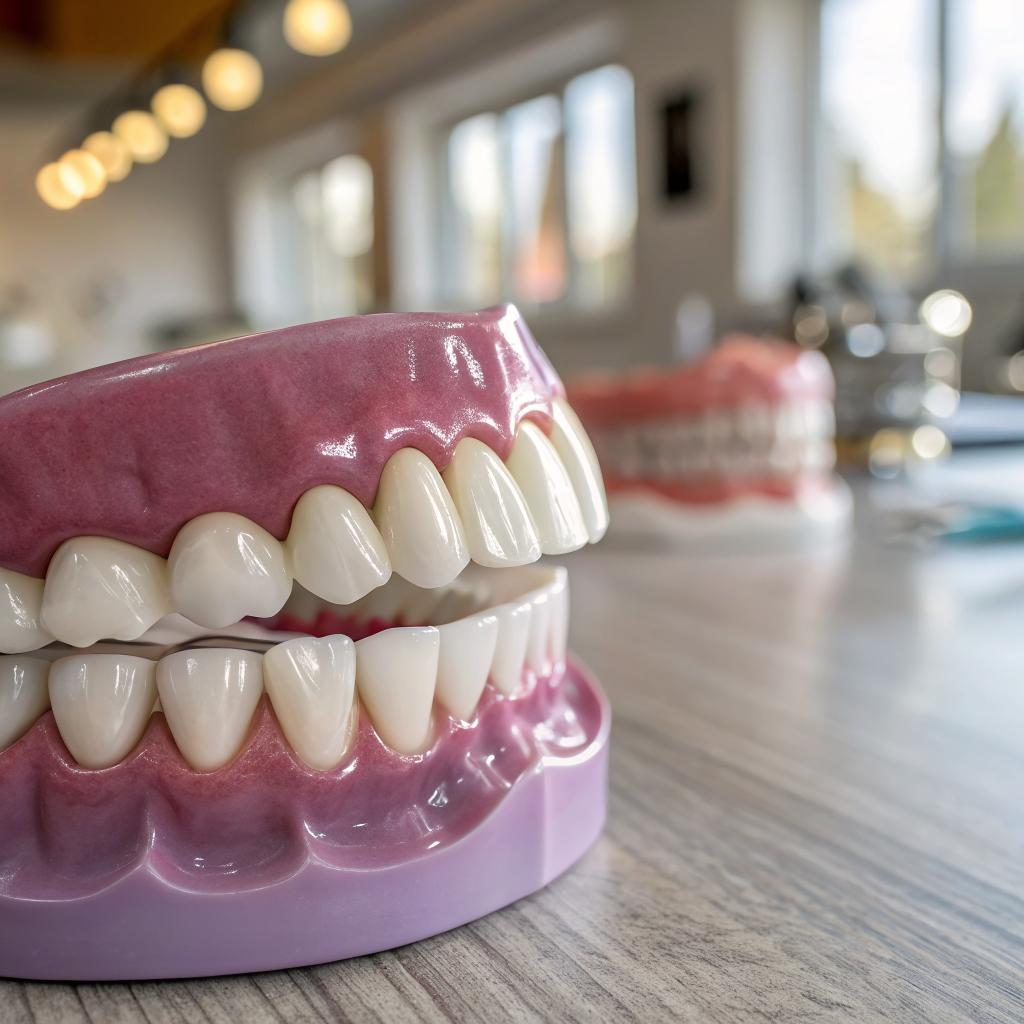
What if I told you that the most advanced tooth replacement in New York today is not a perfect copy of nature, but something quietly better in a few ways?
If you grew up around grandparents who kept their teeth in a cup at night, you probably remember the sight very clearly. Maybe a bit too clearly. There is something both funny and a little sad about a smile that can be removed and placed by the sink.
For a long time, that was just normal. Teeth fell out. Age happened. Dentures were what you got. Click here to visit Centre Dental.
Now we live in a city where you can order food by tapping a screen, adjust your thermostat from the subway, and scan your mouth in 3D at the dentist. It is a bit odd that many people still use a solution that has not changed much since the mid 1900s: acrylic plates resting on the gums, held in place mostly by suction and habit.
At the same time, dentures have their own nostalgic comfort. They belong to a slower age of medicine. Hands, impressions, wax, pink plastic. No apps. No scans. Just craft.
So why are implants taking over, and are they really that different?
What dentures actually do well (and where they fall short)
Traditional full dentures solve two problems:
- They replace missing teeth in a way that looks like a full smile from a distance.
- They give the cheeks and lips some support, so the face does not collapse inward as much.
For partial dentures, they also fill gaps between natural teeth, using small clasps or attachments.
If we stop there, they sound completely reasonable. But the problems show up when we think about how we use our mouths every day.
Dentures sit on top of the gums, while natural teeth and implants are anchored inside the bone.
That one detail changes almost everything.
Here is what that means in real life:
- Chewing force is weaker, so tough food can feel like a battle.
- The plastic base can rub and cause sore spots.
- The lower denture is often unstable because it has less surface to “grip.”
- The jawbone under the denture slowly shrinks, because it is not being used the way nature designed it.
People learn to adapt. We adjust our diet. We use adhesive pastes. We plan social events around what food will be served. This is not failure. It is just what humans do.
Still, once you have seen what fixed teeth can offer, it is hard to unsee the limits of plates in a glass.
The quiet revolution: placing roots, not just teeth
If dentures belong to the age of hand tools and plaster, implants belong to the age of aerospace metal and medical imaging.
The core idea is simple enough:
An implant is a small titanium post placed into the jaw, where it fuses with the bone and acts like an artificial tooth root.
On top of that root, the dentist attaches a crown, a bridge, or a connector that supports a full arch of teeth.
The key difference is where the load goes. Instead of pressing on the gums, chewing forces travel down the implant into the bone, just like a real tooth root.
This does three big things:
- Makes chewing feel more firm and secure.
- Reduces rubbing and sore spots on the gums.
- Helps the jawbone stay active, so it resorbs more slowly.
There is a reason titanium is used in aerospace and joint replacements. Bone likes it. It is not romantic, but it is very practical.
From false teeth to future teeth: a quick comparison
For readers who like clean comparisons, here is a simple table that sums up the main differences between traditional dentures and implant supported solutions.
| Feature | Traditional Dentures | Dental Implants |
|---|---|---|
| Support | Rest on gums | Anchored in jawbone |
| Stability | Can move or slip | Fixed or very secure |
| Chewing strength | Lower than natural teeth | Closer to natural teeth |
| Bone preservation | Jawbone keeps shrinking over time | Helps maintain bone volume |
| Comfort | Can cause sore spots and bulky feeling | More natural feel over the long term |
| Adjustments | Relines and remakes fairly often | Occasional maintenance of crowns or attachments |
| Removability | Remove every night | Most are fixed, some snap-on types are removable |
| Initial cost | Lower | Higher |
The cost line is important. It is probably the main reason many people still use full dentures instead of implants. That is not a moral failure. It is just money.
At the same time, the daily reality of chewing, talking, and smiling for the next ten or twenty years is also real. You have to weigh both.
Why New York is such a strange test lab for smiles
New York is a city that combines three things in a way few places do:
- Old buildings and old habits
- Fast adoption of new tech
- Very high social contact
That last one matters. You can live in some places and barely talk to anyone outside work. In New York, you are constantly on display. Subways, elevators, open offices, small apartments with no real privacy.
For some people, dentures are fine in that context. They manage them well, speak clearly, and wear them most of the day.
For others, the fear of a plate slipping while laughing with friends, or clicking while speaking in a meeting, is enough to make them whisper, avoid hard food, or even avoid certain jobs. It sounds small, but anyone who has ever choked on their words in a meeting knows how quickly confidence can vanish.
The future smile is not just about stronger chewing. It is about feeling like your teeth are “yours” again when you navigate a crowded, demanding city.
You can call that vanity if you want. I think it is more about a basic wish: to move through life without your mouth being the weak link.
The tech behind implants: from X-rays to guided surgery
Let us look at how modern implants actually reach your mouth. This is where the “technology” part of nostalgia + evolution + tech really shows.
In the past, dentists had 2D X-rays and their hands. Today, many offices use:
- CBCT (3D cone beam scans) to see bone in three dimensions
- Intraoral scanners to capture digital models instead of gooey impressions
- Software that combines these to plan implant angles and depth
- Surgical guides, often 3D printed, that direct the drill to the exact planned location
This does not remove the dentist’s skill. It just moves some of the heavy mental guesswork into a more visible form. Human judgment is still needed, but the map is clearer.
Some people worry that all this tech means less personal care. I do not fully agree. In many practices, the opposite happens: when the technical steps are more predictable, the dentist has more mental space to focus on you, your questions, and your goals.
At the same time, there is a tradeoff. A small, old-school dentist who makes beautiful dentures by hand may not always offer advanced implant planning. You gain one kind of craft and lose another. That is the weird part of progress.
The basic types of implant solutions
When people say “implants” they often imagine a single new tooth. In reality, there are a few main options.
-
Single tooth implant
Used when one tooth is missing. A single titanium post supports one crown. It does not touch the neighboring teeth, which is nice if those teeth are healthy. -
Implant bridge
One or more implants support a span of several teeth. This can replace a longer gap. You do not place one implant for every missing tooth in many cases. -
Implant retained denture
A removable denture that snaps on to a few implants. It is more stable than a regular denture but still comes out for cleaning. -
Full arch fixed teeth
Often supported on 4 to 6 implants. These are not removable by you. They stay in like natural teeth and are taken off by the dentist only when needed.
Which path makes sense depends on:
- How many teeth are missing
- How much bone remains
- Your health and habits (smoking, grinding, etc.)
- Budget and tolerance for longer treatments
There is no single “best” solution for everyone. That is not a cop out. It is just reality.
The emotional shift: from “false teeth” to “my teeth again”
Technology talk is one thing. The emotional part is different.
For older generations, dentures were often tied to age. You got them when you were “old enough,” whether that was forty, fifty, or sixty. They were a sign that you had lived a life, eaten a lot of bread, maybe smoked, maybe had limited access to care. They were not noble, but they were understood.
Implants break that script.
Now you can be twenty five, lose a front tooth in a bike crash, and have a single implant with a crown that looks like nothing ever happened. You do not need to change how you talk. You do not have to remove anything at night.
Or you can be seventy, tired of decades of shaky dentures, and choose a fixed set of teeth on implants so you can chew steak again and stop worrying about glue.
It changes how people talk about their teeth. Less “these are false” and more “these feel like mine.”
The real upgrade is not titanium. It is how quietly teeth can return to the background of your life instead of sitting at the center of every meal and conversation.
Humans are funny. We only notice our bodies when they hurt or embarrass us. The goal of good dental treatment is often to be boring.
Costs, time, and the honest tradeoffs
If someone tells you implants are an easy, one day fix for everyone, that is not accurate.
A more honest picture looks something like this:
- Planning and scans take time and visits.
- Healing after implant placement usually takes a few months before final teeth are attached.
- You might need bone grafting if the jaw has shrunk too much.
- Shortcuts can exist, but they are not for every case.
- Insurance coverage is mixed and often partial.
Money is a real barrier. In NYC, housing and daily life are already expensive. It is not easy to add a multi thousand dollar treatment on top of that, even if it is “worth it” in the long run.
I think it is better to see implants as a tool that is very powerful for the right cases, not as a default for everyone.
Some people do very well with well made, carefully adjusted dentures. Some do best with a hybrid, like an implant retained denture that is more stable but still removable. Others feel only fully comfortable when their teeth do not come out at all.
If a dentist tries to push you into one path without really discussing the others, it is fine to question that.
How nostalgia shapes what we accept in our mouths
On a site that cares about nostalgia, it is hard not to notice how “old” solutions carry a certain charm.
You can see it in people who keep their vintage vinyl records even while streaming music. Or in the person who loves their mechanical watch but still wears a fitness tracker on the other wrist.
Dentures are a bit like that. Even when we know implants are more advanced, the image of someone setting their teeth in a glass is almost iconic.
The twist is that teeth are not like music formats or watches. You cannot comfortably swap between old and new just for fun. Every change in your mouth comes with healing, cost, and adjustment.
Still, I do think nostalgia plays a role in how we accept new dental tech:
- Some people feel implants sound “too artificial,” even though dentures are also artificial.
- Others worry that once they go high tech, repairs will be more complex than a simple denture adjustment.
- There is a quiet fear that “having screws in my jaw” is somehow unnatural, even if the outcome is more natural than plastic plates.
We are comfortable with old things failing in familiar ways. We are less comfortable with new things failing in new ways, even if it happens less often.
So if you are hesitant about implants, that does not make you irrational. It just means you are human, with memories and feelings and a mental picture of what “real teeth” should be.
The body as hardware, the mouth as interface
One more angle that fits the nostalgia / evolution / tech theme is to look at how we think about the body.
For a long time, the body was treated like a fixed thing. You got what you were born with. Maybe some fillings. Maybe dentures in later life.
Now we casually upgrade parts of ourselves:
- Artificial joints in hips and knees
- Pacemakers and stents in the heart
- Laser corrected eyes
- Clear aligners to move teeth without brackets
Implants fit into that pattern. They are hardware upgrades to a very old system.
Your mouth is also your interface to the world:
- You eat with it.
- You speak and express emotion with it.
- You breathe through it at times.
When the interface works poorly, everything you do with it is affected. Food, conversation, relationships.
Smaller tech upgrades like digital scanning and better materials may not sound dramatic, but they are like going from a sticky keyboard to one that just works. You stop thinking about it. That is the quiet goal.
What the future might look like for smiles in NYC
Trying to predict the future of teeth in a city that changes as quickly as New York is risky, but there are a few trends that seem pretty solid.
1. More people will avoid full dentures entirely
With better preventive care and more access to information, many younger people will:
- Keep more of their natural teeth through midlife.
- Replace single lost teeth with implants instead of bridges or partials.
- Use orthodontic tools like clear aligners earlier to prevent problems.
That means fewer people hitting sixty with a mouth so damaged that full dentures are the only choice.
2. Digital planning will become the default, not the upgrade
3D scans, digital impressions, and guided surgery will likely become as normal as regular X-rays once were. Old methods will still exist, but the direction is clear.
This will change the feel of dental treatment. Less guessing, more screens. Some will miss the older, more “crafty” feel. Some will be grateful for the precision.
3. Hybrid solutions will blur the lines
The divide between “dentures” and “implants” will probably soften.
We are already seeing:
- Thinner, more precise removable arches that clip to implants with tiny, strong attachments.
- Modular full arch designs where individual teeth can be repaired or replaced without remaking the whole thing.
- Crossovers between clear aligners and restorations, where teeth are moved, then restored in a planned sequence.
You might end up with something that technically counts as a denture but feels and behaves very differently from your grandparents plate.
4. The psychology of “real” will keep shifting
Today, some people see dentures as “fake” and implants as “less fake.” In a few decades, children might grow up thinking of implanted teeth as simply another normal part of medicine, like getting a vaccine.
Our sense of what is “natural” moves. Often quietly.
At the same time, I think there will always be a pull toward keeping original teeth where possible. There is a certain satisfaction in saying, “These are my own teeth,” even if they have a few fillings.
The trick will be using tech to support that, not just replace it.
Questions people often ask when thinking about switching from dentures to implants
To end on something very practical, here are some questions people in your position often ask, with honest, short answers.
Can I go from full dentures to fixed implants at any age?
Age by itself is not the main issue. General health, bone quality, and medication history matter more. Many people in their 70s or even 80s have successful implants. A careful exam and medical review are needed first.
Will implants feel exactly like natural teeth?
Not exactly. They have no nerves inside, so you will not feel hot or cold in the same way. But in daily life, most people say they forget they have them and treat them like normal teeth when chewing and speaking.
Are implants permanent?
They are designed for long term use, often many years or decades, but nothing in the body is completely permanent. With good care, many implants last a very long time. Poor hygiene, smoking, or heavy grinding can shorten their life.
Is the surgery painful?
During the procedure you are numb, and sometimes sedated. Afterward, there is some soreness and swelling for a few days. Most people compare it to an extraction or a few difficult dental visits stacked together, not to a major hospital surgery.
What if I am scared of high tech solutions in my body?
It is reasonable to feel that. You can ask for very clear explanations, see scans and models, and take time to decide. You do not have to choose the most complex solution to improve your quality of life. Even a few implants to stabilize a lower denture can make a big difference without fully replacing everything.
Is it too late if my jawbone has shrunk from years of dentures?
Not always. Bone grafts, sinus lifts, and angled implants are tools that can sometimes work around bone loss. In very advanced cases, options are more limited, but a specialist can show you what is realistic in your mouth, not just in theory.
How do I decide between staying with dentures and moving to implants?
Ask yourself a few questions:
- How much do your current teeth limit your food choices?
- How often do you think about your teeth in social settings?
- What can you realistically spend over the next few years?
- Are you ready for a process that takes months, not days?
If your dentures are just a mild annoyance, you might stay with them and upgrade later. If they shape your day in a big way, it might be time to explore implants more seriously.
The future smile in NYC will not look the same for everyone. The real question is a simple one: how do you want your teeth to feel in your own life, in your own routines, in this very particular city?
