

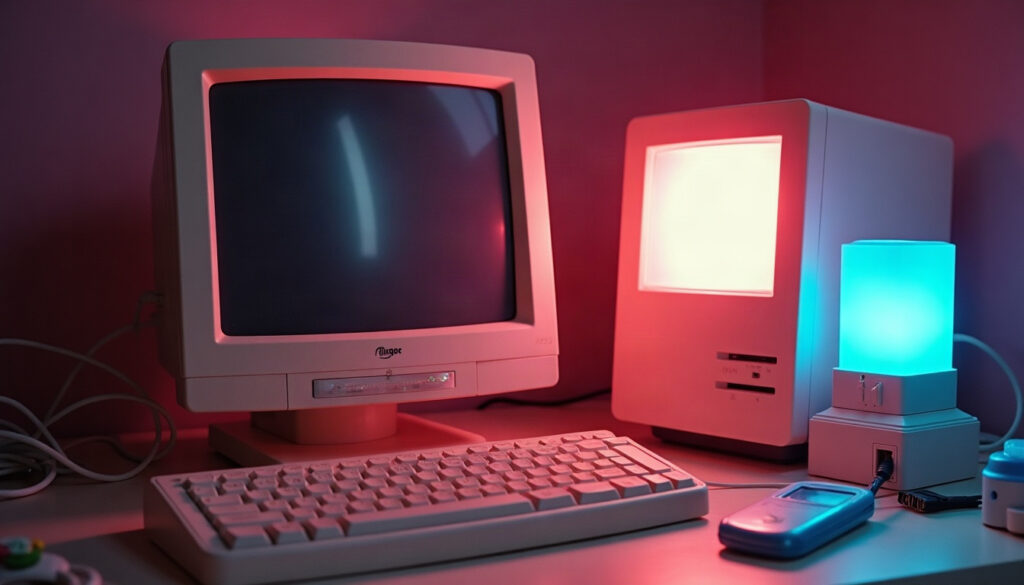
Clack. Silence. The CRT collapses to a bright dot, the tower’s fan winds down, and an unsaved essay goes with it. In my house that was the sound of a tripped breaker, and it usually meant someone had plugged a space heater into the wrong wall.
The gadget pile has grown since then, and it still hangs off the same gray box. Local pages for electrical panel repair Colorado Springs usually cover when a panel needs attention and what a licensed electrician checks. Consider this the nerdy prequel: how the box works, and why it matters more now.
The power strip was a polite fiction
Then
Behind every desk sat a beige power strip with a glowing switch, and I half believed it multiplied electricity. It doesn’t. It splits one wall outlet into six, and everything plugged in shares the same supply.
How it actually worked: the wall circuit has a ceiling, every device draws some of it, and the strip only adds more places to draw from. Think of a splitter on a garden hose: more nozzles, same supply. One hungry device and the whole row can go dark.
Retro vault
An uninterruptible power supply is a battery with a beep. When the wall power dropped, it kept a desktop computer alive long enough to save work and shut down properly. They sat under a lot of desks in the CRT years.
Now
Now the desk holds a laptop, a monitor, a phone, a router, speakers and a lamp, plus whatever the kitchen is running two rooms away. Each device is polite on its own. Together they decide how hard the circuit works.
The garden-hose rule still holds: the supply in the wall sets the flow, not the number of nozzles. Which outlets share a circuit isn’t visible from the room, because that’s decided at the panel, and an electrician can map it. Modern gear rides out short dips better than my CRT did, since laptops and phones carry their own batteries. Routers and desktops still drop out when the circuit does.
Here’s the nerdy bit. One desk draws a modest amount. Put every desk, lamp, charger and kettle on a single circuit and you’ve built a crowd. The panel is where that crowd gets split into rooms, each with its own breaker, so one overloaded room doesn’t take the whole house down with it.
The fuse was a one-time hero
Then
Older houses had a fuse box, and somewhere between the batteries and the tape lived a spare fuse. How it actually worked: a thin strip of metal inside the fuse heats as the current rises, and past its limit it melts and breaks the circuit. Effective, a little dramatic, and single-use.
Retro vault
Before circuit breakers, house circuits were protected by fuses, thin metal elements that melt when too much current flows. A breaker does the same job with a switch that trips and can be reset, and breakers gradually replaced fuses in homes.
You swapped in a new fuse, crossed your fingers and hoped the cause wasn’t still plugged in. The spares lived in a drawer of random objects, which is how people ended up hunting for them with a flashlight at night.
Now
The breaker does the same job without sacrificing a part. A steady overload heats a metal strip until it bends, and a short circuit pulls on a small electromagnet. Either way a spring-loaded latch lets go and the switch snaps off. You get a handle instead of a funeral.
That’s the good news. The less comfortable news is that a breaker which keeps tripping is filing a report, and resetting it again and again is not a fix. These are signs a panel deserves a professional’s look:
- Breakers that trip repeatedly, or won’t stay on
- Buzzing, crackling or a cover that feels hot
- Scorch marks, rust or moisture around the panel
- Lights that flicker or dim for no clear reason
If you smell burning, treat it as an emergency and call your local emergency number. Never open the panel cover yourself. The inside is for licensed electricians, who test what’s there and explain what they found.
The monitor shivered when the fridge woke up
Then
Every so often my CRT monitor would shiver, the lights would dip for half a second, and somewhere in the house the fridge had just started up. How it actually worked: motors draw a big gulp of current to get spinning, then settle down. The gulp is brief, but it tugs on the circuit and you see it in the lights. The dip was over before you could blame anyone, which was probably for the best.
We shrugged. It was the house breathing. I learned to save my work whenever the compressor clicked on, a superstition that worked about as well as most superstitions. Sensitive gear and big appliances shared everything, and nobody ever drew a diagram. A flicker was a free diagnostic signal, and we treated it as entertainment.
Now
Today’s biggest gulp isn’t in the kitchen. An EV charger in the garage draws steadily for hours, which is a different pattern from a motor starting up, and it’s a good reason to ask whether the panel has room for it.
A licensed electrician works out what the house already uses, what the new load adds, and whether the panel can carry both. Sometimes it can. Sometimes an upgrade is the sensible move. Either way, it’s a measurement, not a guess.
Flicker still tells a story. Lights that dim whenever a big appliance starts, or a router that reboots when the microwave runs, are details worth passing to the electrician, because they help narrow down what’s sharing what. Jot down when it happens and which appliance was running.
And that pencil list on the panel door, the one that says “Den,” “Misc” and “???” Once someone has traced what’s what, it deserves a proper relabel.
What we kept, what we lost
| Then | Now |
|---|---|
| Power strip splits one outlet six ways | Circuit planning decides what shares a breaker |
| A UPS buys a few minutes and beeps | Laptop and phone batteries cover short blips |
| Fuse melts and gets replaced | Breaker trips and invites a question |
| Pencil labels on the panel door | Clear labels after a professional traces circuits |
| Fridge starts, monitor shivers | Sensitive electronics share the house with bigger loads |
| Space heater on the computer circuit | EV charger, home office and kitchen all at once |
We kept the basic idea: a circuit has a ceiling, and a safety device guards it. We lost the luxury of ignoring the box, because the load behind it keeps climbing.
Hit save
The habit worth keeping from the CRT years is saving early and often. Today’s version of that habit is giving your electrical panel a checkup before it forces the issue. If yours is old, trips often, or you’re about to add something big, book a licensed electrician to look at it. Save early. Save often. Let someone licensed touch the box. Then tape the date of the checkup somewhere you’ll actually find it.
