

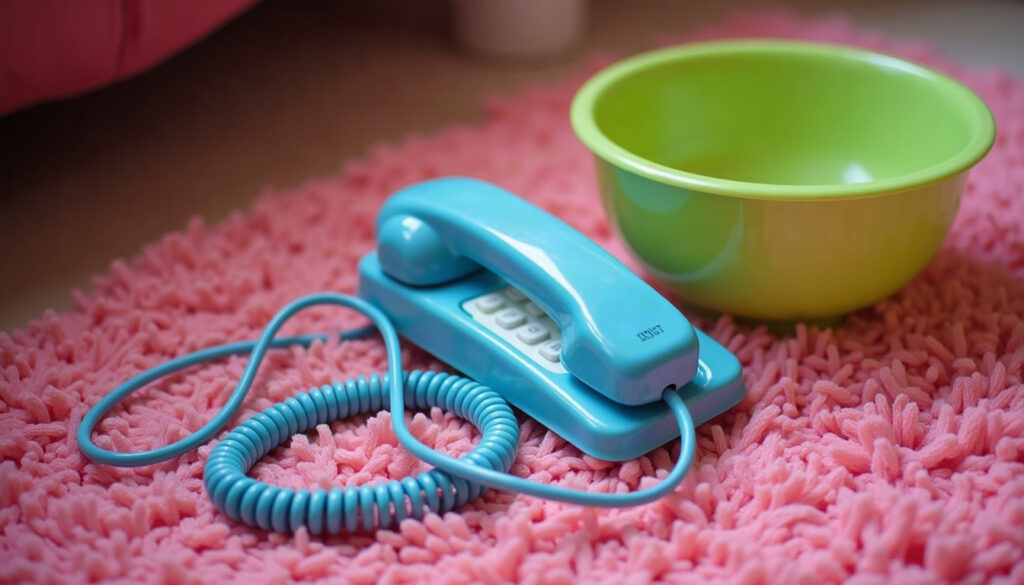
Clunk. Boing. That’s a wall phone’s coiled cord snapping back after somebody stretched it into the pantry for a private call. It never quite reached, and it never quite let go. If you grew up with one, you can still feel the weight of that handset.
The kitchen still runs the house. The gadgets just got quieter and a lot more numerous. Local pages for custom kitchen washington DC projects usually cover layouts, cabinets and counters in detail, and say very little about where the phone charges. I like gadgets to have a place, so let’s talk about that part.
The wall phone had one spot and everybody knew it
Then
The wall phone hung by the kitchen doorway, usually next to a corkboard and a drawer stuffed with takeout menus, pens that mostly worked and a phone book as thick as a brick. Nobody had to ask where the phone was. It was mounted to the wall, and it wasn’t going anywhere.
The build was honest, too. A thick plastic shell, a hook switch that clicked like a light switch, a cord with enough stretch to reach the fridge. You could drop the handset and the worst outcome was a swinging cord and a lecture. Charging? There was nothing to charge. The phone sat there, ready, until somebody tripped on the cord and learned the meaning of the word tension.
Retro vault
Many corded landline phones drew their small amount of power from the phone line itself, not from a wall outlet. That’s why a basic corded phone often kept working through a power cut, long after the lights had gone out.
Now
Today’s phones have no cord and no home. They live in pockets, on sofa arms and on whatever counter is closest, which means they end up beside the sink, next to the stove or under a pile of mail. Nobody planned that. It just happened, one charger at a time.
A kitchen remodel is the rare chance to plan it. A good designer will ask how your household actually uses the room: where the phones land when you walk in, where the tablet stands while you cook, where the speaker sits. Then the layout can give those habits a spot, such as a drawer with a charging area or a shelf at a sensible height, instead of leaving them to chance.
Outlets are the other half. Where they go, how many you need and how they’re protected is work for a licensed electrician, and the local building department can tell you what the rules require. The designer’s job is to ask the questions early. The electrician’s job is to make the answers safe.
The counter was a swap meet for gadgets
Then
Somewhere along the way the counter turned into a swap meet. The cordless phone sat in its cradle by the toaster. Beside it stood a kitchen radio with a telescoping antenna you had to angle just so, and maybe a tiny TV wearing rabbit ears and a wad of foil. Every one of them had a cord, and every cord had its own opinion about which outlet it deserved.
Build quality was a mixed bag. The cordless handset had a battery door that popped open whenever it hit the floor, and plenty of us fixed that with a strip of tape. The radio took a splash from the sink and kept playing. Grease turned every button into a sticky puzzle. Still, you knew what each thing did, because each thing did one job.
Retro vault
Early answering machines recorded messages on small cassette tapes, and a blinking light told you someone had called while you were out. Later models moved to digital memory, and the tape quietly disappeared.
Now
Now one device does all those jobs, and it’s fussy about steam. A tablet propped against the backsplash collects splatter. A phone left near the cooktop gets hotter than it should. Chargers and speakers gather crumbs and spilled coffee like they’re being paid for it. My rule for keeping old gadgets alive applies to modern ones in a kitchen: moisture, heat and grease are the enemies.
That’s where planning pays off. Counter zones, closed storage and a spot for screens that’s well away from the splash area all start on paper, long before anyone picks up a hammer. When you sit down with a kitchen designer, a few questions help:
- Where will phones and tablets sit during the day, and where do they charge overnight?
- Which spots near the sink and the cooktop are too wet or too hot for a screen?
- Who handles the electrical side, and is that person licensed?
- Which permits does the job need? The local building department can tell you.
The table was the office before offices came home
Then
The kitchen table did a bit of everything. Homework at one end, the mail pile at the other, and a paper calendar on the wall covered in handwriting that only the family could read. In some homes the family desktop took over a corner, with a beige keyboard that clacked like a typewriter and a modem that screeched whenever someone wanted to check something online.
It was a shared space in every sense. Whoever needed the computer waited their turn, and whoever was cooking worked around the person typing. Privacy was a rumor. Nobody minded much, though. Dinner smelled good, and waiting is easier with a pot of something on the stove. The only real casualty was the cord, which always ended up snaking under somebody’s chair.
Now
The table is still the office, only quieter. A laptop replaced the tower, and the paper calendar became a shared one on every phone. An island with seating, a corner desk or a table by the window can now handle homework, a video call and a grocery list inside the same hour.
That raises design questions a remodel can answer. Does the seat height suit a laptop, or only a dinner plate? Is there light on the face of the person on a call, or only over the stove? Will a call from the island get drowned out by the dishwasher? Good kitchens answer those with layout, lighting and a sensible choice of materials, so the room works at breakfast and at a nine o’clock meeting.
So bring the real list: who works from the kitchen, when, and with what. A designer can’t plan around habits they never hear about, and neither can anyone else.
What we kept, what we lost
| Then | Now |
|---|---|
| Wall phone with a coiled cord | Phone that charges in a planned spot |
| Phone book in the junk drawer | Contacts in your pocket |
| Rabbit-ear TV on the counter | Tablet on a stand, away from the splash |
| Blinking answering machine | Notification buzz on the counter |
| Paper calendar on the wall | Shared calendar on every phone |
| Family desktop in the corner | Laptop at the island |
We kept the kitchen as the place where everyone ends up, which is still the best thing about it. We lost the one shared phone, the one shared computer and the one shared calendar, along with the habit of putting every one of them in the same spot. The gadgets multiplied, and the places to put them didn’t.
Hit save
The wall phone’s best trick was that it had a place. Everyone knew where to find it, and nothing else needed charging. That’s worth stealing. Before you talk to anyone about a kitchen, walk through the house and write down every device that gets used or charged in that room, then hand the list over along with your wish list for cabinets and counters. The cord is optional. The spot is not.
