

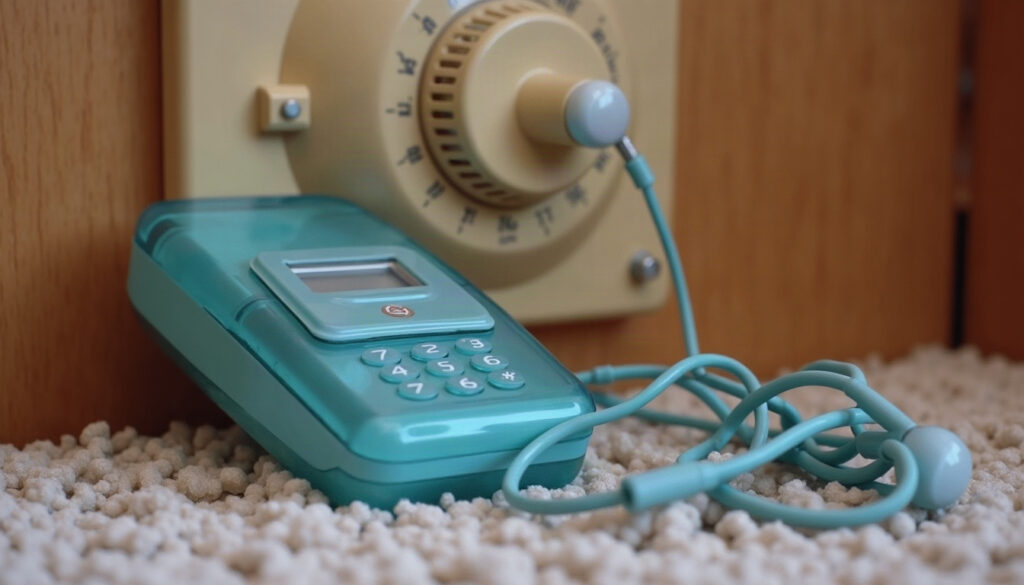
Click. A pause. Then a low whoosh somewhere inside the walls. That was the house answering the little dial in the hallway, and in my memory nobody ever argued with it.
Today the same conversation happens on a phone. For a local company’s own description of what it offers, Learn More. Either way, the story of how home comfort got connected is a good one, so let’s walk it, one wall dial at a time.
One dial on the hallway wall, and we liked it
Then
The round dial thermostat in the hallway had a beige face, a lever and a printed scale. Nudge the lever, hear a faint click, and the house got to work. Nobody asked for a second opinion.
How it actually worked: many of those dials held a coil made of two metals bonded together. The metals grew at different rates, so the coil curled as the room warmed or cooled. That curl tilted a small switch, and the switch told the heating to start or stop. No chip, no screen, no software update. A metal sandwich making one decision, over and over.
Retro vault
The round wall thermostat hung in a great many homes for decades. Many models used that two-metal coil, and some paired it with a tiny sealed glass capsule of mercury that tipped to switch the heating on. That tipping is a big part of the click you remember.
Now
These days the dial is a thermostat with a screen and a schedule. It shows the room temperature, holds a plan for weekdays and weekends, and in many cases talks to your phone, so you can nudge the heat from the couch or from the other side of town.
The mechanism hasn’t changed as much as the interface. It still reads the temperature and asks the system to start or stop. What’s new is the memory and the connection. The old coil had one opinion. The new one has a calendar.
Here’s the part the box rarely stresses: not every system plays nicely with every thermostat. The wiring behind the faceplate differs from house to house, and that’s work for a licensed professional, not a weekend project. A local heating and air company can tell you what your system supports before you buy anything. If an old mercury dial is still on your wall, a pro can swap it and dispose of it properly.
The clock that blinked 12:00 forever
Then
Then came the programmable thermostat, with a small gray display and four buttons that seemed designed by someone who hated the human thumb. You were supposed to enter a handful of time slots a day, with names like Wake and Sleep. I remember standing in the hallway, pressing buttons, and giving up halfway through Tuesday.
How it actually worked: a small electronic clock counted the minutes and compared them with a table of times and target temperatures you had typed in. Match found, setting changed. Simple. The hard part was the typing, which took about as long as heating a bowl of soup.
Retro vault
Early VCRs needed their clocks set by hand, and after a power cut the display went back to flashing 12:00. In a lot of living rooms it simply stayed that way for years. Plenty of thermostat schedules met the same fate.
Now
Today’s version of that schedule lives on a phone, and it forgives you. Move a setting with a thumb, copy Monday to the rest of the week, and switch on an away mode before a trip. Some thermostats can use your phone’s location to notice that the house is empty, and some learn your routine from the changes you make over a few weeks.
The old programmable model was good in theory. The app is good in practice because it’s something you actually open. A schedule only helps if it matches how you live, so give it a week, check the history it keeps, and adjust. Some thermostats can also send an alert when the house is drifting away from your plan, which the old coil could only do by letting you shiver. And if the house still feels wrong after you’ve fiddled with every setting, the thermostat is probably innocent. That’s the moment to ask a technician to look at the system itself.
Summer meant a window unit and a prayer
Then
In the dial-up years, cooling often meant a window air conditioner wedged into a bedroom window. It rattled, dripped, and made one room the only livable space in the house. You carried your pillow there. Movie night happened wherever the cold was. The controls were a dial or two labeled with words instead of degrees, and the real setting was how much noise the family could tolerate.
How it actually worked: a sealed loop of refrigerant picked up heat inside the room and dumped it outside. The loud parts were a fan and a compressor, and the drip was moisture pulled out of the air. Nothing about that loop was meant for tinkering, which is why refrigerant work has always belonged to licensed technicians.
Now
Whole-house cooling is quieter and shares a screen with the heat. Ducted systems move cooled air through vents, and some homes use ductless units that cool one room at a time without ducts. Either way, the temperature you set from the couch is the one the house tries to hold, with no pillow relocation required. That’s the real upgrade: comfort you used to bargain for is now the default setting.
A few habits keep any of it happy, and none of them involve opening a panel:
- Keep vents clear of furniture and rugs so air can move.
- Check the air filter on the schedule in your system’s manual, and swap it when it’s dirty.
- Replace the thermostat’s batteries, if it uses them, before the first heat wave or cold snap.
- Leave anything involving gas, wiring or refrigerant to a licensed professional, and ask about a checkup when the seasons change.
What we kept, what we lost
| Then | Now |
|---|---|
| One dial or lever on the hallway wall | A touchscreen and a phone app |
| A coil of two metals that curled with the temperature | A small electronic brain with a clock and a calendar |
| Walk to the wall and move the lever | Weekly plans, away modes and reminders |
| A clock that blinked 12:00 until somebody cared | A clock that sets itself when connected |
| A window unit, one room at a time | One system, one screen |
| “Is it warm yet?” | A history, alerts and a reading from anywhere |
We kept the wall as the place where comfort lives. We lost the satisfying click and the confidence of a gadget with exactly one job. In return, we got a house that can be told about the weekend in advance.
Hit save
The old dial’s best trick was that it never needed an update, and that plain, one-job simplicity is worth keeping. Pick settings you can explain to a houseguest. This week, check your thermostat’s batteries and your filter schedule, and if you want a second opinion on the system itself, ask a local heating and air professional. Then enjoy never walking to the hallway again. Click.
