

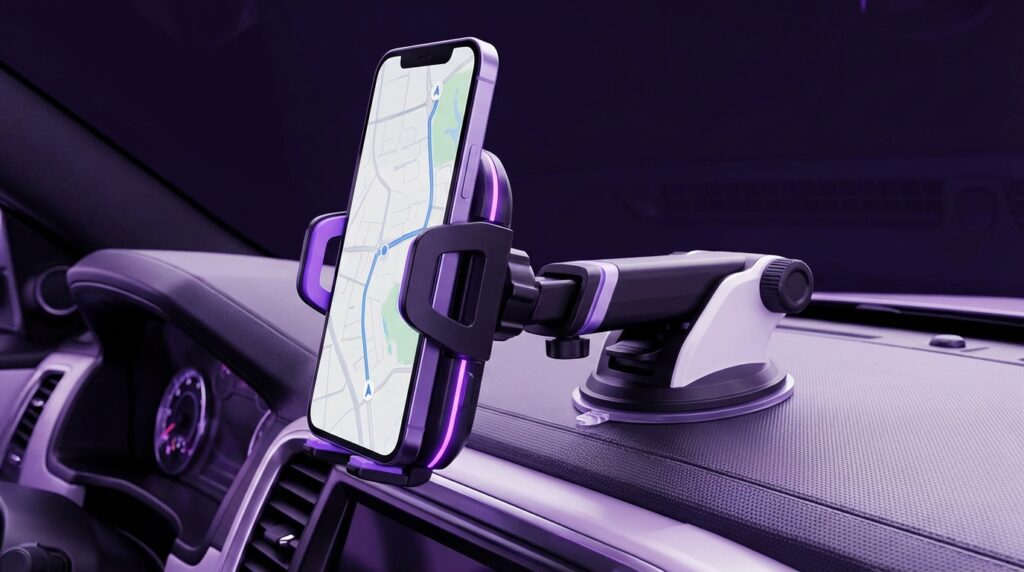
“The weak little suction cup on my first car mount sighed, drooped, and sent my Nokia 6600 sliding down the dash like it was base jumping without a parachute.”
The funny thing is, that tiny, tragic slide is exactly what people are still fighting with in 2025. Different phones, bigger screens, heavier cases, MagSafe rings everywhere now, but the same frustration: why will this thing not stay stuck to my car? You remember that sound, right? The soft thunk of a phone hitting the center console on a hard brake. Back then it was a chunky Symbian brick with a 176 x 208 screen. Now it is a 6.7 inch OLED slab that costs more than your first laptop. The stakes went up. The mounts had to grow up too.
Car mounts used to be an afterthought, the impulse buy hanging next to cigarette lighter chargers in a gas station. Today, they sit right in the middle of how you use CarPlay or Android Auto wirelessly, how you follow Google Maps, how you prop your iPhone 17 or Galaxy S25 Ultra while you listen to old MP3-era playlists on Spotify. The question is not just “Will it hold my phone?” It is “Will it hold my phone through a pothole, in summer heat, with a case on, without peeling my dashboard off in the process?”
The sticky struggle: from clip-on chaos to serious hardware
Back in the mid 2000s, car mounts were basically plastic experiments. You had three main species: the air vent clip that snapped off if you sneezed at it, the suction cup that treated glass like a suggestion not a commitment, and the cup holder monsters that wobbled with every turn.
“Retro Specs: 2005 no-name car mount
Material: thin ABS plastic
Suction: single-stage rubber cup
Max phone weight: around 150 g
Phones it held: Motorola V3, Sony Ericsson K750i, maybe a PDA if you were brave.”
You remember the feel of those early mounts. Hollow plastic, creaky joints, that almost gray-ish clear suction pad that picked up every bit of dust. You pressed it on the windshield, flipped a tiny lever, and for the next fifteen minutes, you felt like an engineer. Then the sun hit the glass, the cabin turned into an oven, and the cup slowly released like a balloon losing air.
Fast forward to now. Phones sit around 200 to 260 grams with cases. Foldables are heavier. MagSafe rings add more metal. Wireless charging coils heat up. Dashboards have more curves and textures. Suction alone on plain rubber just does not cut it anymore.
So the whole category evolved. Gel layers, adhesives that feel almost like mild glue, upgraded clamps, ball joints that do not sag, and magnets strong enough to hold a flagship phone through a speed bump without turning your center console into a mini catapult. The “stick factor” went from an afterthought to the main spec.
Then vs now: mounts grew up with our phones
To see how far this tiny corner of tech came, it helps to compare it to the phones themselves. Think of a classic Nokia 3310 against a current iPhone 17 sitting in the same car.
| Spec | Nokia 3310 (2000) | iPhone 17 (2025) |
|---|---|---|
| Weight | 133 g | ~210 g |
| Screen size | 1.5 inch monochrome | 6.3-6.9 inch OLED |
| Primary use in car | Calling, Snake on long lights | Navigation, music, voice assistant, dashcam apps |
| Mount needs | Simple cradle, light grip | Strong grip or magnet, heat resistance, safe viewing angle |
| Risk if it falls | Minor drop, tough shell | Glass sandwich, camera bump, expensive repairs |
The same way phones went from “call and text” to “pocket computer,” car mounts went from “cheap clip” to “mini rig for your main device.” A good mount in 2025 is part mechanical engineering, part materials science, part understanding how people actually treat their cars.
The physics of sticking: why mounts fail in real cars
Let us get nerdy for a second. The reason your old suction mounts kept falling is not just “bad product.” It is a mismatch between old designs and real-world forces.
Heat and pressure: the enemy of weak suction cups
Inside a parked car, temperatures can pass 60°C. That soft rubber cup you press to the glass relaxes in heat. Air seeps in. The negative pressure holding it against your windshield slowly equalizes. Hit a sharp bump, and that last bit of hold breaks. Cue the slow-motion slide.
Modern suction mounts that actually stick in 2025 usually combine three things:
1. A thicker, softer rubber rim to get a tighter initial seal.
2. A central gel pad that conforms to micro bumps and texture.
3. A locking mechanism that compresses the cup harder against the surface, keeping the vacuum tighter.
When you lock one of these, you feel a stronger “pull.” It is the same kind of satisfaction you got clicking a T9 keypad, just with more physics baked in.
Dash textures: the hidden villain
Older cars had pretty smooth dashboards. Newer models often have textured, soft-touch materials. Great for glare and looks, terrible for simple suction cups.
Plain rubber cups need a very smooth surface. Even tiny peaks and valleys break the seal. That is where gel and adhesives come in. They deform more, filling in those microscopic gaps. You end up with mounts that feel almost sticky, like a mild reusable sticker.
Still, some dashboards are so grainy or curved that they outsmart most mounts that promise “any surface.” This is where proper base plates and 3M-style adhesives changed the game.
The four main mount types in 2025: where “stick” lives or dies
We have plenty of brands now, but under the logo war there are still a handful of basic mount categories. They have all leveled up, but each has its own strengths and tradeoffs.
1. Windshield mounts: the original suction warriors
Remember that huge window real estate you ignored when you were toggling through polyphonic ringtones? That glass is still one of the best surfaces for suction.
Modern windshield mounts that actually stay put usually share these traits:
* Large suction cup with a gel center
* Locking lever that creates tight vacuum
* Short or medium-length arm to reduce wobble
* Ball joint head with solid friction adjustment
The arm length matters more than most people think. A long arm might look nice on the box, but it is a leverage machine. Every tiny vibration at the base gets amplified at the phone. The shorter the distance from glass to phone, the less movement and strain on the suction.
On hot days, cheap cups soften. High-end ones keep their shape better and use materials rated for automotive interiors. That small choice is the difference between your phone floating above the dash all summer or crashing once a week.
“User Review from 2005: ‘Worked great for 2 days holding my Ericsson T610, then fell off the glass when the sun hit it. Phone is fine, mount is in the trash.'”
Compare that to a decent 2025 windshield mount that uses an upgraded gel suction. It may leave a ring on the glass, but it holds through heat waves. Maybe it is nostalgia talking, but that little ring stain feels like a badge of honor.
2. Dashboard mounts: sticking to textured chaos
Dashboard mounts are the real stress test. Cars have curves, seams, ridges, and grains. The mount has to bridge that chaos.
The strongest dash setups usually look like a combination:
* A flat plastic base plate stuck to the dash with a permanent or semi-permanent adhesive pad
* A suction cup that locks onto that base instead of the raw dashboard
* Short, stiff arm or direct ball joint to reduce flex
If you ever used those early “gel pads” in 2010 that claimed to hold anything, you might remember them getting dusty and gross. The newer ones are more refined. They still pick up dust, but many can be rinsed under water and regain grip.
The big choice in 2025 is: are you willing to stick something to your dash that might leave a mark later? Pure suction alone on textured dashboards is still a gamble. The mounts that really stick often lean on serious adhesives, especially from brands that license 3M pads.
3. Vent mounts: simple, but not for every car
Vent mounts started out as little hooks that grabbed onto the fragile slats of your air vents. With a 120 g flip phone, that was fine most days. With a 230 g phone and a thick case, not so much.
Modern vent mounts that actually work use:
* Deep prongs with rubberized surfaces
* Spring or screw tension to grip the fin
* Designs that brace against surrounding trim to distribute weight
The big challenge here is compatibility. Some cars have vertical vents, some horizontal, some circular airplane-style. Some vents tilt easily, some are stiff. A strong magnet and a light mount body help reduce stress on the vent, but if your vents are flimsy, no vent mount will feel perfect.
Vent mounts also put your phone right in the air flow. Great for cooling while charging. Less great if you like blasting heat in winter and do not want your phone baking like a leftover pizza slice.
4. Magnetic & MagSafe-style mounts: magnets grew up
This is where the biggest jump happened over the past few years. The old magnetic mounts were little metal plates that slipped behind your case. They were fine for smaller phones, but always had that fear of “Is this really going to hold?”
Now, with MagSafe and copycat magnetic rings built into cases, mounts can match that ring pattern with strong magnets that cover a larger area. More magnet surface, more holding power.
The magnetic part just solves the phone grip. The “stick to car” part still depends on suction, vent clips, CD slot wedges, or adhesives. But when done right, it feels like cheating. You get:
* One-handed attach and detach
* No arms pressing side buttons
* No width adjustment when you change phones
Wireless charging built into the mount is more common now too. It adds heat, which is why better mounts plan for cooling: vent placement, metal frames, or extra spacing between coil and back plate.
“User Review from 2005: ‘I glued a magnet to my dashboard and put a piece of metal under my phone’s battery cover. Works, but my wife says it looks like I modded the car with fridge parts.'”
Today, the fridge-hack vibe is gone. Clean rings, hidden plates, precision magnets. The concept is the same though: clamp the phone with invisible force instead of plastic fingers.
Why some mounts “actually stick” in 2025
Mounts that survive real-world use across seasons, different cars, and different phones usually win in three key areas: materials, mechanical design, and phone interface.
Material choices: gel, adhesives, and plastic that does not give up
The sticky part is rarely just “rubber” anymore.
* **Gel suction pads**: Soft, slightly tacky, help conform to smooth and semi-textured surfaces. They create a better seal than plain rubber.
* **Adhesive pads**: Often 3M VHB-style foam. They feel like double-sided tape but with more forgiving strips. They hold base plates tight to the dash for years if applied to clean, dry surfaces.
* **High-temp plastics**: Arms and joints that stay rigid when the cabin heats up. Cheap plastic softens, and your phone slowly “nods” down, aiming at your shifter instead of the road.
Then there is the joint between base and phone. A metal ball joint with a solid collar grip beats a hollow, thin plastic joint almost every time. You can feel the difference as you tighten it. It goes from loose to firm without any crunching sound.
Mechanical design: arms, joints, and center of gravity
Even with strong suction, you can ruin a mount’s stability with bad geometry. Think of it like holding an old camcorder out by your fingertips compared to gripping it close to your palm.
Strong designs share a few traits:
* Shorter arms or double-jointed arms that still keep the phone close to the base
* Thick stems with minimal flex
* Support feet or bottom ledges for the phone so the load does not sit only on the magnetic ring or side grips
Phones with cases, PopSockets, or camera bumps change the center of gravity. If the phone sits far out, every bump wants to twist the mount. The better mounts design for that torque.
Phone interface: grip vs magnet vs hybrid
In 2025 you are usually choosing between:
* **Clamp-style**: spring-loaded side arms that you squeeze around the phone. Old school but still popular. These put more stress on the main joint.
* **Magnetic-only**: cleanest user experience, but really depends on a good magnet pattern and proper alignment, especially with chargers.
* **Clamp + magnet hybrid**: less common, but strong. The magnet helps align and hold, the arms back up the rest. Good for heavy phones over rough roads.
Maybe it is nostalgia talking, but there is something satisfying about the click of a clamp closing on a modern phone, the same way T9 keys clicked under your thumbs. But magnets are catching up fast in that “feel” department.
Comparing old mounts to modern ones
To see how far the holding game has moved, imagine a no-brand 2005 mount vs a 2025 quality MagSafe-style dash mount.
| Feature | Car mount, 2005 gas station special | Quality car mount, 2025 MagSafe-style |
|---|---|---|
| Attachment to car | Plain suction cup, no lock | Gel suction with lock lever or 3M-style dash plate |
| Temperature resistance | Softens quickly in heat | Rated for automotive cabin temps, less deformation |
| Phone grip | Plastic jaws, manual screw width | MagSafe ring alignment, auto grip or strong magnets |
| Weight it can hold confidently | Up to around 150-180 g | Up to around 300 g with case |
| Vibration control | Long, thin arm, lots of wobble | Shorter, thicker arm and solid ball joint |
| Wireless charging | None | 15-20 W wireless charging with heat-aware design |
That is the same rough jump you see moving from a 3310 to an iPhone 17. Same category, new rules.
Where people actually want mounts to stick in 2025
The cars changed too. Big touchscreens, built-in CarPlay, weird dash lines. That shapes where a “sticky” mount can even live.
1. Above or next to the infotainment screen
If your car did not ship with wireless CarPlay or Android Auto, you might run your phone screen directly for navigation. The sweet spot is often just above or beside the built-in display. This keeps your eyes in almost the same band as your speedometer and map.
Dash mounts that stick here often share:
* Low-profile base on a ledge or shelf
* Short arm or direct joint
* Magnetic head for quick removal when you park
Here, adhesives often win over pure suction. The plastic around factory screens can be curved or matte, and you might not want a big, circular cup area on show.
2. Windshield lower left or right corner
This is the old reliable zone. Lower corner of the windshield, mount arm reaching inward so the phone floats above the dash edge. Many drivers still trust glass over dashboard plastic.
The key in 2025 is clearance: tinted strips, collision cameras, and rain sensors eat into that glass real estate. Good mounts now list their footprint more clearly, and some even curve around mirror housings.
3. Vent area: center or driver side
Vent mounts remained popular because they do not touch the dash or glass and they are easy to remove if you sell the car. The better ones shift from clamping just one vent fin to bracing against surrounding trim. Less sagging, less risk of breaking a fin.
Phones with MagSafe-level magnets changed vent mount designs too. Many now combine a small mag puck with a very light frame, so the weight on the vent stays low.
4. Cup holder and CD slot outliers
Cup holder mounts found a second life thanks to big center consoles. They are not pretty, but they can be very stable. You sacrifice a cup spot, but you gain a rock-solid base.
CD slot mounts are now a nostalgia pocket. If your car still has a CD slot, that slit is a solid mechanical anchor. A small wedge with a screw spreads inside the slot and locks the mount in place. It feels overbuilt for a simple phone holder, but it works.
“Retro Specs: 2008 CD-slot car mount
Base: expanding wedge
Compatibility: single-DIN CD players
Phones it held: iPhone 3G, HTC Touch Diamond
Bonus: blocked your ‘Now Playing’ track info, but you did not care.”
Heat, weight, and wireless charging: the 2025 stress trio
If there is a common failure pattern in 2025, it is: heavy phone plus wireless charging plus summer sun.
Heat build-up from wireless charging
Wireless charging wastes some energy as heat. Inside a car, that extra warmth can push things past what weak adhesives or cheap suction cups can handle.
Good modern mounts handle this by:
* Leaving air gaps or vents behind the charging coil
* Using metal back plates as heat spreaders
* Keeping the charging pad slightly away from the main adhesive zone so heat does not travel directly
Bad ones cook themselves, soften the suction, then fall off right when your battery hits 85 percent and you hit a pothole.
Heavy phones and bulky cases
If your daily driver is a Pro Max or Ultra model with a thick case and a ring holder, you are putting way more load on the mount than most early design drawings had in mind. That is where magnet-only mounts can struggle unless they have a strong magnetic array.
Clamps give more margin for weird shapes and heavy loads, but stress the ball joints. That is one reason hybrid designs started to appear: small side arms plus a magnet. The magnet centers the phone, the arms keep weight from rotating the joint too much.
How the “stick” evolved from ringtones to smart cars
Think about how you used phones in cars in the early 2000s. You slipped a candybar phone into the ashtray or a cup holder. Calls came in, you maybe put it on speaker and shouted at it. Texting at a light was T9 gymnastics with one hand, elbow braced on the door. The idea of a stand just for the phone felt extra.
Then GPS apps came in. A chunky Nokia N95 held up near the windshield on a plastic arm so you could see that pixel-heavy map. Suddenly, the mount was not a toy anymore. If it fell off, you lost your directions.
Now, in 2025, the car mount is part of your whole driving stack. It slots between your phone, your car’s infotainment, your charger, and your assistant in your ear. It has to:
* Stay stuck under weight and heat
* Keep the phone in a safe line of sight
* Avoid blocking airbags, vents that you need, or cameras
* Deal with bigger screens and more sensors
Maybe it is nostalgia talking, but the quiet hero here is not the bright OLED or the A-series chip. It is the little circle of gel, the hidden foam pad, the vent clip that actually bites onto the fin and refuses to let go, the well-made ball joint that holds that perfect viewing angle day after day.
We moved from ringtones echoing in plastic cabins to entire dashboards glowing with maps and widgets. Through all of that, one thing stayed the same: somewhere on that dash, there is a small piece of hardware whose only job is to stick, and in 2025, the good ones finally do.
