

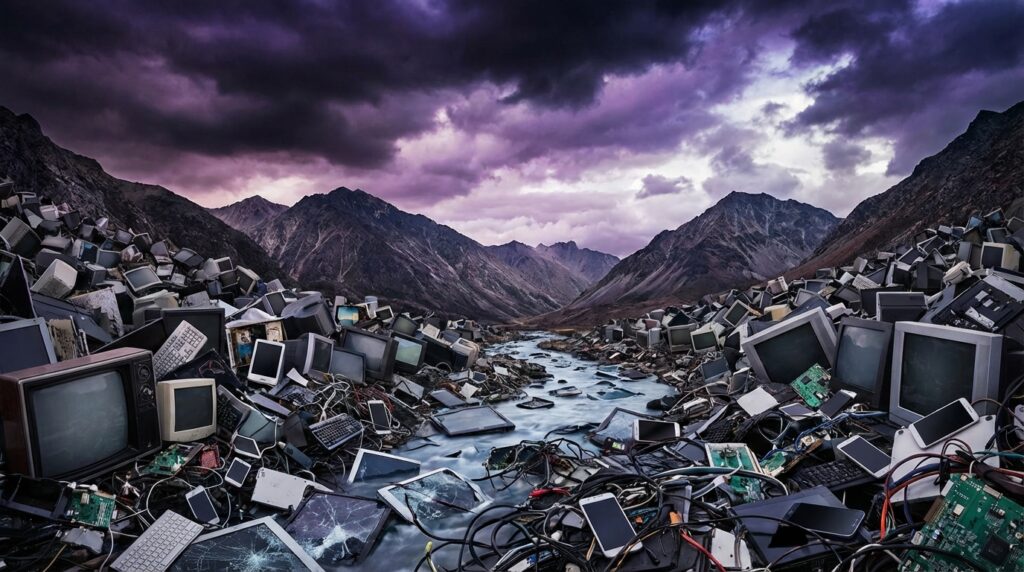
“The soft buzz of a CRT monitor powering off, the faint static on your fingertips, and that chunky beige tower that sounded like a tiny jet every time it booted up.”
You remember that hum, right? Back then, when you shut your PC down, the story ended in your room. You pressed the power button, the fan slowed, the screen faded, and that was it. At least that is what it felt like. Today, when you retire a gadget, its story keeps going. Your old phone, that dead laptop, the smart speaker that stopped updating. They leave your desk, your drawer, your backpack, and slip into a huge global river of electronic waste. E-waste.
And here is the twist. The same things that made those devices feel special to hold in your hand, the weight of the battery, the glass, the smooth plastic, the tiny bright screen, are the things that make them very hard to forget once they leave your life. The copper traces, the rare metals in the chips, the lithium in the battery. They do not just vanish because your upgrade cycle moved on.
The weight of our nostalgia: from drawer phones to dumping grounds
If you reach into that “random tech” drawer in your house, you probably already know how this story starts. There is a candybar Nokia with worn-down keypad numbers, maybe a slider phone with a shaky hinge, a digital camera with a scratched lens, and a power brick that belongs to nothing you own anymore.
Those things have a certain feel.
The Nokia is light but solid, that smooth matte plastic that never felt fragile.
The camera has a cold metal ring around the lens, with a gritty little zoom toggle.
The old laptop charger is heavy for its size, like it is hiding a secret inside the plastic brick.
You can almost hear them when you pick them up. The hollow click of the battery cover on a 2000s phone. The crisp sound of AT keyboard keys. The high-pitched whine of an old CRT TV when you stand next to it.
“User review from 2005: ‘This phone is built like a tank. If I ever upgrade, I’ll keep it as a backup. No way I’m throwing this thing out.'”
Back then, most of us thought like that. “I will keep it as a backup.” “I might need this cable.” “That old PC could be a home server one day.”
Multiply that by billions of people and you get the modern e-waste problem. The digital attic got full, and the overflow went somewhere. Very often, that “somewhere” is a huge informal dump in another country, or a recycling facility trying to pull gold out of circuit boards while managing a cocktail of toxic byproducts.
What counts as e-waste, really?
From ringtones to smart homes: the broad net
E-waste is not just dead phones and broken TVs. It is any device with a plug or a battery that you stop using.
That includes:
– Smartphones and tablets
– Laptops, desktops, monitors, printers
– Game consoles, controllers
– Smart speakers, smart watches, fitness bands
– Routers, modems, external drives
– Headphones, chargers, power banks
– E-readers, old MP3 players, DVD players
– Kitchen gadgets with logic boards: smart fridges, coffee makers, microwaves with touch panels
– Even “dumb” devices hiding tiny chips: LED bulbs, car key fobs, toothbrushes with charging stands
The line between “appliance” and “gadget” blurred. When your light bulb has a firmware update, your trash can easily become e-waste without you noticing.
Why this stuff does not just disappear
Unlike a cardboard box or a glass bottle, a gadget is a mini materials puzzle. Inside one phone you might find:
– Copper in traces and connectors
– Gold in tiny contact points
– Silver and palladium in solder and components
– Cobalt, lithium, nickel, manganese in batteries
– Rare earth elements in speakers and vibration motors
– Plastics mixed with flame retardants
– Glass fused to metals and adhesives
Every part wants a different end-of-life treatment. And all of it is glued, soldered, or welded together in a tight package that was designed for sleekness and durability, not for taking apart.
Maybe that old saying is backwards. The more “premium” a device feels in your hand, the more of a headache it can be when it hits the waste stream.
Then vs now: how our gadgets changed, how our trash changed
To see how we reached this point, you can look at a simple phone evolution. Think about a Nokia 3310 in your left hand and a modern flagship like an iPhone 17 in your right.
The Nokia 3310 was a brick in the best way. The iPhone 17 is a slab of glass and silicon that feels like a tiny piece of the future. They both fit a pocket, they both make calls, but their afterlives are completely different.
| Feature | Nokia 3310 (circa 2000) | iPhone 17 (hypothetical modern flagship) |
|---|---|---|
| Weight | About 133 g, chunky plastic body, removable battery | About 190 g, glass and metal, sealed battery |
| Battery | Removable NiMH or Li-ion, easy swap | High-capacity Li-ion or Li-poly, glued and sealed |
| Screen | Monochrome, low-res, ~1.5 inch | High-res OLED, 6+ inch, laminated glass |
| Average usable life | 5+ years, often longer | 3-6 years, depending on support and user habits |
| Repairability | High. Case pops off, battery out, keypad replaceable | Low to moderate. Special tools, glue, paired parts |
| Materials mix | Mostly plastic, basic metals, simple board | Complex board, multiple antenna systems, rare metals, large battery |
| Typical end-of-life | Kept as backup, handed down, then bin or drawer | Resold, traded in, recycled program, or export as e-waste |
The Nokia was easy to keep going. Keypad broken? Swap it. Battery weak? New battery, two seconds, zero tools. That kept it out of the waste stream for longer.
The modern phone has more reusable value inside, but it is harder to open, harder to fix, and often locked into a fast upgrade treadmill. That combination feeds e-waste, even when the device still works fine.
“Retro Specs: Nokia 3310. SAR value printed on a sticker behind the battery, T9 keypad that felt like a safe, and a charger plug that clicked in with a satisfyingly firm snap.”
So where does your old phone actually go?
When you are done with a gadget, a few paths are possible. Some are pretty good. Some are ugly.
Path 1: The drawer pause
First, the limbo. You stick the phone in a drawer. You tell yourself you will wipe it later, or keep it “just in case.” Months pass. The battery quietly drifts down to zero, and the chemistry inside starts to age. That little slab is not dead, but it is not alive either.
Multiply that behavior across the planet and you get a huge invisible stockpile of inactive devices. Researchers sometimes call this “hibernated” e-waste. It is like a delayed wave. When those drawers finally get cleaned, all that material hits the system almost at once.
Path 2: Resale and reuse
If you trade your phone in to a carrier, or sell it on a marketplace, you are probably extending its life. It might end up:
– In a second-hand store in your city
– In a different country through bulk resale
– As parts for repair shops
This is not waste yet. From an e-waste angle, reuse beats recycling. Every extra year someone gets out of a phone is one less new device that needs to be manufactured.
The tricky part is the tail end. Many of those second-hand devices do not go back into neat recycling flows. They often slip into the informal sector when they finally fail.
Path 3: Official recycling and take-back
Drop-off points at electronics stores, manufacturer take-back boxes, city collection days. These are part of the formal e-waste system.
What tends to happen:
1. Devices are collected and sorted by type: phones, computers, TVs, small devices.
2. Batteries are removed where possible, since they need special handling.
3. Devices are shredded or dismantled.
4. Materials are separated: ferrous metals, non-ferrous metals, plastics, glass.
5. High-value parts (circuit boards, connectors) go to smelters or specialized refiners for metal recovery.
The good side: more material is recovered safely, and harmful outputs are better contained.
The less good side: not all materials are worth recovering from a cost view. Some plastics and mixed materials still end up as low-grade filler or in landfills or incinerators.
Path 4: The export route
Some e-waste is shipped across borders, often labeled as “used goods” or “donations.” On paper, this might sound like reuse. Old machines going to places where they can have a second life. In practice, quite a bit of it is junk that cannot be repaired.
Those devices land in ports in Africa, Asia, and other regions, and then spread into large informal processing centers. Whole neighborhoods can live around tearing them apart.
Inside the informal e-waste world
Breaking things to mine the past
Picture a phone in your hand again. Feel the smooth glass, the cool metal edge, the tiny haptic bump when you press the side button. Now flip that mental image and think about what it looks like when someone wants the metals inside and nothing else.
Common informal methods:
– Burning wires and cables to strip plastic and recover copper
– Cracking open CRT TVs to get copper from coils
– Smashing cases and breaking boards to get to visible parts
– Using crude acid baths to dissolve and separate metals
– Burning circuit boards on open fires to melt solder and expose components
These are low-tech solutions to a high-tech design. They recover some copper and a bit of gold, but they leave behind fumes, contaminated ash, heavy-metal-laden soil, and unprotected workers.
“User review from 2005: ‘Old PCs are almost free now. You can grab a whole tower for parts. So much metal in these things, they must be worth something if you know how to break them down.'”
That comment from the early 2000s was not wrong. There is value inside old electronics. A ton of circuit boards can contain more gold than a ton of ore from a mine. The question is how we get it out without turning the ground around us into a toxic archive.
What actually gets recovered
Even in rough conditions, some metals are too tempting to ignore. Informal recyclers often focus on:
– Copper from wires, coils, motors, and some boards
– Aluminum from frames, heatsinks, and cases
– Iron and steel from chassis and screws
– Gold from connectors, fingers on cards, some chips
Everything else is more guesswork. Plastic housings might be burned or dumped. Glass can shatter and scatter. Batteries might be pried out, punctured, or just thrown in piles, where they leak or catch fire.
There is a strange tension here. The more compact and tightly packed the tech becomes, the harder it is to pull materials back out with simple tools.
What e-waste does to the environment
The slow leak of toxic leftovers
Think about the old gear you grew up with:
– CRT TV with chunky plastic shell
– Tower PC with a steel case and slow fan
– Beige keyboard and ball mouse
Those devices carried traces of lead, flame retardants, and other chemicals that were accepted at the time. When they break down in landfills or informal dumps, those substances do not vanish.
Some common issues:
– Lead and cadmium from old solder, batteries, and CRT glasses can seep into soil and water.
– Brominated flame retardants from plastics can end up in dust and air during burning.
– Mercury from some old switches and screens can disperse into local ecosystems.
Modern gadgets have less of some of those substances because of regulation, but they use more complex mixes of plastics, adhesives, coatings, and composites. Different problems, not always smaller ones.
Fires, smoke, and phantom pollution
You know that sharp smell when a cheap charger overheats or fails? Multiply that by heaps of gadgets.
In dumps where e-waste sits in piles, spontaneous fires can start:
– Damaged lithium batteries can short and ignite.
– Loose plastic shreds can burn like fuel.
– Cables catch and carry flame.
Burning e-waste creates smoke full of fine particles and chemical residues that spread across communities, farm fields, and water sources. Many people in these areas breathe this every day while working around the fires.
The rare metal story: mining in your junk drawer
There is more gold in your gadgets than in some rock
It sounds like one of those bold marketing lines, but for certain metals, it is literally true. Discarded electronics can carry higher metal content per ton than raw mined ore.
Think of one modern phone:
– A few tens of milligrams of gold
– Small amounts of silver and palladium
– Dozens of other metals in tiny fractions
On its own, that is not much. But when you pile millions of phones together in a recycling stream, their insides look more like a very rich mine.
The trouble is access. It is easy to melt a bar of pure metal. It is not so easy to take a glue-sandwich of glass, plastic, copper, solder, chips, and adhesives and split it into clean streams.
Urban mining vs traditional mining
Some people call large-scale electronic recycling “urban mining.” The idea is simple: instead of digging holes in the ground, you mine the material that is already in circulation.
From a materials point of view, that makes sense:
– Metals recycled from gadgets can be used again in new electronics.
– Every gram recovered reduces the need to dig, crush, and process fresh ore.
– E-waste can become a loop instead of a one-way path.
From an engineering point of view, it is tough:
– Devices were not designed for disassembly at scale.
– Many materials are mixed in ways that are hard to separate cleanly.
– Some recovery processes still use high energy and harsh chemicals.
We are stuck between the way gadgets are built now and the way we would like their afterlife to work.
Design choices that decide a gadget’s fate
The power of a battery glued in place
Every time a phone maker decides to seal a battery under glue and special screws, they make a call about its future. That one design move changes:
– How long a phone can stay useful for users who would swap a weak battery
– How safe and easy it is for recyclers to handle the device
– How many devices end up discarded when a fix could have kept them going
You can feel this trade-off in your hands. A unibody phone feels solid, no flex, almost like a single stone. A phone with a removable back creaks a bit, or has a tiny gap around the cover. That tight feel often wins in the showroom, but it adds friction at the end.
Pairing parts, locking repairs
Modern devices often tie parts to each other through software: screens, batteries, cameras, even some chips. Swap a part without the maker’s tools and you might see warnings, reduced performance, or lost features.
From an e-waste angle:
– Less repair means shorter active life.
– Fewer independent repair shops can survive.
– More devices jump from “slightly broken” to “trash” in one move.
It is not dramatic to say that a code line in a firmware file can add years or subtract years from a gadget’s practical life.
Material choices that echo decades later
Flame retardants, mixed plastics, decorative coatings, non-standard screws. These choices often come from cost, style, or short-term performance. Your phone feels less warm, your laptop lighter, your game controller grippier.
Downstream, those choices decide:
– Whether plastic casings can be reused or just burned or buried
– Whether shredding releases more harmful dust
– Whether sorting machines can tell one piece from another
Maybe it was just nostalgia talking, but those old chunky beige PCs, with their boring ABS panels and straight steel frames, are easier for recyclers than some glossy modern gear with soft-touch coatings and complex blends.
The hidden costs you do not see on the bill
Short upgrade cycles
Many people swap phones every two to three years. Not because the phone turned into a brick, but because:
– Software support ends.
– New features feel hard to resist.
– Battery life degraded a bit.
– Camera no longer feels “good enough” next to newer models.
Your hands still know that the old phone works. The screen still wakes, the icons still glow. But the surrounding services, apps, and social pull push you along. That pressure feeds the stream of “premature” e-waste.
The emotional side of our gadgets
There is a softer layer here too. Some devices carry memories. That flip phone with photos from high school. The MP3 player that powered your bus rides. The game console that holds your save files.
Sometimes, that memory layer keeps gadgets out of the waste flow for longer. You keep them in boxes, not because they work, but because you are not ready to throw them out.
That can be both good and bad:
– Good: delays entry into badly managed waste streams.
– Bad: bunches up discarded gear for later, when you or someone else finally clears them out fast and sends them to mixed trash.
The archive of your tech life does not vanish. It just shifts location, from your hand to your drawer to a truck, and then to somewhere your eyes never see.
Then vs now: how we handle e-waste
Let us put “old world” electronics waste next to today’s more digital mess.
| Aspect | Then (early 2000s and before) | Now (smartphone & smart home era) |
|---|---|---|
| Typical devices | CRT TVs, VCRs, tower PCs, basic mobiles | Smartphones, tablets, IoT devices, wearables, smart appliances |
| Material complexity | Fewer plastics, more bulk metals, visible boards | Complex composites, hidden boards, mixed materials |
| Repair culture | Common to fix TVs, PCs, replace parts | Mixed. Some repair, a lot of replacement |
| Formal recycling systems | Limited to some countries, smaller volumes | Growing global systems, still uneven coverage |
| Informal recycling | Smaller-scale, less global trade | Large hubs handling imports, visible health impacts |
| Volume of e-waste | Lower, slower growth | Rapid growth, tens of millions of tons per year |
| Awareness | Most people see electronics as “just trash” | More awareness, still a gap between knowing and doing |
The smart home, the dumb end-of-life
When your fridge is part gadget, part appliance
Look around a typical home now. You might have:
– A voice assistant speaker in the kitchen
– A smart thermostat on the wall
– Connected bulbs in the ceiling
– A Wi-Fi camera at the door
– A smart watch on the counter charging
– A TV with more compute power than an old desktop
Individually, each one feels light. A puck speaker, a slim thermostat, a compact camera. Together, they add up.
Many of these are:
– Hard to open
– Built with custom shapes and mixed glues
– Tied to cloud services that might shut down long before the hardware fails
So you can end up with a physically fine device that no longer does anything useful because the app died or the server went offline. That is one of the strangest flavors of e-waste: hardware that aged out in the cloud, not in your hands.
Disposable smart accessories
Headphones with sealed batteries, cheap wireless earbuds, fitness trackers that are almost cheaper to replace than repair. You know the kind: glossy plastic, tiny pins for charging, no screws in sight.
They often last:
– One or two battery cycles before capacity feels bad
– Just long enough for a promotion cycle or product refresh
From an e-waste lens, these small devices are tricky. They are too tiny and low-value to justify complex disassembly in many cases, but they still carry lithium cells and mixed plastics.
How better recycling actually works
The high-tech side of e-waste
Not all recycling is a guy with a hammer and a fire. Some facilities feel closer to a factory than a scrapyard.
Common stages:
1. **Manual sorting**
Workers pull out obvious batteries, large parts, cables.
2. **Shredding**
Machines chew devices into smaller fragments.
3. **Magnetic separation**
Magnets pull out steel and ferrous metals.
4. **Eddy current separation**
Non-ferrous metals like aluminum and copper are separated using induced currents.
5. **Optical sorting**
Cameras and sensors help classify plastics and other materials.
6. **Refining**
High-value fractions like circuit boards go to smelters or chemical refiners to extract gold, silver, copper, etc.
You can imagine an old phone going through these steps. That smooth slab becomes a rough mix of shards, then slowly separates into streams of copper, steel, aluminum, some plastics, and precious metal bearing dust.
The limits of current systems
Even with good tech:
– Many plastics are contaminated or mixed, so they are hard to reprocess into new high-grade parts.
– Some metals are present in such small amounts that recovering them is not profitable with current methods.
– Hazardous residues still need secure handling and storage.
The result: recycling improves recovery rates and reduces harm, but it does not turn e-waste into a perfect closed loop.
The human link in the chain
Workers at both ends
At one end, you have engineers designing slimmer, faster, glossier devices. At the other, you have workers in both formal and informal sectors tearing them apart.
Their work realities could not be more different:
– Design labs with clean rooms, CAD software, and controlled tests.
– Open-air yards with smoke from burning cables, dust from smashing CRTs, children running around piles of shattered plastic.
Every port, every connector, every glue point is a decision point that ripples all the way to the person who will one day handle that device as scrap.
Communities living with our upgrades
For people living near informal e-waste hubs, the presence of all those broken gadgets is not abstract:
– Contaminated soil where kids play.
– Water sources with traces of metals.
– Air with constant low-level smoke or dust.
It is easy to think of e-waste as stuff “over there,” far from your neighborhood. But many of the gadgets that end up in those piles started life on desks, in bedrooms, and in pockets just like yours.
Retro gear, modern lessons
What old gadgets got right for the planet
Not from intent, but from design habits, some retro tech behaved better at end-of-life.
Think about:
– Removable batteries in phones, cameras, MP3 players
– Standardized chargers like early Nokia barrel plugs
– Devices built to be opened by default for repairs
– TVs and stereos with common screw types and accessible boards
You could argue those traits came from a mix of lower integration and different cost trade-offs. The side effect was better repair and longer life.
“Retro Specs: Early MP3 player. 128 MB storage, one monochrome screen, one AA battery. Weighed almost nothing, but you could pop in a fresh battery from any corner store and keep going for years.”
Comparing that to a sealed, tiny, wireless earbud that you toss when the battery fades says a lot about how design choices changed the afterlife of our gear.
Where old gear still hurts today
At the same time, old CRT monitors and TVs are a headache now. Heavy glass with lead content, plastic shells with certain flame retardants, and limited value in resale or parts.
Those giant boxes piled up in many countries, and only now are some regions catching up with organized take-back and special treatment for CRTs. That backlog is another kind of e-waste echo from our earlier tech waves.
What actually happens when you recycle a phone today
Think of your last smartphone that you dropped in a store recycling box. Its afterlife might look like this:
1. **Collection and consolidation**
The box fills with phones from many users. It gets shipped to a central sorting center.
2. **Data-safe handling**
Some programs wipe or destroy memory chips before processing, often by shredding the entire device.
3. **Pre-processing**
Workers remove visible batteries if they can. Accessories and cases are separated.
4. **Shredding and separation**
The phone enters a shredder. Fragments pass through magnets, eddy currents, and screens.
5. **Refining of valuable streams**
The fraction with circuit board material goes to a specialized facility where metals are recovered using smelting or chemical methods.
6. **Residuals**
Low-value plastics and mixed residues might be downcycled, used as low-grade filler, burned for energy in some plants, or landfilled in controlled sites.
So the glass you once tapped, the aluminum edge that dug into your palm a bit, the stainless steel screws you never saw. Parts of them might live on in new products. Parts might end up as unglamorous filler in construction materials. Parts might sit in a sealed cell in a modern landfill.
The future archive of our gadgets
We are still early in understanding what the full arc of digital hardware looks like over decades. From the first mobile phones to smart fridges, we have had only a few generations of products.
What we do know:
– E-waste volumes keep growing.
– Material complexity keeps increasing.
– Some regions deal with the heaviest loads of discarded devices.
– Design, policy, and user habits all feed into the same stream.
There is a strange poetry in thinking that one day, archaeologists might dig into what used to be our modern dumps and find cross-sections of phones, laptops, and circuit boards the way we find pottery shards now.
All those textures you remember:
– The rubbery feel of a 2006 game controller grip.
– The glossy shell of a candybar phone.
– The faint roughness of a brushed aluminum laptop palm rest.
They will still be there, layered in soil, mixed with the fragments of devices that came after them. An archive of our tech choices, pressed into the ground, waiting for someone to read the story backward.
