

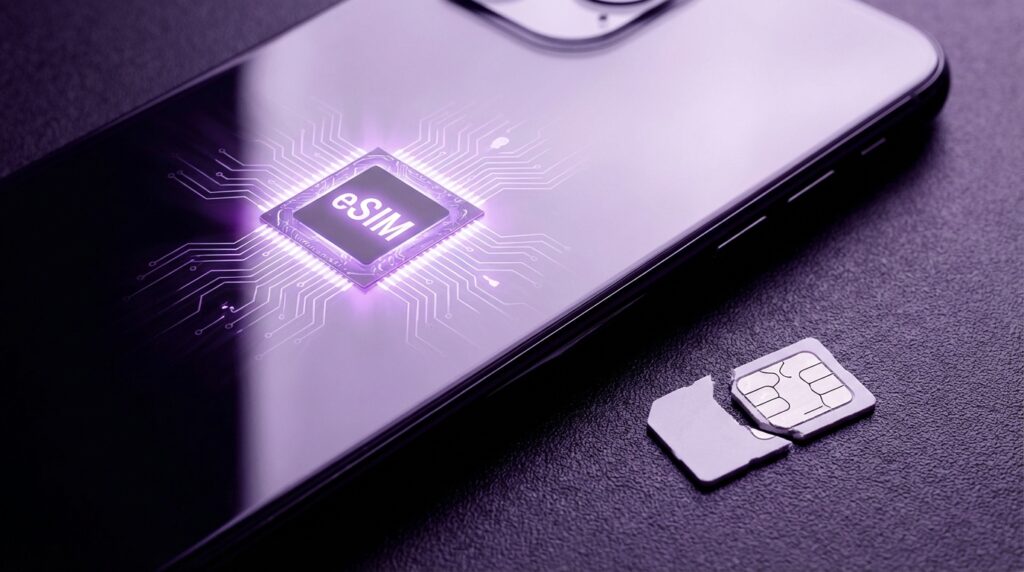
“The sharp snap of a mini SIM breaking out of that credit-card sized plastic, the tiny gold contacts catching the light for a second before you slid it into the side of a Nokia. You remember that sound, right?”
You went from hunting for a paperclip to eject a SIM tray to tapping “Add eSIM” in your phone’s settings. No tiny card, no fragile metal tray, no store visit. Just a QR code and a status bar that flips from “No service” to full bars. That small shift sums up the bigger question a lot of us are asking right now: if your phone can download a mobile plan like an app, is the physical SIM card already done?
The answer is not as simple as “yes” or “no”, because mobile history rarely works in straight lines. It is more like a messy drawer full of chargers, adapters, and phones that still boot if you hold the power button long enough. eSIM sits right in that drawer, next to your first micro SIM and that faded card with your PUK code printed on it.
You probably remember the first time you swapped SIM cards to “change identity”. Maybe you had a weekend SIM because calls were cheaper, or a second card from a different carrier to get a better text bundle. You slid that little piece of plastic into a Sony Ericsson or a Motorola RAZR, snapped the back cover on, heard the battery press into place, and waited through that pixelated boot logo. Nothing felt more “techie” than bringing a dead phone back to life just by moving a SIM.
Back then, the SIM card felt solid. It had weight. Not much, but enough that if one dropped on a tiled floor, you heard the faint tick as it slid under the couch. The phones had texture. Matte plastic that warmed in your hand, slightly raised keypads, and those dot-matrix menus where every icon looked like it came out of a Game Boy game. Your “mobile identity” lived on a tiny card in your pocket.
Now, your identity lives inside a soldered chip on your phone’s motherboard. No contacts to scratch, no tray to lose, no physical slot to protect from water. That is the eSIM: an “embedded” SIM, baked into the phone at the factory, reprogrammable through software.
Maybe it is just nostalgia talking, but there is something weirdly final about a phone with no SIM slot. It feels almost like the moment laptops dropped CD drives. You knew it was logical, modern, clean. You also knew your shelf of old discs just got a little closer to relic status.
What eSIM Actually Is (And What It Changed)
If we strip away the marketing, an eSIM is just a SIM that cannot leave the device. The “SIM” part still does what it always did: it stores subscriber info, authenticates you with your carrier, and tells the network who you are.
The “e” part means:
– The chip is soldered into the phone.
– The profile that used to sit on the plastic card now gets downloaded.
– You can host multiple profiles on one chip.
Where a physical SIM was like a key you could carry around, an eSIM is more like a digital keychain built into the lock itself.
Back in the early 2000s, carriers loved physical SIMs because they were tangible. Branded cards, printed phone numbers, brochures in stores. You walked out with something in your hand. The SIM slot was a gateway only retail staff could really handle for most users.
eSIM ruins that control. You scan a QR code, or your phone auto-activates when you log in with your carrier credentials. Suddenly the friction drops. No store, no waiting for a card to ship. It feels like signing into email, not like registering hardware on a network.
Retro Specs: “My first SIM card was 32 KB. The sales guy said I could store 250 contacts. No one mentioned it would stop working if I cut it wrong trying to make it ‘micro’.” (User, 2005)
The Weight Shift: From Plastic Identity To Digital Profile
Think about how many sizes of SIMs we went through:
– Full-size SIM (credit-card sized, the original monsters)
– Mini SIM (what most people wrongly call “standard SIM”)
– Micro SIM
– Nano SIM
Each shrink felt like progress. Smaller phones, more space for batteries, slimmer bodies. The Nokia 3310 had a big, chunky mini SIM slot. That phone weighed around 133 g, and you could almost feel where the SIM and battery sat behind that solid plastic back cover.
Fast forward to something like an iPhone without a SIM tray. The body is sealed tighter. Water resistance is better because there is one less hole to protect. There is no delicate tray that can bend or snap. The internal layout is more packed. Every cubic millimeter goes to antennas, logic boards, and battery.
The SIM, physically, stopped feeling like a “part” of the phone and quietly turned into firmware.
From Store Counter To Settings Menu: The User Journey Shift
Before we talk about whether physical SIMs are “dead”, it helps to look at the workflow change.
Old path:
1. Choose carrier.
2. Visit store or kiosk.
3. Sign some papers.
4. Receive SIM card.
5. Insert into phone.
6. Restart and connect.
New path with eSIM:
1. Choose carrier (web or app).
2. Scan QR code or tap activation link.
3. Profile downloads.
4. Line appears in settings.
Same end result: your phone is on the network. Very different ritual.
User Review from 2005: “Swapped my SIM into my friend’s phone for the weekend. Same number, all my SMS, my own contacts. His phone but my life. Wild.” (Posted on a mobile forum, 2005)
That “my life follows my SIM” trick was pure magic. On early feature phones, moving the SIM was like logging into your entire persona. Your stored texts, your T9 dictionary, maybe even some contacts lived on that card.
Smartphones broke that spell. Once data moved into the cloud, WhatsApp backed up to servers, Google or Apple synced your contacts, the SIM stopped being the place where your life lived. It just turned into a network login.
eSIM is basically the logical next step of that: if the SIM is no longer your diary, only your network badge, why does it need to be removable?
eSIM vs Physical SIM: Then vs Now
Let us frame this shift in the same spirit as comparing a brick Nokia to a modern flagship.
| Feature | Then: Physical SIM (Nokia 3310 era) | Now: eSIM (Modern flagship, e.g., “iPhone 17”) |
|---|---|---|
| Form factor | Removable plastic card with exposed gold contacts | Soldered chip on motherboard, no user access |
| Activation | Carrier store visit, manual insertion, reboot | QR code, app, or automatic provisioning in settings |
| Number of profiles | One SIM card per line, swap cards to change | Multiple profiles stored, switch in software |
| Travel experience | Buy local SIM, swap cards, keep track of tiny plastic | Buy local eSIM online, activate before landing, no swapping |
| Physical durability | Contacts can scratch, trays can bend or jam | No moving parts, nothing to lose or damage |
| Device design | Dedicated slot, more sealing points, more internal space consumed | No slot, easier sealing, frees up internal volume |
| Carrier control | High; SIM distribution tied to stores and logistics | Shifts toward digital onboarding and remote provisioning |
| User “ownership” feeling | Strong; number feels tied to a physical token | More abstract; line feels like a toggle in settings |
The physical SIM had personality. That tiny card was a relic of the era when phones shipped with printed manuals and removable batteries. eSIM feels more like a background service. Invisible, but always there.
Why Phone Makers Are Pushing eSIM So Hard
If you design phones for a living, eSIM is almost irresistible.
– You gain space. Nano SIM slots, trays, and their metal cages take physical volume inside the device. Removing them gives a tiny bit more room for battery, antennas, or internal bracing.
– You gain structural integrity. One less external cutout means a stiffer frame and fewer paths for dust and water. When phones moved from plastic shells to glass and metal slabs, every port became a stress point during drops.
– You reduce mechanical failure points. SIM trays bend. People shove pins that are too big into eject holes. Contacts get dirty. These are all support headaches.
From the hardware side, eSIM is like the jump from headphone jack to USB-C or wireless audio. It cleans up the design, even if it annoys people who still like physical parts.
The funny thing is, if you look at a teardown photo of a modern phone’s motherboard, the eSIM is just another tiny chip among many. It does not look special. The magic comes from the software stack wrapped around it.
Why Carriers Have Mixed Feelings
Carriers used to treat SIM distribution as part of their grip on the customer. Physical cards meant retail presence, verification, and logistics. Those cards even became marketing surfaces with logos and slogans.
eSIM rewires that:
– Onboarding goes digital. A customer can compare carriers, sign up in an app, and be live in minutes. Less foot traffic into stores.
– Switching gets simpler. In theory, you can flip between plans without touching hardware. That adds churn risk.
– Logistics simplify. No printing, shipping, or storing SIM inventory.
Some carriers leaned hard into eSIM because it removes costs. Others dragged their feet, offered eSIM only for postpaid, or hid it behind support calls.
You can feel that push-pull in how messy eSIM activation flows still are in some regions. Sometimes you get a beautiful app that provisions the profile in seconds. Sometimes you get a PDF with a QR code that feels like a fax from 2010.
Retro Specs: “Got my first 3G SIM in 2005. They told me my old card wouldn’t handle ‘high-speed’ data. It looked the same. I swear they just wanted me to come into the store.” (Forum user, 2005)
We saw this story once already: 2G to 3G to 4G often came with “you need a new SIM” pitches, sometimes real, sometimes marketing. eSIM is another round, but this time the hardware change is hidden inside the phone rather than in your wallet.
Travel, Dual Lines, And Why Power Users Love eSIM
If you spend time in airports, eSIM feels like cheating.
Before:
– Land in a new country.
– Find a kiosk.
– Stand in line, hand over passport, fill forms.
– Receive SIM, poke your phone, keep your old SIM somewhere “safe”.
– Hope you do not lose it.
With eSIM-compatible devices:
– Buy an eSIM plan online hours or days before.
– Land.
– Signal appears. Roaming off, local data on.
You keep your primary number active for calls or messaging apps, while a second eSIM handles cheap local data. The phone quietly juggles both.
For people who run separate work and personal lines, eSIM turns your phone into a multi-identity device without the physical juggling act. Many modern flagships let you hold:
– 1 physical SIM + 1 or more eSIM profiles, or
– Multiple active eSIM lines, depending on the model.
That is the part that feels futuristic. Not that the SIM is “embedded”, but that your phone starts to resemble a network router, managing several logical lines at once.
So, Is The Physical SIM Card Actually Dead?
Short answer in plain language: no, but its long-term future is shaky.
There are pockets of the world where:
– eSIM support is limited or absent.
– Regulatory rules demand physical ID checks tied to SIM issuance.
– Feature phones still sell in high volume, often with basic SIM slots.
– People swap SIMs often to take advantage of local offers or coverage.
In those spaces, pulling the card out is still normal. You might have a family member with a phone that weighs almost nothing, with a glossy plastic back that pops off with a fingernail, the SIM and battery under a single thin cover. That design works, costs less, and needs no QR codes.
At the same time, high-end phones are already coming out in some markets with no SIM slot at all. Apple did this in certain regions. Others will follow, especially where carriers have mature eSIM support.
The pattern looks familiar. Compare it to something like this:
| Feature | Then: Nokia 3310 | Now: “iPhone 17” |
|---|---|---|
| Connectivity | 2G GSM, voice and SMS only | 5G and Wi‑Fi 7, voice, data, VoIP |
| Storage | No internal “GB” concept for users, only contacts and SMS counts | Base models starting at hundreds of GB |
| SIM type | Removable mini SIM, slot under battery | eSIM only in some regions, no slot or tray |
| Battery access | User-removable, click-out plastic cover | Sealed, glued, requires tools to access |
| Ringtone style | Monophonic or simple polyphonic MIDIs | Lossless music clips, streaming tones |
Removable batteries still exist. So do feature phones. So do wired headphones. Physical SIM cards will sit in that same bucket: they will not vanish overnight, but they will drift toward the low end, the specialist devices, the places where cost and simplicity beat sleek design.
Security, Privacy, And Lock-In: The Less Glossy Side
With a physical SIM, there is a certain satisfaction in pulling the card out of a phone. You kill service instantly. For some people, that is not just about network control, but about a sense of privacy.
eSIM makes that more abstract. You are dealing with menus:
– Settings
– Mobile Service
– Remove eSIM
– Confirm
That digital layer introduces a few questions:
– How easy is it to transfer your eSIM from a lost phone to a new one?
– How fast can a carrier kill a stolen phone’s eSIM line?
– How many hoops do you have to jump through to move your number between devices?
The experience varies. Some ecosystems try to make transfer a one-tap process. Others insist on calls, security questions, or store visits.
There is also the question of lock-in. If your entire connection to the outside world depends on a provisioning pipeline controlled by your carrier, and your device does not even have the capability to accept a physical SIM, the carrier relationship becomes more central. They can shape how easy or hard it is to move.
This is not completely new. Number porting rules, device locks, and contract terms were already part of the game. eSIM just shifts that friction from the physical layer (card and slot) into the digital one (profiles and policies).
IoT, Wearables, And Why eSIM Was Inevitable
If you zoom out from phones and look at the rest of the gadget shelf, eSIM starts to feel less like a phone feature and more like infrastructure.
Think about:
– Smartwatches with cellular: there is almost no space for a full SIM slot in a small, curved body pressed against your wrist. eSIM solves that cleanly.
– Connected cars: built-in modems that stay with the car for years, updated remotely, no card for owners to lose.
– Industrial sensors: tiny boards stuck on shipping containers, in fields, or inside machinery, needing long-life connectivity.
In those settings, a physical slot is not just inconvenient, it is a liability. Corrosion, vibration, dust, all attack any moving part or connector. An embedded chip that never exposes contacts is more practical.
Phones just got pulled along by this larger shift. Once the infrastructure for remote provisioning exists at scale for machines, it becomes attractive for consumer devices too.
User Review from 2005: “Imagining a phone without a SIM slot is like imagining a PC without a floppy drive. Oh wait.” (Tech blog comment, 2005)
That comment aged surprisingly well.
What This Means For Your Old Devices
If you still keep an old T9 phone in a drawer as a “backup”, the spread of eSIM raises a small headache: in some future scenarios, your primary line may never have a physical SIM again.
Imagine:
– Your carrier moves you to eSIM only.
– Your new phone has no SIM tray.
– You want to fall back to a Nokia 6310 during a festival or a long hike.
Without some kind of adapter service or special arrangement, that switch becomes tricky. Your old phone wants plastic. Your new network identity lives in silicon that never leaves the main device.
There will be workarounds. Virtual numbers, call forwarding, or secondary low-cost physical SIM plans. But the classic “same number, different phone for the weekend” experience will feel less straightforward.
For collectors and digital archivists, that is a subtle cultural shift. The link between “number” and “object” weakens. Your number rides the network more than it rides a card or a specific handset.
Where eSIM Still Feels Rough Around The Edges
From a pure technology standpoint, eSIM is mature: the standards are set, the chips ship, the provisioning servers run. The roughness lives in the experience layer.
Things that still feel awkward:
– QR codes printed on paper you are scared to lose.
– Carrier portals that only work in certain browsers.
– Confusing messages about whether a line is transferable.
– Lack of consistent tools across Android OEMs and platforms.
On some phones, adding an eSIM feels almost magical. A single tap, a brief spinner, and service appears. On others, you feel like you stepped into a 2003 web portal with three different passwords and a vague SMS confirmation code.
That gap slows the “death” of the physical SIM, because for many regular users, the idea of walking into a store, getting a card, and following a simple insert-and-reboot ritual still feels safer than messing with QR codes and device IDs.
How Manufacturers Are Phasing Things Step By Step
Right now, we sit in a hybrid zone:
– Many phones ship with both: one physical slot plus eSIM support.
– Some regions get dual SIM trays plus eSIM.
– A few premium models in specific markets show up as eSIM-only.
That hybrid period matches patterns we have seen before:
– Laptops with both DVD drive and USB boot support.
– Consoles that played physical discs while also pushing digital downloads.
– Phones that kept headphone jacks for a while after wireless audio got good enough.
You do not yank the old port out immediately. You let users grow comfortable with the new path first.
At the hardware level, the cost of keeping a SIM slot is non-trivial. It is not huge either. It is a trade against other parts: maybe 0.5 mm of thickness, a tiny battery size change, a little more complexity in sealing. As long as enough customers and carriers still want physical SIMs, that trade is acceptable.
As eSIM adoption spreads, those trade-offs start to look less attractive, especially on the flagship end where every fraction of a millimeter and every design element gets scrutinized.
What To Expect Over The Next Few Years
Looking ahead, a realistic path looks something like this:
– Entry-level and midrange phones: keep physical SIM slots for longer, often with hybrid trays that take SIM + microSD. These devices sell in markets where eSIM infrastructure lags or where cost-sensitive users still buy prepaid SIMs from street kiosks.
– Flagship phones: shift further into eSIM-first or even eSIM-only in more regions. Pressure carriers to support full digital provisioning.
– Wearables and IoT: go almost fully embedded. Physical SIM there will feel niche very quickly.
– Carriers: gradually retire physical SIM distribution where regulation and customer behavior allow it, while offering migration tools for people holding onto older hardware.
Physical SIM cards will sit in that strange space between “still everywhere” and “quietly fading”. You will see them in corner shops, with scratch-off top-up vouchers, long after your main phone stopped needing them.
From Click To QR: The Emotional Gap
There is something you lose when you do not handle that little piece of plastic anymore.
The tactile side:
– Breaking the SIM out of its card.
– Sliding it under a metal contact clamp.
– Feeling the tiny resistance as it clicked into place.
The boot sequence:
– Phone logo.
– Network name appearing.
– That buzz when the first “Welcome” SMS from the carrier arrives.
eSIM strips that down to progress bars and silent switches. Clean, fast, very modern. Less theater.
For some users, that is perfect. Connectivity becomes invisible, like electricity: always there, never thought about. For device nostalgics and people who enjoy the physical ritual of tech, it is another object removed from the desk drawer.
Maybe it is just nostalgia talking, but there was a certain comfort in knowing that your digital life could be powered down and pocketed as a card smaller than a postage stamp. eSIM trades that feeling for a different kind of freedom: you can spin up and tear down lines with far less friction, across a growing web of devices, without touching a single piece of plastic.
