

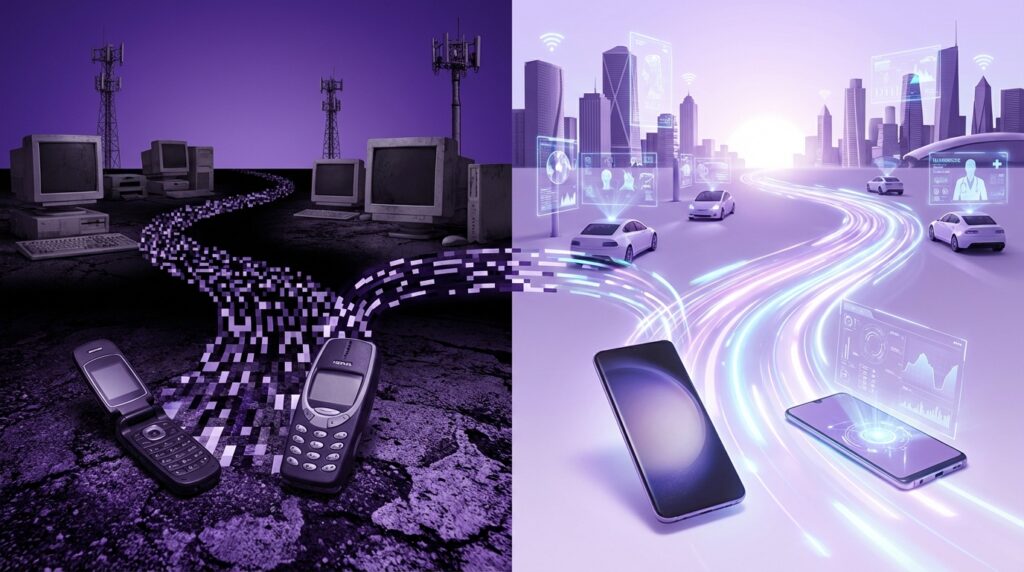
“The soft buzz of a Nokia 3310 on a plastic classroom desk, that tiny green screen lighting up while a single bar of 2G signal tried its best to load a text that weighed less than a blink.”
You remember that sound, right? That muted vibration on a chunky phone that felt like a small brick in your pocket. Back then, “mobile speed” meant how fast your thumb could hammer out a T9 text, not how fast you could stream 4K video. Yet that same weak 2G signal that took forever to load a tiny WAP page laid the tracks for the 5G world where your phone now pulls data faster than a lot of home broadband. What used to be about “Can I send this message?” has become “Can I run my business, my house, my car, and my social life from a device lighter than an old battery pack?”
The jump from 2G to 5G is not just a story of bigger numbers on a spec sheet. It is a story of what you could and could not do at different points in time. From days when a ringtone download felt like a minor miracle to now, where real‑time video calls barely make your phone break a digital sweat, each “G” quietly reset what felt normal.
Back in the early 2000s, 2G phones felt solid in your hand. Thick plastic shells. Removable batteries with that faint metallic smell. Screens that glowed a kind of soft green or blue, with pixels big enough to count if you stared long enough during math class. You were never going to watch a movie on that screen. You were just grateful your SMS with 160 characters got delivered.
Then 3G appeared in the corner of our screens and suddenly the phone was not just a messaging box. It was a tiny window to the web. Slow, clunky, sometimes painful, but still a window. 4G came along and turned that window into a full-blown cinema, office, and arcade. And now with 5G, we are stepping into a phase where the phone is not the endpoint, it is the remote control for everything else.
Maybe it was just nostalgia talking, but there was something pure about waiting 30 seconds for a small image to load over 2G. Yet that slow drip of data is exactly what pushed networks, devices, and our habits toward the kind of speed that quietly runs modern society in the background.
The static crackle of 2G: When text was king
“Retro Specs: Nokia 3310 (circa 2001)
Screen: 84 x 48 pixels, monochrome
Network: 2G GSM
Data speed: About 9.6 to 40 kbps
Storage: Enough for a handful of texts and a couple of ringtones”
2G felt simple. Pick up the phone, type a text, hit send. No spinning wheels, no loading bars, just a tiny envelope icon and maybe a short delay. At its core, 2G was about digital voice and SMS. Before 2G, analog networks transmitted your voice as raw radio waves. 2G digitized that voice, which made calls clearer and networks more reliable.
From a technical angle, 2G networks like GSM usually sat in the 900 MHz or 1800 MHz bands, with narrow radio channels and circuit-switched connections. Data was more of an extra feature, not the main act. With GPRS and later EDGE, you could reach tens of kilobits per second. On paper, that was “mobile internet.” In practice, it was more like a postcard from the internet.
You felt it in your hands. Those early 2G phones were weighty, 100 to 150 grams of dense plastic and metal. No glass backs, no camera bumps. Just a sturdy case with a small, almost square screen, and a keypad that clicked with a sound your thumbs could recognize with your eyes closed. The ringtones were polyphonic at best, and the idea of streaming music over mobile data looked ridiculous.
Still, 2G shifted social behavior. Texting became the preferred way to talk without “talking.” You could send an SMS during class, at dinner, on the bus, quietly narrating your life in short bursts. Flirting, breakups, jokes, late-night confessions, all squeezed into 160 characters. That tiny bandwidth was enough to change how people coordinated, how they showed up late, how they said “I arrived safe.”
Society got its first taste of being always reachable, even if “reachable” just meant a beep and a simple line of text. Businesses started to use SMS alerts. Banks sent balance notifications. Media companies pushed short news headlines. All of that on a network meant for voice calls.
From a speed perspective, 2G’s ceiling made one thing very clear: mobile phones were for text and maybe a crude web portal. Full webpages would crawl down the screen line by line. WAP portals stripped everything down to bare text and tiny black‑and‑white icons. Your thumb would hover while the loading bar crept along, and you could feel every kilobyte make its way to your device.
Those limits are exactly why the next step felt like such a jump.
The 3G moment: When phones started pretending to be computers
“User Review from 2005:
‘I can check my email from the bus now. It is not fast, but it works. Feels like having a mini laptop in my pocket, except the screen is the size of a postage stamp.'”
When that “3G” symbol appeared for the first time on tiny color screens, it felt like a quiet unlock. 3G raised peak speeds into the hundreds of kilobits and later megabits per second. Suddenly, loading a full web page on a phone was not just a cruel joke. It still took patience, but it worked.
On paper, early 3G (like UMTS) promised up to 384 kbps. With upgrades like HSPA and HSPA+, you could push into a few megabits per second. Compared to 2G, that was a leap. The network switched from mostly circuit-switched to packet-switched data, which made it more flexible for things like browsing and email.
In your hand, you felt this jump in the hardware too. Phones got a bit taller, screens gained color, resolutions moved from “iconic blob” to something that could actually show a photo with enough detail to recognize faces. You started seeing 176 x 220 pixels, then 240 x 320, with maybe 65k colors. Still small, still blocky, but very different from those old green displays.
Manufacturers added cameras that could send pictures via MMS, though sending one photo often felt like shoving a full suitcase through a keyhole. You would wait, watch a small progress bar, and hope the network gods were listening.
3G made mobile email normal. People started checking work emails while commuting. That tiny shift extended office hours because now your boss could reach you away from your desk. Social habits stretched. Meetings could be rearranged from the train. Plans changed mid-route. People used mobile web portals for weather, maps, and news long before apps took over.
Business models shifted as well. Operators introduced mobile data packs: per‑megabyte fees, “fair use” limits, then fixed data bundles. WAP portals gave way to fuller mobile sites. Flip phones with glossy plastic shells and small color screens turned into “multimedia phones” with music players, expandable storage, and video playback.
Maybe it was just nostalgia talking, but those first 3G video calls felt almost magical. The quality was terrible, frames per second were low, and the audio would lag, yet seeing someone on a two‑inch screen, in real time, on a moving bus, changed what people believed phones could do.
3G’s real social shift came from perceived speed. For the first time, many people felt that the phone was capable enough to stand in for a laptop in small bursts: checking flight times, booking tickets, doing light research, finding directions. The idea that your main gateway to the web might not be a PC slowly started to form during the 3G years.
4G: When ‘mobile internet’ stopped feeling like a compromise
“Retro Specs: Early 4G Android phone (circa 2012)
Screen: About 4.3 inches, 800 x 480 pixels
Network: 4G LTE
Data speed: Real-world 5 to 20 Mbps down
Storage: 8 to 16 GB flash, plus microSD card”
If 3G made mobile internet possible, 4G made it comfortable. LTE networks pushed peak speeds into tens and later hundreds of megabits per second. Even real‑world speeds in the low double digits were enough for smooth video streaming, fast app downloads, and cloud sync without much friction.
You could feel that power in the way apps behaved. Tap a YouTube link and video started playing without much buffering. Scroll through Instagram and photos loaded almost instantly. Maps shifted smoothly as you panned around with your finger. Suddenly, your phone did not feel like a weaker cousin of the laptop. It felt like the main device.
The physical design of phones mirrored this shift. Larger screens, thinner bodies. Touchscreens took over completely. The click of T9 keys gave way to the soft thud of virtual keyboards. Glass fronts with capacitive touch replaced plastic resistive screens. A 4.7‑inch or 5‑inch display in your hand became the new normal, with resolutions jumping to 720p and then 1080p.
Under the hood, 4G networks used wider channels, better modulation schemes, and more advanced antenna setups. The goal was simple: move more data per second per user and per cell. That extra capacity did not just mean faster speeds, it meant you could have a lot more smartphones streaming, syncing, and refreshing at the same time.
Socially, 4G speed became oxygen for entire business categories:
Streaming culture
Music streaming went from “buffering every few seconds” to “press play and forget.” Video streaming moved from blurry mobile clips to HD content, then live broadcasts. People started watching entire series on the phone, on the train, in bed, in line at the coffee shop.
Creators built careers around platforms that assumed constant, quick mobile access. TikTok, Instagram Stories, live streams on multiple platforms all banked on the idea that viewers could watch and upload everywhere, all the time.
App‑first everything
With 4G, apps no longer tiptoed around limited bandwidth. They pulled large images, live feeds, push notifications, real‑time updates. Food delivery, ride hailing, banking, dating, messaging, payments: all wrapped into slick interfaces that depend on consistent speed.
This changed how cities feel day‑to‑day. People hail rides without planning ahead. Food arrives from kitchens you never visit. Meetings happen over video with coworkers in three time zones. You check your bank balance, invest, pay bills, and split bills in seconds while standing at a crosswalk.
Work and education on the move
4G connected laptops through phone hotspots, turned tablets into work tools, and made remote work more flexible. For some people, 4G was their primary home connection. Workers in remote areas, or people who moved often, relied on tethering or mobile routers instead of cable.
Online learning tools, video classes, and webinars started to feel usable on phones and tablets. The latency and bandwidth were finally good enough to keep audio and video stable most of the time.
From a speed story, 4G erased most of the obvious pain points that 3G users knew too well. Loading bars shrank. Waiting times dropped. People got used to tapping and getting results almost instantly.
That expectation is where 5G enters the picture.
5G: The network your phone uses, but your phone is not the only star
When people hear 5G, they often think “faster.” That is part of it, but 5G is also about how many devices the network can handle and how quickly they can talk back and forth.
In technical terms, 5G brings three core shifts:
1. Higher peak speeds and higher sustained speeds
Under ideal conditions, 5G can reach multi-gigabit per second peaks. Real‑world speeds vary a lot, but you often see hundreds of megabits per second where coverage is strong. That makes tasks like downloading a multi‑gigabyte game in minutes feel normal.
2. Lower latency
Latency is the round‑trip time for data packets. 4G often sat in the 30 to 50 ms range. 5G aims for single‑digit milliseconds in good conditions. That sharper response is what helps things like cloud gaming, AR, and real‑time control systems feel smoother.
3. Massive device density
5G networks are built to support far more devices per square kilometer. Not just phones, but sensors, cameras, cars, wearables, machines in factories, devices in smart buildings. This is where the “society” part gets interesting.
Your phone, in your hand, slightly heavier now with multiple camera modules and larger batteries, becomes the control panel for a wider network of objects. It is not just you and your screen anymore. Behind that 5G logo, there might be elevators reporting their status, streetlights adjusting brightness, traffic sensors counting vehicles, home appliances checking in, and vehicles talking to each other or to road infrastructure.
Then vs now: A quick spec jump cut
| Feature | Nokia 3310 (2G era) | Modern 5G flagship (iPhone 17‑class) |
|---|---|---|
| Network | 2G GSM, GPRS/EDGE data | 5G (Sub‑6 + mmWave), 4G, 3G fallback |
| Typical mobile data speed | 10-40 kbps | 100-1000+ Mbps (depending on network) |
| Screen | 84 x 48 monochrome, non‑touch | 6+ inch OLED, ~2796 x 1290 or higher, touch |
| Weight | About 133 g | About 190-210 g |
| Storage | Roughly enough for SMS and simple games | 128-1024 GB flash storage |
| Battery | 900 mAh removable | 3000-4500 mAh sealed, fast and wireless charging |
| Primary use | Voice calls, SMS, simple games | Work, media creation, streaming, smart home hub, payments |
Looking at that table, the speed jump stands out, but the societal jump hides between the lines. With 40 kbps, you send text and maybe a tiny picture. With hundreds of megabits, you stream, call, coordinate fleets of vehicles, run remote desktops, manage machines, and sync large files.
The device in your hand got heavier and thinner at the same time. The plastic shell turned to glass and aluminum. The screen turned from a tiny glowing window to a slab that fills your palm, edge to edge. The network around it quietly changed what “normal” looks like.
How speed changed daily habits
“User Review from 2011 vs 2025:
2011: ‘I pause YouTube to let it buffer when I am on 3G.’
2025: ‘I got annoyed because my 5G dropped to 4G and my 4K stream took a few seconds to jump to full quality.'”
You can almost track human expectations by watching complaints. On 2G, people felt grateful that a text arrived. On early 3G, they tolerated slow loading. On 4G, buffering became annoying. On 5G, a slight resolution drop or a one‑second lag looks like a problem.
That rising expectation reshaped behavior:
Communication: from words to live presence
2G: SMS and voice calls. Text and audio, asynchronous or linear.
3G: Early video calls, picture messaging, basic mobile email. Add pictures and some live visual presence.
4G: HD video calls, group video meetings, constant messaging with images, GIFs, audio snippets, stickers. The line between personal and work communication blurred.
5G: High‑quality video conferencing, multi‑party calls, AR filters in real time, virtual events on mobile, remote collaboration that treats video as the baseline, not the special case.
Speed turned communication from “send a message and wait” into “be present anywhere.” Families talk across continents in real time with clear video. Remote teams work together from homes, cafes, co‑working spaces, parks. Doctors consult with patients by video, sometimes assisted by connected devices.
Entertainment: from ringtones to full platforms
2G: Ringtones, simple Java games like Snake clones. Short boredom killers.
3G: Basic streaming, downloadable games, early mobile web-based videos. Still limited by bandwidth.
4G: Full streaming platforms for music, TV, film, and games. Live streams, esports, creator‑driven content, social media video.
5G: Higher resolution streams, multi‑angle sports coverage, cloud gaming services where processing happens on servers and your phone is just a screen and input device. AR layers over the real world during events and concerts.
The more the speed, the more time people spend in these services. Commutes that were once quiet or filled with radio now become screen time. Waiting in line becomes scrolling. Social networks learned to fill every small slice of time with content.
Commerce and money
2G: Basic SMS alerts, maybe WAP shopping portals for the brave and patient.
3G: Mobile web stores that work if you are willing to wait. Some early mobile banking sites.
4G: Full shopping apps, one‑tap payments, instant bank transfers through phones, digital wallets that replace cards, ride hailing, food delivery, marketplace apps.
5G: Faster transaction processing, more reliable contactless payments in crowded areas, richer AR‑assisted shopping where you preview products in your space. Businesses rely on cloud‑based POS systems over mobile links at pop‑up stores, markets, and events.
Speed here is trust. The quicker and more reliably a transaction goes through, the more people are willing to use phones for money. Delays and failures cause anxiety. Smooth flows build habits.
Work and industry
2G: Occasional SMS alerts for field staff.
3G: Remote email and basic VPN access on laptops via dongles.
4G: Full remote work for many office workers. Large file transfers. HD video meetings. On‑site workers using tablets and apps for inventory, routing, and reporting.
5G: Factories with connected machines, real‑time monitoring over mobile networks, AR-assisted maintenance, field engineers using AR overlays, logistics firms tracking assets with dense sensor networks, vehicles sending data constantly for fleet management.
Network speed and lower latency allow decisions to be made earlier in the chain. Machines and vehicles “tell” systems what is happening right now rather than through end‑of‑day reports. That shift affects scheduling, staffing, and even city planning.
The hidden part of speed: Latency and reliability
When people talk about Mbps, they often forget the other key parts: latency and reliability. For many applications, shaving milliseconds matters more than raising peak speeds.
Think about cloud gaming. Your input travels from your device to a remote server, which renders the frame and sends it back. If that round trip takes too long, controls feel mushy. For real‑time control of machinery or vehicles, latency is even more crucial. The network needs to respond almost as fast as a local wired link.
5G’s design focuses heavily on improved latency and network slicing. In plain language, that means the network can treat different kinds of traffic differently. A video call might get one slice, a factory control system might get another, each with its own priority and quality-of-service rules.
For society, this matters when mobile networks stop being just “internet on your phone” and start being “the way things connect.” Then speed is not just about your Netflix quality, it is about traffic lights syncing, power grids balancing, and emergency services sharing data from the field in real time.
In your hand, you do not see these decisions. You just feel that apps are snappier or more dependable. A food delivery app updates driver location more smoothly. Navigation updates your ETA with finer granularity. That subtle smoothness, session after session, day after day, reinforces the sense that the phone is a safe place to run important parts of life.
From luxury to expectation: How society absorbed each ‘G’
At each stage, what started as a perk turned into an expectation.
2G speeds made SMS a novelty, then a default. If someone did not text back, it felt like they were ignoring you, not “offline.”
3G speeds made mobile web and email a premium, then an assumption for people with data plans. Being away from the desk no longer shielded you from messages.
4G speeds made the smartphone the main device for many. Companies designed products and entire services assuming strong mobile bandwidth. Being without high‑speed data started to feel like being cut off.
5G is in the stage where some of its key benefits still look like bonuses. Super fast downloads. Very smooth streaming. AR experiences that feel like extras today.
Over time, as new apps and services quietly take 5G strength for granted, those extras will flatten into baseline expectations. Kids growing up with 5G will not think “wow, this streaming is fast” any more than you think “wow, these lights turn on instantly” when you flip a switch. They will simply notice when it fails.
Maybe it was just nostalgia talking, but there is a strange comfort in remembering how long it took to download a small MP3 on 2G or early 3G. That wait time gave every file a kind of weight. Now, swiping through terabytes of content on the move almost empties that weight out.
How mobile speed changed physical spaces
Walk through a city and you can read the impact of mobile speeds without looking at any network map.
Cafes are filled with laptops and phones tethered to 4G and 5G. QR codes on tables route you to menus and payment pages. Digital billboards swap content that may be updated over mobile networks. People scan codes at bus stops for live schedules, sometimes updated in real time.
Public spaces now assume people will scan, pay, validate, show, and confirm through a device in their hand. The way queues form at airports, how tickets are checked at concerts, how scooters are unlocked on sidewalks: all of this is tied to mobile speed.
In the 2G era, you might have walked around with a paper map in one hand and a phone in the other, calling for directions. With 3G, you could painstakingly load a small map tile. With 4G and 5G, GPS navigation with live traffic, incident reports, and alternative routes runs quietly in your pocket. This changed how comfortable people feel exploring new parts of town, booking last‑minute stays, or traveling abroad.
Even payment behavior in small corner stores shifted. A simple 4G terminal or even a phone running a POS app lets merchants accept tap‑to‑pay from cards and phones. That requires dependable, low‑latency mobile connections. If the network is slow, lines build and frustration rises.
In that sense, mobile speed is baked into the way modern cities move people, goods, and money around. It is not just about streaming any more.
Rural and remote areas: Where speed gaps become social gaps
The story is not uniform. Some regions still run largely on 2G or 3G for wide coverage and basic communication. Others have strong 4G in cities and spotty service in rural areas. 5G rollouts often start in dense urban zones, where network capacity pushes are most urgent.
This creates a practical divide. People with good 4G or 5G can access high‑bandwidth services, online learning, remote work, telemedicine, and modern digital financial tools. Those stuck on slower networks or limited coverage may rely on SMS and patchy calls.
You feel this most when you leave a city. Your 5G symbol drops to 4G, then 3G, sometimes 2G or “no service.” Apps that assume constant data start misbehaving. Maps take ages to load new tiles. Streaming fails. Suddenly your phone feels like that older device again, at least from a bandwidth sense.
From a societal angle, faster networks have the power to close gaps but also to widen them if access is uneven. A farmer with good 4G or 5G coverage can use satellite‑aided maps, IoT sensors, and market data tools. Another farmer, without such coverage, cannot compete in the same way.
Speed is not neutral. It enables some behaviors and chokes others. The places where high‑speed mobile data flows freely start to design daily life around it. The places without it often have to build workarounds.
The weight of history in your pocket
Take your current 5G phone and hold it in your hand for a second. Feel the smooth glass, the almost seamless metal frame, the weight hovering around 200 grams. The screen lights up with colors the old monochrome displays could not dream of. Apps open in fractions of a second. Videos play in higher resolution than most living-room TVs had a decade or two ago.
Then picture that Nokia 3310 body in the same hand. Slightly more curved plastic, rubbery keys with a distinct dome feel under your thumb, a tiny screen that barely fits a few words at once. On 2G, that device took tens of seconds to send a small data packet. Your modern phone, on 5G, can move entire libraries faster than that old phone could send a contact card.
“Retro Specs: Network evolution
2G: Kilobits per second, text and basic images
3G: Hundreds of kilobits to a few megabits, web and email
4G: Tens of megabits, full apps and HD streaming
5G: Hundreds of megabits to gigabits, connected everything”
From 2G to 5G, the speed curve looks steep on charts, but the real story plays out in small things: the expectation that messages send instantly, the comfort of seeing a loved one on video, the ability to work from a cabin with only a mobile hotspot, the way your car updates its software over the air while parked in your driveway.
That click of a T9 keypad belongs to a time when networks were slow, but demands were light. The almost silent tap on your glass screen today belongs to a world where networks move data at dizzying rates, and society quietly reshapes itself around that invisible flow.
