

“The tinny mono speaker of my Nokia 6600 crackled as Snake II loaded up, that little pixelated snake already burned into the screen from hours of play while the battery sagged at 2 bars.”
You remember that feeling, right? Thumb pressed into a tiny rubber joystick, the phone a chunky brick in your palm, screen glowing that weird bluish-grey. No graphics settings. No Wi-Fi. Just you, a few kilobytes of game code, and a battery that you hoped would last until the bus ride home.
Now compare that to the phone in your pocket today, humming with a 120 Hz OLED screen, ray tracing in Genshin Impact or Call of Duty Mobile, and a controller paired over Bluetooth like it is nothing special. The question “Mobile gaming vs. console gaming” used to be a joke. The gap was a canyon. Console was where “real gaming” lived. Mobile was what you did when you were bored in a waiting room.
That is not the world we are living in anymore.
The clicks and chirps of Java games are still lodged in the back of your brain, but the silicon in current phones is on the same spec sheets as console SoCs. Your old PS2 discs are fading and scratching, while your phone is quietly downloading 15 GB updates over 5G. Maybe it is nostalgia talking, but watching phones creep closer to console territory feels a bit like seeing that quiet kid from school turn into a professional athlete.
The clunky start: when “mobile gaming” meant Snake and 12‑button pain
Back in the early 2000s, mobile gaming was not a “platform”. It was a value-add. A bullet point on a carrier brochure. You got a game because the phone shipped with it, or because you paid $2.99 plus “standard messaging rates” for a Java app that might or might not run on your weird screen resolution.
Think about the hardware for a second:
– Screens: 128×128, 176×208, 240×320. Washed-out colors. Terrible contrast.
– Input: T9 keypad or a tiny 4-way D-pad. Maybe a mushy joystick that leaned to the left after 3 months.
– Storage: Measured in megabytes. Enough for a couple of ringtones, some JPEGs, and maybe a game.
– Audio: Mono speaker. No bass. Distorted at full volume.
You did not care though. You played Snake, Bounce, Space Impact, Prince of Persia Java ports, and those Gameloft knockoffs that were basically Diet Assassin’s Creed.
Retro Specs: Nokia 6600 (2003)
CPU: ARM9 @ 104 MHz
RAM: 6 MB usable
Storage: 32 MB internal + MMC card
Screen: 176×208, 65K colors
Games: Java MIDP + Symbian titles
At the same time, consoles were flexing. The PS2, GameCube, original Xbox, even the Dreamcast earlier. Those machines had dedicated GPUs, disc storage, 3D worlds, complex input with analog sticks and triggers, and TV output that, at the time, felt crisp and alive.
Consoles were “sit down, commit, play for hours” machines. Mobile was “kill 5 minutes before class” tech.
The gap was not just big. It was structural. Different use cases, different hardware, different expectations.
How the gap started to shrink: iPhone, App Store, and GPUs in your pocket
The iPhone moment: from utility phone to pocket console seed
When the first iPhone dropped in 2007, the pitch was not “mobile gaming”. It was internet in your pocket, multitouch, a real browser. But the capacitive touchscreen, the accelerometer, and later the App Store cracked something open.
Suddenly you had:
– Real-time 3D on a phone.
– A single hardware target for devs.
– A store where distribution was not controlled by carriers.
When Infinity Blade landed in 2010 with Unreal Engine visuals, people started whispering that forbidden line: “This looks like console graphics.” It was not. But compared to Java games, it felt like a jump across generations.
Android joined the party with its own GPU-accelerated devices, and suddenly mobile had a hardware trajectory that looked more like PC and console. Year after year, new chipsets doubled graphics performance, memory crept up, and displays sharpened. The old “crappy phone games” label did not quite fit anymore.
Touch controls: the blessing and the curse
The problem was always input. You can stack as much GPU power as you want into a phone, but a flat sheet of glass will never feel like an analog stick.
FPS games on touch. Racing games with tilt controls. Platformers with virtual buttons that your thumb drifted off every 20 seconds. It worked “well enough” for casual play, but not for high precision.
Consoles never had that problem. Their input story was boring in the best way:
– Physical sticks
– Pressure-sensitive triggers
– Tactile buttons
– Consistent layout
If you grew up with a DualShock or an Xbox controller, your muscle memory is wired into that layout. That is not nostalgia. That is raw UX.
Phones started shipping with better touch sampling, haptic feedback, and more accurate gyros, but the fundamental constraint stayed: no physical reference points for your thumbs.
The real shift came later, when mobile stopped pretending that touch had to do everything.
Silicon wars: when phone chips started looking like console chips
On paper, a current-gen phone SoC is shockingly close to a console APU. Different power budgets, different thermal envelopes, but the building blocks rhyme:
– Multiple CPU cores
– Integrated GPU with hardware ray tracing
– AI/ML accelerators
– Shared memory architecture
You can see it clearly when you compare “then vs now” side by side.
| Spec | Nokia 3310 (2000) | iPhone 17 Pro (hypothetical 2025 class) |
|---|---|---|
| CPU | 8-bit microcontroller @ ~33 MHz | Custom ARM-based SoC, multi-core @ ~3.5 GHz |
| GPU | None (basic 2D) | Desktop-grade mobile GPU with ray tracing |
| RAM | ~8 KB | 8-12 GB LPDDR |
| Storage | Non-expandable, ~1 MB user data | 256 GB-1 TB NVMe-class |
| Display | 84×48 monochrome | Super Retina OLED, 2778×1284, 120 Hz |
| Game Size | Under 50 KB | Up to 20-30 GB |
When you look at those numbers, saying “phones are not real gaming devices” starts to sound like someone complaining that digital cameras will never beat film while holding a 50 MP mirrorless body.
The funny part is that phones are overpowered for what used to count as console games. A midrange phone today could run PS2-era games with headroom to spare. You can see that in emulation scenes where people run GameCube, PS2, even early PS3 titles on handheld devices.
Mobile silicon caught up. The gap moved from “raw power” to “experience”.
Graphics and frame rates: the eye test is changing
When phone games started to look “good enough”
There was a moment when people stopped laughing at phone graphics and started squinting.
Games like:
– PUBG Mobile
– Call of Duty Mobile
– Genshin Impact
– Honkai: Star Rail
– Asphalt 9
These are not “match three” time-fillers. These are big-budget, visually dense, shader-heavy games with high-res textures, dynamic lighting, particle effects, the works.
Hook your phone up to a TV through USB-C to HDMI or AirPlay, pair a controller, set graphics to high, and walk across a field in Genshin. The average person in a living room would have a hard time instantly calling it “not console”.
Frame rate is the other piece. Console marketing loves “60 fps” and “120 fps performance modes”. Phones now run many titles at 60 fps, some at 90 or 120 fps, especially on high-refresh screens. It is not always stable, and thermal throttling is real, but the target is there.
Consoles still cheat with power and cooling
Consoles sit below TVs, plugged into walls. They do not care about 7-hour screen-on time or keeping a 7 mm chassis cool. They care about sustained performance over time.
That is why:
– A PS5 can push 4K with ray tracing at solid frame rates.
– An Xbox Series X can run large worlds with minimal loading thanks to high-bandwidth SSDs and tuned APIs.
Phones spike very high on benchmarks, then slide down as heat builds up. You feel it as the back of the phone gets warm and the frame rate drops.
So the gap in “technical peak” is still there. Consoles win on sustained, high-fidelity output on big screens. Phones win on portability and density: they pack absurd capability into 200 grams of glass and aluminum.
Controls, controllers, and that “feel” of play
Why input still makes consoles feel “serious”
People talk about graphics a lot, but controls are what make games feel “real”.
Consoles have:
– Standardized controllers
– Low input latency
– Haptics tuned for games
– Nice ergonomics
You do not think about it. You just pick up the pad, and your hands know what to do. That comfort is one reason many players still associate console gaming with deeper experiences.
Phones, by default, break that comfort. Finger smears, hands cramping on big screens, thumbs covering the action, virtual buttons with no feedback.
User Review from 2005
“Playing Splinter Cell on my Nokia felt cool for the first 10 minutes, but then my thumb started to hurt and I kept hitting the wrong number key. Fun, but I would never pick it over my PS2.”
That review could have been written today about any complex action game on a phone with pure touch controls.
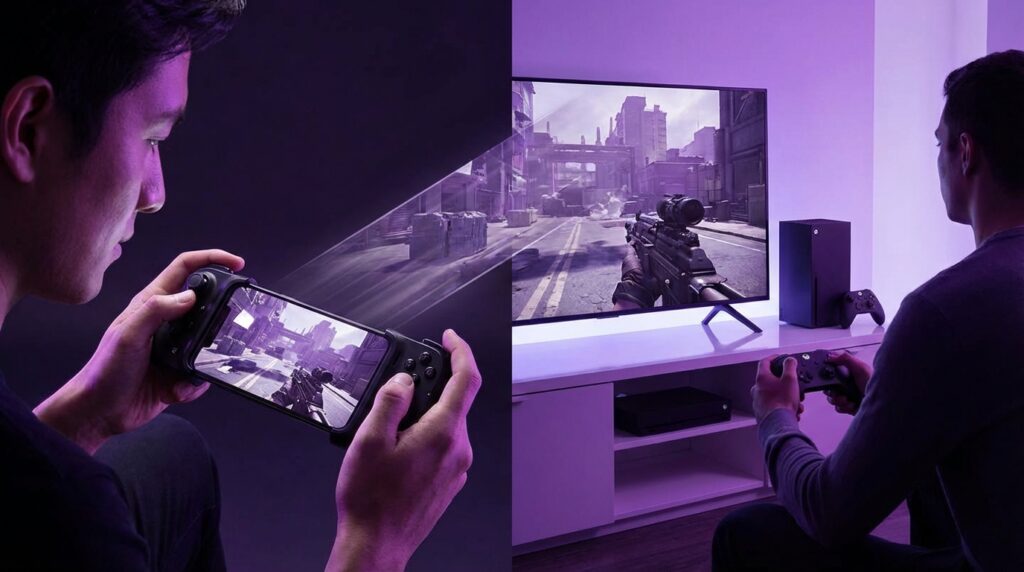
The controller fix: phones piggyback on console hardware
The twist is that mobile did not try to “beat” controllers. It just learned to speak their language.
Now you can:
– Pair an Xbox or PlayStation controller to your phone with Bluetooth.
– Use dedicated mobile controllers like Backbone or Razer Kishi that clamp around the phone.
– Map controls natively in many AAA mobile titles.
This blurs the line a lot. Suddenly your phone feels like a Switch-style handheld. Same layout, same inputs, different OS.
From a player’s perspective, you now have:
– Console-class controls
– Mobile screen and OS
– Access to both native mobile games and streaming services
So that “console feel” is not locked to the box under the TV anymore. It is spreading.
Game design: bite-sized vs blockbuster, and how those lines blur
Session length and context still shape design
Phones and consoles live in different contexts.
Consoles:
– Couch or chair
– TV, sound system or headset
– Longer, more intentional sessions
– Often plugged power
Phones:
– Standing in line
– Lying in bed
– Commuting
– Short, interruptible sessions
Because of that, mobile design historically leaned toward:
– Short levels
– Easy pause and resume
– Simple controls
– Fewer punishments for interruptions
Consoles leaned toward:
– Long missions
– Complex systems
– Cinematic pacing
– Deep narrative arcs
Recently, that gap blurred. Console games started adding:
– Quick resume
– Shorter missions
– Checkpointing every few minutes
Mobile started adding:
– Long story campaigns
– High-complexity systems
– Raids, co-op, ranked ladders
Genshin Impact is a good example. It feels like a console-style RPG living quite happily on a phone, with session structures that support both a 5-minute resin run and a 2-hour exploration binge.
Free-to-play vs premium: the money gap
This is where things still diverge pretty sharply.
Consoles:
– Big focus on $60-70 premium titles
– DLCs and expansions
– Some free-to-play, but not the majority of flagship releases
Mobile:
– Dominated by free-to-play
– Heavy use of gacha, cosmetics, battle passes
– Progress often tied to recurring spending
The average mobile player expects to enter free and possibly never pay. Console players often accept an upfront fee for a complete experience.
This shapes the feel of games:
– Mobile titles sometimes prod you toward daily logins, resource timers, and monetization loops.
– Console titles often focus more on a clean arc from start to credits, even if post-launch content exists.
There are crossovers in both directions. Free-to-play console titles like Fortnite and Warzone feel very mobile in how they monetize and run seasons. Premium mobile titles like Monument Valley or Dead Cells mobile feel very console-like in their one-time purchase structure.
The more these models cross-pollinate, the less that “this is just a mobile game” line holds up.
Online, cross-play, and the idea of “platform” fading
The network pulled everything closer
Once broadband, Wi-Fi, and 4G/5G matured, the distinction between “local box” and “online service” started to fade.
Console gaming used to be:
– Physical discs
– Local saves
– Offline unless you went out of your way
Now it is:
– Cloud saves
– Digital libraries
– Always-connected multiplayer
Mobile, from the early smartphone days, grew up with:
– Permanent connectivity
– Background data
– Push notifications
– Social integration baked in
When cross-play hit things like Fortnite, Genshin, Rocket League, and others, hardware boundaries got weird. You could have:
– A kid on a Switch
– A friend on PS5
– Another friend on a midrange Android phone
– Someone else on PC
All in the same match.
Now ask: who is the “console gamer” and who is the “mobile gamer” in that scenario? Functionally it is just “people with screens and controllers connected to the same server”.
Cloud gaming: console-grade content streamed to your phone
Another crack in the wall came from game streaming:
– Xbox Cloud Gaming
– Nvidia GeForce Now
– PlayStation Remote Play
– Third-party services that let you run PC games remotely
Here is what happens: your phone does not run the game. A server blade somewhere runs it, encodes the video, and your phone acts like a display and input device. With a controller attached, your experience is basically a handheld console, but your hardware is a thin client.
Lag is still an issue depending on connection quality. Compression artifacts can show up. But the concept works.
This is where the “gap” narrative starts to feel dated. If your phone can stream current-gen console games with acceptable latency, the difference is no longer “can this device play real games” but “how and where does it play them”.
Portability vs presence: where each side still has an edge
Where mobile gaming is winning
Portability is the obvious one. You carry your phone everywhere, so your gaming window expands:
– Short bursts throughout the day
– Travel, commutes, waiting rooms
– Bedtime scrolling turning into bedtime gaming
Phones also benefit from:
– Always-on connectivity for co-op, gacha events, and updates
– Tight social hooks: messaging, recording, sharing clips
– Instant payments and low barrier to entry
Another underappreciated factor is demographic reach. Someone who would never buy a console might still spend on a mobile game because the device is already part of their life for communication and work.
Mobile gaming is also winning in pure player hours. Not “hardcore” hours maybe, but raw time spent tapping screens dwarfs time spent on dedicated hardware. That attention keeps money and talent flowing into the space.
Where console gaming still feels stronger
Consoles are still where many people go for:
– Couch co-op with friends physically present
– Big-screen, cinematic experiences
– Audio depth with surround systems
– Long weekend sessions where battery is not a factor
You also get:
– Higher and more stable graphical settings
– Less thermal throttling
– Games designed for that fixed spec, with less need to scale down
There is a psychological element too: picking up a controller and turning on a TV feels like a ritual. You are telling your brain, “Now I am playing.” Phones blur that line because they are also your office, your camera, your messaging hub.
That mental boundary matters for people who want gaming as a separate, protected activity.
Handheld consoles, gaming phones, and the messy middle
Switch, Steam Deck, and the hybrid wave
Nintendo Switch quietly shredded the old “home console vs mobile” line. It is:
– A console on your TV with the dock.
– A mobile handheld in your hands.
Same hardware, same game, two contexts.
Steam Deck and similar devices did something similar for PC gaming:
– Full PC titles
– Controller built-in
– Small screen, big library
These devices sit in that middle zone. Not phones, not living-room-bound consoles, but not “Snake on a tiny LCD” either.
The more players get used to this hybrid feel, the less they care which box is pushing the pixels. They care:
– Does it run the game I want?
– Can I play it where I want?
– Does it feel good in my hands?
That mental model pulls mobile and console closer by default.
Gaming phones: RGB lights on your nostalgia
There is a funny full-circle thing happening with gaming phones:
– Big batteries
– Shoulder triggers
– Active cooling fans
– High-refresh displays
– Aggressive styling
You pick up something like an ASUS ROG Phone and it feels closer to a PSP reboot than a “phone”. But it is fully Android, with notifications and email hiding in the background.
These devices push the idea that “mobile gaming” is not just casual. They target people who care about frame rates, thermal performance, input latency. The same people who tweak console settings and argue about graphics modes.
Retro Specs: Sony PSP (2004)
CPU: 1-333 MHz MIPS
RAM: 32-64 MB
Storage: UMD discs + Memory Stick
Screen: 480×272, 4.3 inches
Inputs: D-pad, analog nub, shoulder buttons
Look at that and compare it to a 6.8 inch OLED Android phone with triggers mapped, a clip-on fan, and 16 GB of RAM. The “handheld console” category did not die. It melted into phones and PCs.
Esports, streaming, and the culture side of the gap
Mobile esports is not a side show anymore
Once you see packed arenas for:
– Arena of Valor
– Mobile Legends: Bang Bang
– PUBG Mobile
– Free Fire
it gets harder to call mobile gaming “casual” with a straight face.
These events have:
– Pro teams
– Sponsorship deals
– Training schedules
– Meta discussions that look very similar to PC and console esports
The mechanics are tuned for touch, but the competitive mindset is the same. High APM, precise positioning, deep teamwork.
Consoles still dominate certain esports verticals, especially fighting games and some shooters, but mobile has carved out robust competitive ecosystems in Asia, Latin America, and other markets where console penetration was weaker.
Streaming and content creation blur hardware identity
From a viewer’s side, watching a creator play on mobile vs console often looks very similar:
– Face cam in the corner
– Overlay, chat, alerts
– Gameplay full-screen
YouTube and TikTok are full of:
– Mobile-only channels grinding gacha banners
– Console players posting clips recorded on built-in share functions
– Creators who switch platforms based on the game or travel
The conversation shifts from “What are you playing on?” to “What are you playing?” The hardware becomes a behind-the-scenes choice, not the lead story.
Preservation, nostalgia, and the weird future of “platform”
Archiving console history on mobile hardware
As a digital archivist at heart, this is where the story gets fun.
Your phone today can emulate:
– NES, SNES
– Sega Genesis, Saturn (with some effort)
– PS1, PS2, PSP
– Game Boy through to 3DS
– Some early PS3 and Xbox 360 titles, depending on hardware and software maturity
That means the entire childhood catalog of multiple generations can, in theory, run on a single slab of glass.
User Review from 2005
“I never thought I would be able to play full-speed SNES games on my phone. Controls are a bit weird, but the fact that it even works is crazy.”
That comment feels naive now, but it captures something: mobile hardware became the default retro console for many players. Your phone is not just competing with consoles for present titles. It is eating their history.
At the same time, console storefronts are going digital, with backward compatibility and classic collections. So console makers are leaning harder into curation, official emulation, remasters, and the premium side of nostalgia.
Where the “gap is closing” really lands
If you strip away marketing labels, you end up with a few axes that matter:
– Performance per watt
– Screen size and quality
– Input style
– Context of use
– Business model
Mobile gaming climbed dramatically on the performance and visual axes. It hacked the input axis with controllers. It owns the “everywhere” context and the free-to-enter model.
Console gaming still owns the stable high-end experience on big screens, with cleaner premium offerings and a stronger ritual around dedicated play.
The gap that used to be hardware-centric turned into something more about taste, habit, and budget.
Phones do not need to replace consoles to feel console-like. They just need to hit that threshold where, when you are deep in a match or a quest, you forget whether you are “a mobile gamer” or “a console gamer” and just respond to the game.
Maybe that moment already happened for you the first time you lost an entire evening to a “phone game” without noticing the clock. Or the first time you beamed your phone to your TV, grabbed your old controller, and your hands slipped into that familiar layout while your eyes looked at a screen driven by a device that, once upon a time, could barely run Snake.
The canyon shrunk to a crack. The bricks in your memory got smarter. And that tiny chirp from your old Nokia speaker is now echoing in Dolby Atmos, whether you are on the couch with a console or curled up in bed with a phone.
