

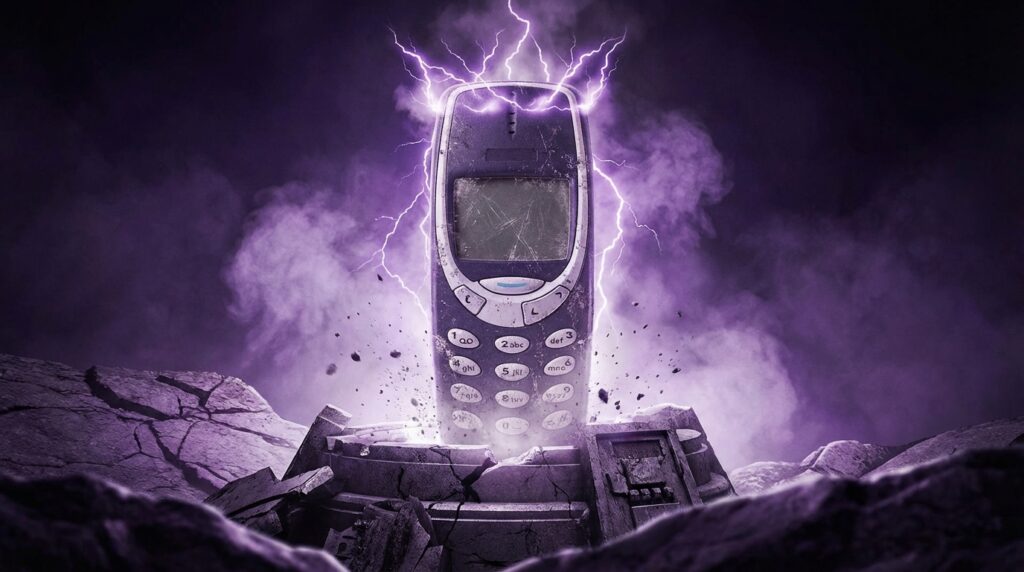
“That sharp little ‘beep-beep’ when an SMS landed on your Nokia 3310 at 2 a.m. It lit up your whole room and your whole night.”
You remember that glow, right? That tiny monochrome screen lighting up like it had something urgent to tell you. No app notification, no banners, no “update available.” Just an SMS from one person who decided to spend their precious 160 characters on you. Today your pocket holds a device that can steer a drone, shoot 4K video, and order you coffee with a thumbprint, but somehow that ancient brick still lives rent free in your head.
The strange thing is, the Nokia 3310 does not need hype. It was not designed to wow you in product keynotes or with cinematic launch videos. It arrived, did its job, survived the floor, the street, sometimes the toilet, and then quietly sat on standby for five days straight. Now you carry a glass sandwich that needs a charger by late afternoon and a case that costs as much as an old feature phone. So why does that little grey (or blue) brick keep popping up in memes, tech talks, and even real conversations about “reliable phones” in an age of folding screens?
Maybe it was just nostalgia talking, but when you held a 3310, you felt something different. It had weight but not too much, around 133 grams that sat perfectly in your palm. The plastic shell felt warm after a long call, the rubber keys had a click you can still hear in your mind. You did not baby it. You tossed it on the bed, the table, the floor of your car. Sometimes it bounced. Sometimes it hit the wall. Almost always, you picked it up, snapped the battery back in if it popped out, and kept texting.
The legend before the legend: how the 3310 showed up
Before the Nokia 3310 became the internet’s go-to “indestructible phone” meme, it was just another entry in Nokia’s long, crowded catalog. The year 2000 was wild for phones. You had candybars, sliders, clamshells, and a wild mix of operator branding and strange antennas that poked your ear. Phones were still phones first. No camera. No app store. Ringtones meant polyphonic dreams or that one ringtone composer you used to tap out the James Bond theme.
Nokia rolled out the 3310 as a successor to the Nokia 3210. It kept the same basic silhouette, but it felt tighter, more refined, a bit more friendly. The front face could be swapped with Xpress-on covers, so you could click on transparent shells, wild colors, tribal patterns, even glow in the dark. That plastic did more than serve style. It took hits. When people talk about the 3310 as “indestructible,” they are not remembering a lab spec sheet. They are remembering that their phone slipped from hoodies, backpacks, bus seats, and somehow kept going.
The specs looked normal for the time. A 84 x 48 pixel monochrome screen. No color. No backlight gradients. Just a firm, greenish glow. 900 mAh battery. GSM network support. The famous Nokia UI with its simple tabbed menu, strong signal bar icon, and the little envelope icon that felt like a reward when it appeared.
Retro Specs: Nokia 3310 (circa 2000)
Screen: 84 x 48 pixel monochrome
Battery: 900 mAh (BL-4C style, removable)
Networks: GSM 900 / 1800
Weight: ~133 g
Ringtones: Monophonic + built-in composer
Storage: Around a few SMS messages before “Inbox full” panic
Games: Snake II, Space Impact, Bantumi, Pairs II
You did not buy it for benchmark scores. You bought it because your friends had it, or your parents trusted it, or your local carrier pushed it as the “reliable” one. Very quickly, it became more than a tool. It turned into a social anchor. If someone said “text me,” they probably expected a 3310 or something very close to it to beep a few seconds later.
Why people started calling it “indestructible”
You have seen the memes. Nokia 3310 embedded in concrete. 3310 as a hammer. 3310 vs nuclear blast. The internet took the real-world reputation of that phone and turned it into a running joke. But for once, the joke rests on something that felt pretty real in day-to-day use.
This phone could take abuse. Not because some brochure promised rugged certification, but because of a few practical design choices that age surprisingly well.
The body that wanted to be dropped
Pick up a modern phone. It is mostly glass and metal. Torsion is its enemy. A single drop can spiderweb a display or warp a corner. With the 3310, you had a thick plastic shell that could flex a bit. The phone had rounded corners, a curved back, and a screen that sat recessed just enough that flat drops rarely killed it.
The front and back covers were removable by design. When you dropped the 3310 hard enough, the battery often flew out. That looked like failure, but it was the opposite. The force was being transferred and released. Pop the battery back in, press the power button, watch the Nokia hands meet in that boot animation, and you were back.
The keypad was another secret weapon. Each key sat in a rubber mat that linked to a single contact sheet. There were no tiny loose keycaps to shatter or twist. You could hammer out T9 messages with your thumb at bus stops, on bikes, while walking. The tactile feedback was mechanical, not haptic. You knew when a button was pressed. No guesswork.
The software that refused to crash
The operating system inside the 3310 was small. It did not push animations or layer complex APIs. It stored your contacts, showed menus, played ringtones, and hosted a few games. Less code, fewer things to fail. The phone booted fast and almost never froze. When something did go wrong, you pulled the battery, plug it back, and in seconds the phone returned like nothing happened.
No random firmware updates. No half-installed patches. The software you got from the factory stayed the software you used for years. That stability is part of why people remember it as “bulletproof.” It did the same thing week after week without drama.
Battery life that spoiled an entire generation
Think of your battery anxiety today. You glance at the percentage more than you check the time. Power banks, fast charging, battery saver modes. Switch back to a 3310 for a week and your whole internal rhythm changes.
A 900 mAh battery in a phone that draws so little power is a different world. Pixel count is low. No background apps. No 4G, 5G, Wi-Fi scanning. Just GSM calls, SMS, the occasional burst of Snake II. You could go 4 or 5 days on a single charge with light to moderate use. Even heavy users usually charged once every 2 days.
That kind of endurance hits deeper than convenience. It changes trust. You trusted that this small block would be alive when you needed it. You could throw it in a bag on Friday, forget it, pick it up on Monday, and still see bars and battery.
User Review from 2005:
“I charge this thing maybe twice a week and that is only because I am paranoid. Signal is strong, it never turns off by itself, and I dropped it down stairs more than once. Screen got a little scratch, but it still works perfect. I keep thinking I should get a color phone, but why bother when this one just works?”
Nokia 3310 vs a modern flagship: Then vs now
You cannot really compare a Nokia 3310 to an iPhone 17 or a current Android flagship on performance. That is like comparing a bike to an electric car. But you can compare priorities. What did we trade away to get what we have now?
| Feature | Nokia 3310 (2000) | Modern Flagship (e.g. iPhone 17) |
|---|---|---|
| Display | 84 x 48 monochrome, ~1.5 inch | 3200+ x 1440 OLED, 6+ inch, high refresh rate |
| Battery life | 4-7 days typical use | 1 day typical use, maybe 1.5 with light use |
| Durability | Thick plastic shell, recessed screen, survives many drops | Glass front/back, prone to cracks, needs case and screen protector |
| Weight | ~133 g, compact, chunky feel | ~180-220 g, thin but wide and tall |
| Connectivity | GSM calls and SMS only | 5G, Wi-Fi 6/7, Bluetooth, GPS, NFC |
| Apps | Built-in only (basic tools + simple games) | App store with millions of apps |
| Repairability | Pop-off cover, removable battery, low-cost parts | Sealed body, glue, expensive repairs |
| Security | PIN lock only, no encryption | Biometrics, encryption, secure enclave |
| Distraction factor | Very low. Calls, texts, a few games | Constant notifications, social media, streaming, games |
When people call the 3310 “king,” what they often miss is that it wins in a category many modern devices barely aim for: reliability over features. Modern phones chase cameras, screens, connectivity. The 3310 chased something quieter: be there, work all the time, stay alive longer than your weekend.
Snake II, ringtones, and the social life of a brick
Let us talk about Snake II. If you held a 3310, you played it. Maybe in class, under the table. Maybe on a long car ride where you were not allowed to sit in front. The physical keys gave Snake a precision that touchscreen clones rarely match. Up, down, left, right. One press, one move.
Snake on the 3310 had a certain rhythm. The small screen meant you could see the entire arena at once. No scrolling, no zoom. You felt the speed ramp up, your thumb tapped faster, the snake grew, the pixel food spawned in awkward corners. That tiny game turned waiting in line into a tiny personal challenge.
Then there were ringtones. You did not just pick one. You created them. The ringtone composer on the 3310 gave you a simple grid to punch notes and lengths. You could copy sequences from magazines or websites filled with “Nokia Composer codes.” You held the phone, entered long strings of digits and symbols, tried it out, tweaked a note, raised a pitch. That tinkering made the phone feel like yours.
Retro Specs: Built-in Games & Fun
Snake II: Grid-based, increasing speed, obstacles in later levels
Space Impact: Side-scrolling shooter with power-ups
Bantumi: Digital version of Mancala
Pairs II: Simple memory matching game
Composer: Manual ringtone creation tool using note codes
Profiles: “Silent,” “General,” “Outdoor,” each with vibration and tone tweaks
The social side of the 3310 was not a feed or a follower count. It lived in small exchanges: “Send me that ringtone,” “What is your Snake score,” “Can I borrow your phone to text someone.” You measured your texting speed in how fast your T9 could keep up. You learned that combinations like “4663” could mean “good” or “home” until context saved the day.
In a time before read receipts, the 3310 had delivery reports. That tiny “Message delivered” pop-up gave you closure. Not analytics. Just a hint that your message reached somewhere.
Hardware design: why this shape worked so well
Take the 3310 in your hand and you notice something your palm understands faster than your eyes. The body tapers gently toward the bottom. The top is slightly broader. Your thumb falls naturally on the central “Navi” key and the two soft keys, then down onto the numeric pad. This brick was not a rectangle with sharp edges; it was more like a softened pebble.
The plastic had a matte texture. Not slippery, not rubbery, just enough grip. That surface aged in an interesting way. Frequent use could polish it slightly, especially around the edges and near the keys. The phone started to bear your wear pattern, tiny scratches, faint discoloration on high-touch areas.
The removable covers opened a path for personalization and for repair. Scratched front plastic? Swap it. Feeling bored of navy blue? Buy a transparent neon green shell at a market stall for a few coins. That shell also served as a sacrificial layer. It took hits and cracks while the core internals stayed safe.
Inside, the layout was simple. A main board, a screen, a battery bay. Fewer thin flex cables, fewer delicate components close to the edge. The antenna was internal, which already felt futuristic compared to the stubby external ones of earlier phones.
The keypad’s design is worth pausing on. Raised, separated buttons with a little ridge. You could text without looking at the screen after some practice. 2 for ABC, 3 for DEF, and so on. Your fingers built muscle memory. Modern glass screens rarely grant that feeling. They support swipes and taps, not discrete, physical clicks.
The cultural meme: from real life tank to internet legend
Where did the “indestructible king” status really explode? Once social media and image boards started sharing exaggerated 3310 stories, the phone went from “reliable old Nokia” to myth. People joked about using it as a weapon, as a doorstop, as a building block for bunkers.
There is a kernel of truth behind those jokes. Many users genuinely kept a 3310 alive for five years, seven years, sometimes longer, with only a battery replacement. In a tech cycle where phones now get replaced in 2 or 3 years, that lifespan feels almost unreal.
Memes work well when they exaggerate something people already half-believe. Dropping a glass flagship from pocket height and watching it shatter once will make any 3310 meme feel suddenly accurate. The internet locked onto the Nokia brick as a symbol of a different design philosophy.
Yet the 3310’s meme fame sometimes hides what made it loved in the first place: it was a friendly device. The interface talked your language. The start-up tone felt familiar from the first day. The menu labels were short, clear words. No cluttered icons fighting for attention.
Why people still buy “dumbphones” and the 3310 reboot
Fast forward to the mid-2010s. Screens are huge, batteries struggle, notifications swarm. A new micro-trend starts bubbling: people looking for “dumbphones” to escape constant pings. Some grabbed old Nokias from drawers. Others bought new feature phones aimed at minimalists or kids.
Nokia (under HMD Global) spotted that nostalgia and brought out a “new Nokia 3310” in 2017. It had a color screen, a basic camera, microSD support, and a more modern body. The core promise was familiar: long battery life, simple OS, strong build, Snake included.
Was it the same as the original? Not really. It was lighter, slimmer, and geared more toward the “I remember this phone” crowd than people needing a serious daily driver. But it underlined something: the 3310 brand still carried weight. People walked into stores and asked for “a phone like the old Nokia, you know, that never breaks.”
The reasons people reach for phones like that today usually fall into a few buckets:
1. Backup phone logic
Keep a 3310 or a similar device in your glovebox or travel bag. When your main smartphone dies, you still have voice and SMS. Long standby makes this tactic viable. You might forget a modern phone dead in a drawer after a week. The 3310 greets you with remaining bars.
2. Digital detox with physical edges
Some users want to step away from never-ending feeds without losing contact with family or work. A 3310-style phone narrows the channel. It lets calls and simple texts through, but nothing more. No quick Instagram check “just for a minute.” Your brain spikes fewer dopamine hits, you regain a sense of control over your attention.
3. Use cases that abuse phones daily
Construction sites, delivery jobs, outdoor work. In places where gloves, dust, and impact are common, high-end glass phones feel like liability. A 3310, or phones inspired by it, can be gripped with grime-covered hands and shrugged off accidental kicks.
User Review from 2005:
“I work in a garage, lots of oil and tools. I dropped this phone in a tray with nuts and bolts, wiped it with a rag, and it still rings loud over the machines. I do not want a camera. I just want to hear my wife when she calls. This does that every time.”
Design lessons the Nokia 3310 still teaches
Look at the 3310 not as a relic but as a design case study. It nails several principles that modern product teams talk about, even if the phone itself predates most UX buzzwords.
1. Single-purpose clarity
The Nokia 3310 was built when “phone” still meant one thing in people’s heads: calls and texts. Every interface element supports that. Big call and end keys, quick access to the phonebook, simple message threading (as much as the storage allowed).
There was no question about the phone’s role in your life. It was your reachable-self in a block of plastic, not your everything-device. When you picked it up, your options were few but clear.
2. Honest durability
The 3310 did not have “rugged” stamped on the box. No IP rating labels. Its toughness came from straightforward decisions: thick plastic, rounded shape, replaceable outer shells, a small recessed display, a simple keypad.
You felt safe with it without any marketing telling you “this is safe.” Modern devices sometimes talk a big game on protective glass and toughened frames, then ship in a form factor that begs for cases and screen protectors.
3. Repair as a built-in feature
A fingernail was enough to open the back cover. You could replace the battery in seconds. If your cover cracked, you swapped it. Local markets stocked third-party shells in cardboard racks.
This ease of repair extends the emotional life of a phone. You feel less guilty about wear and tear when you know it can be refreshed. It also lowers the barrier to holding onto a device longer, which extends trust.
The feel of disconnecting without going off-grid
Use a 3310 today for a few days and your habits start to shift. You stop checking your phone every few minutes because there is simply nothing new there. No news app, no trending video, no group chat blowing up with GIFs. When the phone rings, you answer. When you get a text, you reply. Then you put it down.
Modern tech often tries to reduce friction. One swipe to pay, one tap to post, one tap to join a call. The 3310 introduces the opposite in a weird way: gentle friction. Writing a long message on T9 takes more effort. Doing nothing on the phone feels natural because there is not much to do.
Maybe it was just nostalgia talking, but this constraint can feel strangely freeing. You pay more attention to where you are and who is next to you, because your phone does not fight for that slot.
Why the 3310 is still the “indestructible king” in our heads
Is the Nokia 3310 literally unbreakable? Of course not. You can crush it. You can drown it. You can lose it. Yet when people argue about phones that last, the 3310 is often the first model name that surfaces.
It sits at a sweet spot in tech history. Early enough to be simple and sturdy, late enough to be small, antenna-less, and user-friendly. Old enough that we remember it with some warmth, recent enough that we can still find one in a drawer or buy a used unit online that works.
The phone’s “indestructible king” crown comes from three things holding together:
1. Physical toughness from design choices that favored plastic, curves, and modular parts.
2. Software stability from a focused, compact operating system that did not try to do everything.
3. Emotional durability from years of reliable service, long standby, and familiar sounds, from the Nokia start-up tone to Snake’s quiet beeps.
The modern smartphone world, with all its power, still has a small Nokia-shaped shadow following it. Whenever a screen cracks, a battery fades in a year, or a firmware update bricks a device, someone somewhere mutters, “My old 3310 never had this problem.”
And you can almost hear that distant “beep-beep” right after.
