

“The soft click of a 3.5 mm jack sliding into a Nokia 6600, that tiny ‘thump’ as the connection locked, and then those compressed 128 kbps MP3s filling cheap foam earbuds like it was magic.”
You remember that sound, right? That tiny analog handshake between your phone and your headphones that made your pocket feel like a portable CD player. Back then, we were happy if a track did not skip when someone called in the middle of a guitar solo. Now we are talking about carrying desktop-grade DACs in a pocket, chasing “reference” sound from phones that do not even have headphone jacks anymore.
If you are hunting for high-end DACs for mobile, you are basically doing what we all tried to do in 2005, but with better tools. The story did not change: phone audio has always been a compromise, and obsessives have always tried to escape that compromise with adapters, external dongles, and too many cables hanging from their ears. The difference is that today, the tech actually keeps up with what our ears want.
We went from polyphonic ringtones to DSD files. From a single flimsy DAC chip on the phone’s board to dedicated external DAC/amps that rival hi-fi stacks. The same itch is there: “Can this sound better?” The gear just got smaller, cleaner, and way more serious.
The early days: when ‘audiophile’ and ‘phone’ barely fit in the same sentence
Back in the early 2000s, the idea of “audiophile sound from a phone” sounded like a joke you told in an IRC channel. Most phones treated audio as an afterthought: ringtones, call audio, maybe a mono MP3 player if you were lucky.
Retro Specs: Nokia 6600 Audio (circa 2003)
Format support: MP3, AAC (with third-party apps)
Output: 2.5 mm jack (with adapter to 3.5 mm)
Noise floor: “Noticeable hiss with any halfway decent IEM”
User description: “Good enough on the bus.”
You did not ask about bit depth and sample rates. You just wanted the new Linkin Park track to loop while you stared at a 176 x 208 TFT screen. The DACs inside those phones were integrated, cheap, and tuned for “loud and not terrible,” not neutral or resolving.
Then a few weird outliers appeared. You got devices like:
– Nokia N91 with a focus on music playback and a hard drive.
– Sony Ericsson Walkman phones that tried to bring the Walkman brand into the pocket computer age.
– early smartphones from HTC and others where someone in engineering clearly cared a bit more about audio.
They were still limited by tiny power budgets and basic components, but you could feel that shift: “Maybe this could replace my MP3 player.”
From 128 kbps to hi-res: where mobile DACs started getting serious
Once phones started:
– shipping with more storage,
– supporting FLAC,
– and hooking into streaming apps with higher bitrates,
people started noticing that the internal DACs were now the weak link. It was not the file format anymore. It was the output stage.
Some Android devices flirted with higher quality audio components. A few LG models with ESS Sabre DACs, some Vivo and Sony models that put more effort into analog paths. But they still lived inside noisy phone boards, next to RF radios and low-cost power circuits. The sound improved, but you could always hear the limits if you plugged in headphones that were even slightly revealing.
So audiophiles did what audiophiles always do: they overcomplicated everything.
– Phones connected over USB OTG to small brick DAC/amps.
– Stacks of rubber-banded gear with LOD cables from iPods.
– First-gen USB “dongle” DACs hanging from USB-C or Lightning ports.
It did not look neat, but it started to sound good. Suddenly, the DAC was no longer tied to the phone’s design compromises.
User Review from 2005 (Imagined but very accurate)
“Using my PDA with an external sound card via USB is ridiculous. The cable is bigger than the device. But the background is finally black and bass is no longer mush. Worth it.”
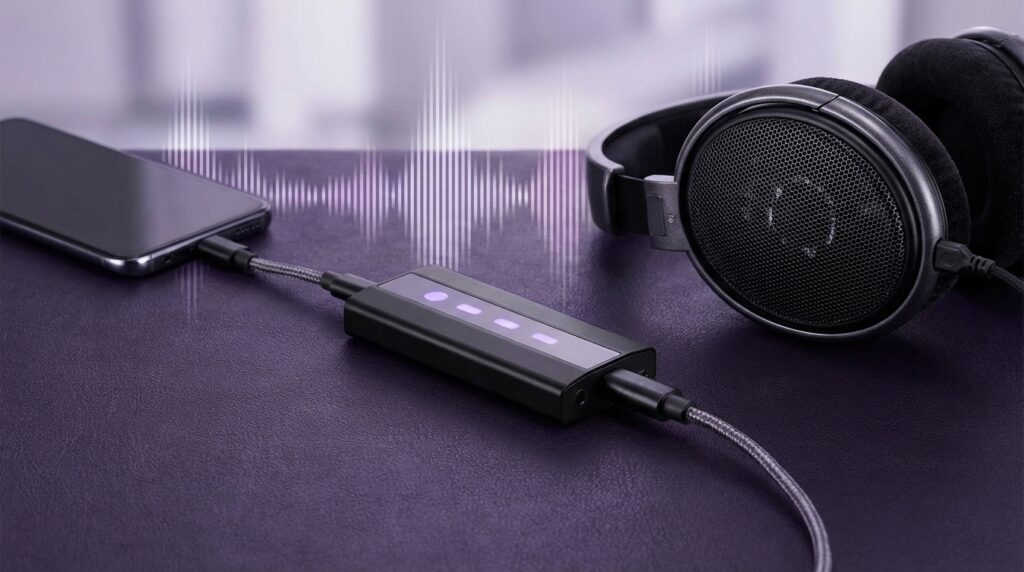
Now we are in a spot where “high-end DAC for mobile” is an actual product category, not a hack. You get tiny sticks, compact bricks, and even Bluetooth DACs that talk to your phone and try to keep quality high while cutting the cable.
What makes a DAC ‘high-end’ for mobile use?
Before we talk models, it helps to clarify what “high-end” even means in your pocket. It is not just cost, and it is not just a fancy chip name in the marketing copy.
For mobile use, a high-end DAC tends to check a few boxes:
1. Noise floor and black background
If you plug in sensitive IEMs and hear hiss when no music plays, that is your noise floor talking. A strong mobile DAC will give you a quiet background even with:
– BA IEMs,
– hybrids,
– or efficient dynamics.
That black background is part of why people describe the sound as “clean” or “effortless.”
2. Power and control
Your phone’s basic dongle might spit out 1 V RMS and call it a day. A serious portable DAC/amp will give you:
– more voltage swing for higher-impedance headphones,
– more current for planar magnetics,
– gain options so you do not blast your ears.
Power is not only about “loud.” It is about control. Bass that does not feel loose, dynamics that do not collapse on busy tracks.
3. Format handling
Modern high-end DACs for mobile handle:
– PCM up to 24 or 32 bit, 192 kHz, often higher.
– DSD, usually up to DSD256 or 512.
– MQA, on some units, for people who still care about that.
Does every listener genuinely hear the jump between 24/96 and 24/192 on the street? Probably not. But headroom never hurt.
4. Output quality, not just chip names
You will see a lot of ESS, AKM, Cirrus, or ROHM DAC chips mentioned. They matter, but the surrounding analog stage, power regulation, and layout matter more.
Two DACs with the same ESS chip can sound very different because:
– one has better op-amps in the output stage,
– one uses better filtering,
– one has cleaner power rails and better grounding.
“High-end” in this space usually means the designer did not cheap out on those boring but critical parts.
5. Practical mobile design
For mobile use, it is not just about sound:
– Size and weight matter in your pocket.
– Heat output matters if you do not want your phone to get toasty.
– Battery draw matters, especially for USB-powered sticks.
– Usability: hardware buttons, volume control, gain switches, screen or no screen.
A DAC can sound great on paper and still be annoying in day-to-day use if you need two extra cables and a rubber band every time you step out the door.
From 3310 to iPhone: Then vs now for mobile audio
Let us anchor this in something concrete. Compare a classic early-2000s phone with a current flagship running through a serious external DAC.
| Feature | Nokia 3310 (circa 2000) | Modern flagship + high-end USB DAC |
|---|---|---|
| Audio output method | Mono ringtones, basic speaker | Digital out over USB-C/Lightning to external DAC |
| Supported formats | Monophonic / polyphonic tones | MP3, AAC, FLAC, ALAC, WAV, DSD, hi-res streaming |
| DAC quality | Integrated, low-cost, phone-only use | Dedicated DAC chip & analog stage, hi-fi grade |
| Output power | Speaker only, low power | Up to hundreds of mW into 32 ohms on high-end portable units |
| Noise floor | Audible hiss and artifacts on any external amp | Near-silent background, suitable for sensitive IEMs |
| User control | Volume steps for calls and ringtones | Hardware volume, gain, filters, EQ via apps |
| Use case | Calls and simple tones | Serious music listening, even studio-grade monitoring |
The gap is absurd. Back then, “mobile audio” meant you accepted tradeoffs without question. Today, phone plus DAC plus decent headphones can sit next to a living room stack and not feel out of place.
Types of high-end DACs for mobile
1. Ultra-portable dongle DACs
These are USB-powered sticks, barely larger than the plug itself, such as:
– AudioQuest DragonFly series,
– Cayin RU series,
– iBasso DC series,
– tiny ESS or Cirrus-based sticks from various brands.
Characteristics:
– Size: around a USB thumb drive or smaller.
– Power: usually enough for IEMs and efficient headphones.
– Power draw: directly from the phone, no separate battery.
– Sound: often cleaner and more open than internal phone audio, but with limits on output power.
You plug them into USB-C or Lightning (often with a small adapter), connect your headphones, and that is it. Simple, clean, minimal.
This is often the first “high-end” upgrade people try, because it keeps the pocket situation sane.
2. Portable DAC/amp bricks
Then you get to the thicker gear that looks like a shrunken hi-fi component:
– Chord Mojo 2,
– iFi hip-dac, xDSD, or Gryphon,
– FiiO Q series,
– Topping G5,
– Questyle handheld units.
These usually have:
– Their own battery.
– More robust headphone outputs (single-ended and sometimes balanced).
– Higher power output for planars and picky full-size cans.
– More physical controls, sometimes screens.
The tradeoff: you are now carrying a phone plus a brick, often connected by a short USB cable. You will feel this in a pocket. On the flip side, you get desktop-like drive and very polished sound.
3. Bluetooth DAC/amps
Then there are Bluetooth DACs:
– FiiO BTR series,
– Qudelix 5K,
– Earstudio ES100,
– various compact Bluetooth receivers with built-in DAC/amp.
These live clipped to a shirt or in a pocket. Phone connects over Bluetooth (LDAC, aptX HD, AAC, etc.), wired headphones plug into the DAC/amp.
The advantage:
– No physical tether phone-to-DAC.
– Convenient for commutes and walking.
The tradeoff: audio is going through a codec like LDAC or aptX. These can sound very good, but purists still prefer a wired USB link for lossless.
Key specs that matter more than marketing
When choosing high-end DACs for mobile, three spec groups matter most.
Output power and impedance matching
You want enough power to drive your gear without distortion. Look at specs like:
– mW into 32 ohms and 300 ohms.
– Max voltage swing (Vrms).
– Output impedance.
If you are using:
– Low-impedance IEMs: you want low output impedance (under 1 ohm is ideal).
– Higher-impedance headphones (150-300 ohms): you need enough voltage.
– Planars: you need current and higher mW figures.
A lot of users underestimate how much headroom helps. Running a DAC/amp at 30-50 percent of its available output tends to sound cleaner than pushing a weak one to 95 percent.
Noise floor and gain structure
If you mainly use IEMs, a quiet noise floor is critical. Even a lovely-sounding DAC can become annoying if there is constant hiss.
Good portable DACs solve this by:
– providing low-gain modes,
– designing analog stages with low self-noise,
– using well-regulated power sections.
If you swap between IEMs and full-size cans, gain switches are your friend. Low gain for sensitive gear, higher gain when you plug in big drivers.
File support and platform friendliness
You want the DAC to:
– play nice with your OS (Android, iOS, Windows, macOS),
– avoid driver drama for basic use,
– support the formats you care about (hi-res PCM, DSD, maybe MQA if you are in that ecosystem).
On mobile, some apps bypass the OS mixer and talk directly to the DAC (bit-perfect playback) using their own audio engine. Examples: USB Audio Player Pro on Android. This can let you push native sample rates to the DAC rather than resampled streams.
How phones behave as digital transports
One weird twist with modern setups: the phone is not the audio source in the traditional sense anymore. It is more like a transport or streaming front end.
Your phone:
– pulls audio from local storage or streaming apps,
– sends digital data over USB or Bluetooth,
– leaves the analog job to the DAC/amp.
The quality of the phone still matters in a few ways:
– USB stability: some phones handle USB audio better than others, with fewer dropouts.
– Power management: some brands are aggressive with background app killing, which can cause issues.
– RF interference: poor shielding can sometimes leak noise into USB lines. Good DACs fight this with isolation, but it is still a factor.
There is a reason some people still love dedicated digital audio players: they are built from the ground up around audio, not as phones with audio tacked on. But for most users, a good phone plus high-end DAC is already beyond what they can hear as a clear limitation.
Use cases: who actually benefits from high-end DACs on mobile?
1. The streaming audiophile
If you live inside Tidal, Qobuz, Apple Music, or similar, and you pay for hi-res tiers, you are wasting that tier with basic on-board audio.
A high-end DAC:
– lets you hear more space and air around instruments,
– improves separation in complex tracks,
– cleans up bass texture.
Maybe it is partly expectation bias, but there is a reason people stick with these upgrades even after the honeymoon period.
2. The IEM collector
If you collect IEMs that cost more than some laptops, pairing them with a cheap dongle is like buying a high-performance car and filling it with low-grade fuel.
You care about:
– noise floor,
– output impedance,
– microdetail.
A high-end DAC/amp lets your IEMs show their actual tuning and technical limits, instead of being held back by a weak source.
3. The planar headphone user on the go
Some planars are more efficient now, but they still like current and control. Running them straight from a phone is like asking a scooter to tow a trailer.
A higher-power portable DAC/amp step:
– tightens bass,
– keeps dynamics lively at normal listening levels,
– avoids harshness from clipping or thermal strain.
4. The casual listener with good ears
Not everyone in this group calls themselves an audiophile. Some just notice that:
– vocals sound clearer,
– cymbals are less hashy,
– long sessions are less tiring.
You do not need golden ears to hear a difference between phone audio and a serious DAC, especially if you are using decent headphones.
Usability quirks: where the nostalgia creeps in
Remember when:
– you had a phone,
– and a wired headset,
– and maybe that was it?
Life was simple. The worst tangle was the headphone cable.
High-end DACs bring back some of that old-school stack feeling. In 2007 it was iPod line-out dock to portable amp to headphones. Today it is phone to DAC/amp to headphones. Functionally similar, just with better bits.
User Review from 2005 (Stylus-tapping audiophile)
“Carrying a PDA, a portable amp, and a battery pack is madness. But it is the first time my Shure E4C sounds like it should from something that fits in my pocket.”
Now you trade:
– pocket bulk for sound quality,
– one sleek slab for a cabled mini-stack.
Some people love the ritual. Cable management, careful gear matching, the small pleasure of clicking a volume wheel on a metal-bodied DAC instead of tapping a glass screen.
Maybe it is just nostalgia talking, but that extra bit of friction can make listening feel more intentional.
Practical tips when picking a high-end DAC for mobile
Match the DAC to your headphones, not your ego
Buying the biggest, most powerful DAC “just because” can backfire. If you mostly use:
– very sensitive IEMs,
– listening at low to medium volume,
– in quiet indoor environments,
you will often be happier with a lower-power, super-quiet dongle DAC instead of a giant amp that never gets out of its first few volume steps.
If you use:
– 300-ohm Sennheisers,
– planars that like power,
– and you listen at strong but safe volumes,
then a larger DAC/amp starts to make sense.
Check phone and OS compatibility
Before you commit:
– Confirm USB audio works reliably with your phone model.
– On iOS, make sure you account for the need for a proper camera adapter or certified connection.
– On Android, check user reports about specific DACs if you plan to use hi-res or bit-perfect modes.
Think about how you actually carry gear
Be honest about:
– Pocket space,
– Bag vs no bag,
– Whether you accept a short USB cable between phone and DAC every time.
If you know you hate carrying extra stuff, a slim dongle or a Bluetooth DAC might be smarter than a thick brick, even if the brick measures better on paper.
How far we have come: from ringtones to reference tracks
The first time many of us heard music from a phone, it was a tinny mono clip played through a plastic speaker on a device that weighed under 150 grams and felt like a toy. The screen was low-res, the body creaked a bit when you squeezed it, and the idea of “audiophile” in that context would have made you laugh.
Now the same pocket carries:
– bit-perfect FLAC or DSD files,
– networked hi-res streams over 5G or Wi-Fi,
– external DACs with THD+N figures that used to be reserved for full-size gear.
The feel of the hardware changed too. External DACs have weight. Metal shells that feel cool when you pick them up, buttons with defined clicks, smooth volume wheels. You can feel the density of components inside, packed tight but not rattling.
And then there is that first moment when you plug a favorite track into a good mobile DAC for the first time. The noise floor drops, the stereo image snaps into place, vocals sit in a space rather than a line, and you catch yourself re-listening to songs you thought you had fully mapped years ago.
Maybe some of that is nostalgia for the early days, when every new audio gadget felt like a glimpse into the future. But here is the twist: the future actually caught up. That wild idea that your “phone” could double as serious hi-fi is no longer a fantasy.
It is just a USB cable and a DAC away.
