

“The crackle of a campfire, the faint hiss of a dial-up modem in your memory, and that one Nokia that stayed at 3 bars of battery for what felt like a week.”
You remember that first “mobile freedom” feeling, right? Back when a Nokia 3310 in your pocket meant your parents could text you to come home, and Snake was the only game that mattered. Back then, battery anxiety was not really a thing. Those phones sipped power like they were on some kind of energy detox. Plug it in once, forget the charger at home, and it just kept going.
Fast forward to camping now. You are not just carrying a phone. You have a power-hungry slab of glass that shoots 4K video, runs GPS, tracks your hikes, plays Spotify offline, maybe runs a Starlink app if you are really going for it. The same trip that your 3310 would shrug off now drains your iPhone or Android by lunchtime.
So you toss a “solar charger for camping” into your cart and think: problem solved. Free power from the sun, right? Then the real question hits: do those solar chargers actually work when you are out in the woods, or are they just modern-day snake oil with USB ports?
That tension, between gadget marketing and what happens after two cloudy days, is where this story lives.
The jump from indestructible bricks to battery-hungry slabs
Before we talk about solar chargers, it helps to remember how different our power needs were.
“Retro Specs: Nokia 3310
Talk time: up to 4.5 hours
Standby: up to 260 hours
Battery: 900 mAh NiMH
Charging: 3-pin wall charger, no one brought a backup.”
The 3310 weighed around 133 grams, had a 48 x 84 pixel monochrome screen, and no background processes screaming for data. The phone’s biggest power draw was the backlight. You could go on a camping trip, turn it on twice a day, and come back with half a battery.
Now think about a modern smartphone. Around 170 to 230 grams, high refresh OLED screen, 5G radio, GPS, Bluetooth, background sync, camera sensors big enough to take usable night shots. Battery sizes around 3,000 to 5,000 mAh, sometimes more.
So even though modern batteries are bigger, the power draw is in a completely different league. Camping today means you might be:
– Running Gaia GPS or AllTrails the whole hike
– Recording clips for Reels or YouTube Shorts
– Checking star maps, weather radar, or offline maps
– Connecting to a satellite communicator or smartwatch
Suddenly, that “all weekend battery” dream feels like marketing copy again.
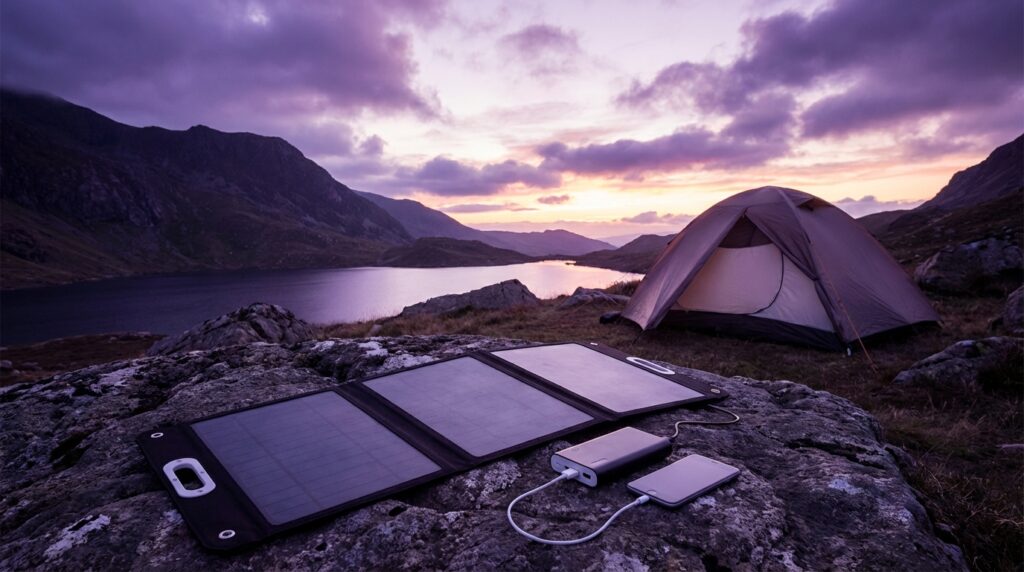
Now enter solar chargers. Fold-out panels, often in black nylon, with USB ports sewn into the side. Some even come with built-in batteries. The packaging looks convincing. A hiker on a ridge. Blue sky. Bright sun. Phone at 100 percent.
The real question behind “Do they really work?” is this:
– Do they produce enough power to be useful?
– Under real camping conditions, not studio lighting.
– For the devices you actually carry, not just a candybar phone from 2005.
Then vs now: power needs in the wild
Let us put some numbers side by side to frame the power story.
| Feature | Then: Nokia 3310 era | Now: Modern flagship (e.g. iPhone 17-style) |
|---|---|---|
| Battery capacity | ~900 mAh | ~4,500 mAh |
| Screen | Monochrome, tiny, always off | 6+ inch OLED, high refresh, always tempting |
| Typical use on a camping day | 2-3 texts, quick call | GPS all day, camera, music, maps, social when signal appears |
| Daily power draw | 10-20% of battery | 70-130% of battery |
| Backup strategy | None, maybe bring charger for hotel on last day | Power bank, car charger, solar panels, battery case |
Now look at solar.
A “typical” camping solar charger you find online is rated:
– 10 W, 14 W, 21 W, sometimes 28 W
– 5 V output, 2 A peak on a USB port
– Real weight: 400 to 900 grams depending on size
The rating is in perfect lab sun, at the perfect angle, no clouds, no shading, panel kept cool. Camping does not always give you that.
So when you ask “Do solar chargers for camping really work?” what you are really poking at is:
– How much of that rated wattage do you actually see on a backpack or at a campsite?
– Is that enough to meaningfully charge an iPhone, Android, GPS, headlamp, or power bank?
– Should you trust a solar panel as your only power source?
What “works” really means with solar
Let us translate marketing numbers into something that feels real.
Say you have:
– A 20 W foldable solar panel
– Bright mid-day sun
– Your phone battery: 4,000 mAh at 3.8 V nominal (around 15.2 Wh)
On paper:
– A 20 W panel might push around 10-15 W in real sun when you account for imperfect angle, heat, conversion loss
– Many panels in real conditions sit closer to 30 to 60 percent of rated power while actually strapped to a backpack
So if you are getting, say, 10 W into your phone, and your battery holds 15.2 Wh:
– Roughly 1.5 to 2 hours for a full charge from near zero to full
– Add some overhead and inefficiency, you might be closer to 2 to 3 hours
In perfect sun, yes, the panel works. It charges the phone.
Now change the scenario: clouds half the day, some trees, mid-latitude autumn sun, or the panel hanging at a weird angle on your pack.
That 20 W panel may behave more like a 3-6 W panel in practice.
Now you are talking 4 to 6 hours of good daylight to get one solid phone charge. You can feel the gap between the picture on the box and your real campsite.
User reviews from 2005 vs now
“User Review from 2005:
‘Went camping with my Nokia and forgot my charger. Battery dropped one bar after 3 days. No big deal. We had more trouble keeping the flashlight alive than the phone.'”
“User Review from now:
‘Took a 21 W solar panel on a 4-day hike with my iPhone. On clear days, it topped off my phone while we ate lunch. On the cloudy day, it trickle charged and barely kept up. Wish I had brought a bigger power bank too.'”
Those two quotes capture the expectation shift. The solar charger is doing its job. The physics have not betrayed you. The power demands just climbed so much that what feels like “works” for a tiny phone battery feels borderline for a modern multi-device loadout.
The two kinds of camping solar setups
When people say “solar charger for camping,” they usually mean one of two things:
1. A folding solar panel with USB ports and no battery
2. A solar power bank (battery with a tiny built-in solar panel)
Let us run through both and see how they hold up in real use.
Folding solar panels without a battery
This is the classic three or four-panel fabric fold-out with eyelets. It hangs from your backpack or sits on a rock near the tent. Output is usually:
– One or two USB-A ports
– Sometimes USB-C
– Rated 10-28 W
How it behaves in the field:
– In full sun, with the panel angled properly, these can charge a phone from low to 80 percent in a few hours.
– Under light shade or moving in and out of cloud cover, the output drops a lot.
– Many phones stop and start charging because they do not love flaky input current. Some panels add a little regulator to smooth this, but it is still not as clean as a wall plug.
Where they shine:
– If you are out for several days with clear forecast and you can leave the panel open at camp for hours each day.
– If you charge a power bank during peak sun, then use the bank at night. That buffer makes a big difference.
Where they disappoint:
– If you are walking mostly under trees.
– If you expect to charge directly from panel to phone while on the move and get full-speed charging.
– If you are at higher latitudes in winter or shoulder seasons with short sunlight windows.
Solar power banks with a small panel on top
These are the chunky power banks you see with a tiny solar cell built into one side. Often:
– 10,000-30,000 mAh capacity
– A little 1-2 W solar panel on the face
– Maybe a hand strap, sometimes even a mini compass printed on the case
Do they work? Technically, yes. The panel produces power when in sun. The question is: how much and how fast?
Take a 20,000 mAh bank. At 3.7 V nominal, that is about 74 Wh of energy.
A tiny 1.5 W solar cell in perfect sun for an hour yields 1.5 Wh. Realistically outdoors:
– Maybe 4-5 hours of good output on a clear summer day
– So around 6-7.5 Wh into the battery, minus losses
You are looking at several days of strong sun to fully charge from zero using only the tiny cell.
So the practical reality:
– That built-in solar is a “slow top off” feature, not a main source.
– The real hero is the battery itself, which you charge at home or via a bigger panel.
Solar vs old-school power banks
So where does solar stand next to just dragging a beefy power bank into the woods?
| Aspect | Solar panel + small bank | Big power bank only |
|---|---|---|
| Weight | 500-900 g combined | 300-600 g |
| Number of phone charges (3-4 days) | 2-6 from bank + 1-3 from panel in good sun | 4-8 depending on bank size |
| Works in cloudy weather | Limited, depends on stored charge | Yes, until the bank is empty |
| Good for very long trips without outlets | Yes, if you get enough sun | Only if you carry very large capacity or resupply |
| Upfront complexity | More: panel placement, weather watching | Less: just plug into the bank |
You can feel the tradeoff. For a weekend car-camping trip, a solid 20,000-30,000 mAh bank is often easier and more predictable than lugging panels.
For a week-long trek where you will never see an outlet, solar starts to make more sense, with some caveats.
Where solar chargers really make sense for camping
Solar chargers do not magically free you from thinking about power. They shift you into “power management mode.”
Here is when they tend to pull their weight.
Long trips with good sun exposure
Think:
– High desert hikes
– Alpine zones above tree line
– Open beach or lake camping
You are often in direct sun, for large parts of the day. You can clip the panel to your pack or pitch it at camp.
In that case:
– A 20-28 W panel paired with at least a 10,000-20,000 mAh power bank can keep up with one smartphone and maybe a small device like a GPS or headlamp.
– You are not charging a laptop out there. Not realistically, not happily, not without huge panels.
Low-power device loads
If your modern kit leans “retro minimalist”:
– Basic phone in airplane mode most of the time
– Dedicated offline GPS with good battery
– Headlamp
– Maybe a small camera
Your daily power draw is lower. Suddenly a panel that feels underpowered for a TikTok-heavy smartphone day looks much better.
“User Review from about 2010:
‘Solar charger worked great for my basic Nokia and headlamp on a 5-day trek. Put it out during lunch, topped everything up by evening. Would not trust it for a smartphone that lives on Instagram.'”
You can almost hear the sigh from future you who packed a single 10 W panel to power a drone, iPhone, and GoPro. Physics has feelings too.
Backup for emergency communication
If your main concern is “I want some way to get emergency power for a satellite communicator or a phone for SOS,” a small panel can be like a safety valve.
You are not trying to run Netflix. You are trying to make sure “I can get one solid call or text out after two dark days” is still possible.
In this mode:
– Even a small panel that just adds 20-30 percent to your phone over hours in the sun is valuable.
– You are not thinking comfort. You are thinking “bare minimum lifeline.”
Where solar chargers feel weak or frustrating
There are some scenarios where a panel will almost guarantee annoyance.
Dense forest or deep canyons
Tree cover kills panel output. Partial shading is like turning off sections of the panel. Many panels drop their voltage when even a small corner gets shaded.
If your entire hike is under tall trees, hanging the panel from your pack feels cool, but you may be harvesting a trickle.
In camp, if you cannot find a sunny patch that lasts for hours without shifting shadows, you will get bursts of power instead of steady output.
Short, one or two-night trips
On a quick overnight or weekend:
– A 10,000-20,000 mAh power bank is simple insurance.
– Your devices will not burn through that unless you are streaming 4K movies in the tent every night.
The panel becomes dead weight unless you are testing gear or just enjoy tinkering.
High device count, video-heavy use
Think of a creator camping trip:
– Phone shooting 4K
– Action cam running at 60 fps
– Drone flights
– Maybe a tablet
This is a small studio, not a quiet campsite.
In practice:
– You either bring big power banks and maybe re-up in town, or you need a seriously larger solar setup than a “backpacking panel.”
– Those little 10-20 W foldables will never feel like enough, and you start chasing the panel all day, adjusting, repositioning, watching the charge percentage inch upward.
How to make solar actually helpful, not just cool-looking
You can treat solar as part of a system, not a magic box. There is a difference.
Here is the practical approach that usually works better:
1. Size panel and bank to your power budget
Rough method:
1. Estimate your smartphone usage per day:
– Light use: 30-40 percent of battery
– Moderate: 60-80 percent
– Heavy (GPS, video): full battery or more
2. Count your days between outlets.
3. Add in other gear:
– Headlamp: usually small draw
– GPS: medium
– Camera: depends on model and usage
Then decide:
– Short trip (2-3 days): A 10,000-20,000 mAh bank, no panel.
– Medium trip (4-7 days) in decent sun: 20 W panel + 10,000-20,000 mAh bank.
– Longer: same as medium, but be more strict about screen time and recording.
2. Charge a power bank, not directly to phone
Panels with fluctuating output can confuse phones. They stop charging, restart, and sometimes get warm for not much payoff.
A better chain looks like:
– Panel → power bank during the brightest hours
– Power bank → devices in the evening or on the go
The bank acts like a shock absorber. The panel can spike and dip all it wants. Your phone just sees a stable USB output.
3. Aim and cool the panel
A few simple tricks can squeeze more watt-hours out of the same hardware:
– Lay the panel flat facing the sun, not hanging at some weird corner angle.
– Adjust it a couple of times during the day if you are at camp.
– Keep the panel as cool as practical: on a rock, not on a dark surface that heats it up even more. Heat kills efficiency.
You do not need to turn this into a science project, but a minute or two of panel care can be the difference between “barely charged” and “decently topped off.”
Then vs now: solar gear compared
We can even frame solar itself in a “then vs now” style comparison to see how far it has come.
| Feature | Early 2000s solar chargers | Modern camping solar panels |
|---|---|---|
| Typical power rating | 2-5 W | 10-28 W (similar size) |
| Panel type | Rigid, fragile | Flexible or semi-flexible, folding |
| Weight | Heavy for the power | Better power-to-weight |
| Device expectations | Basic phone, maybe AA charger | Smartphone, camera, GPS, sometimes tablet |
| User experience | Slow, finicky, niche users | Still slower than a wall, but usable with planning |
Panels really did get stronger and lighter. The demand side just climbed even faster.
What “works” looks like in real camping stories
To make this real, picture two different campers with the same 21 W folding panel and a 10,000 mAh bank.
Camper A: The mapper and photographer
– Uses GPS for hikes
– Takes photos during golden hour
– Puts the phone in airplane mode at night
– Charges at camp, panel laid out on a rock for 4-5 hours
Result over a 4-day trip:
– Panel keeps up with the phone and a headlamp.
– Bank never fully empties.
– Camper goes home thinking, “This thing works. Worth the weight.”
Camper B: The content creator
– Records long 4K clips
– Checks socials whenever there is a hint of signal
– Streams some downloaded shows at night in the tent
– Panel is mostly on the backpack, in and out of shade
Result over a 4-day trip:
– Phone drains faster than the panel and bank can refill.
– By day 3, everything is under 30 percent.
– Camper goes home thinking, “Solar chargers are a scam.”
Same hardware. Different behavior. Same physics. Different story.
So, do solar chargers for camping really work?
If the question means:
– “Do they turn sunlight into enough power to charge real devices?”
Yes, they do, within their rated range and within the limits of sun, shade, angle, and temperature. They are not fake.
If the question secretly means:
– “Can a lightweight camping panel let me use my devices exactly like at home, without thinking about power?”
That is where expectations collide with reality.
Solar is slow, variable, and kind of picky. Camping with solar feels a bit like going back to that era when you learned to sip minutes on your prepaid phone, or when you turned off your CRT monitor to shave a few dollars off the power bill.
You are trading brute-force wall power for a quieter, slower rhythm. Some people actually like that constraint. It nudges them away from screen binging and toward, you know, staring at the actual stars for a while.
Maybe that is nostalgia talking. Or maybe it is just the old 3310 part of your brain, still impressed that anything with a screen can last more than a day in the wild at all.
