

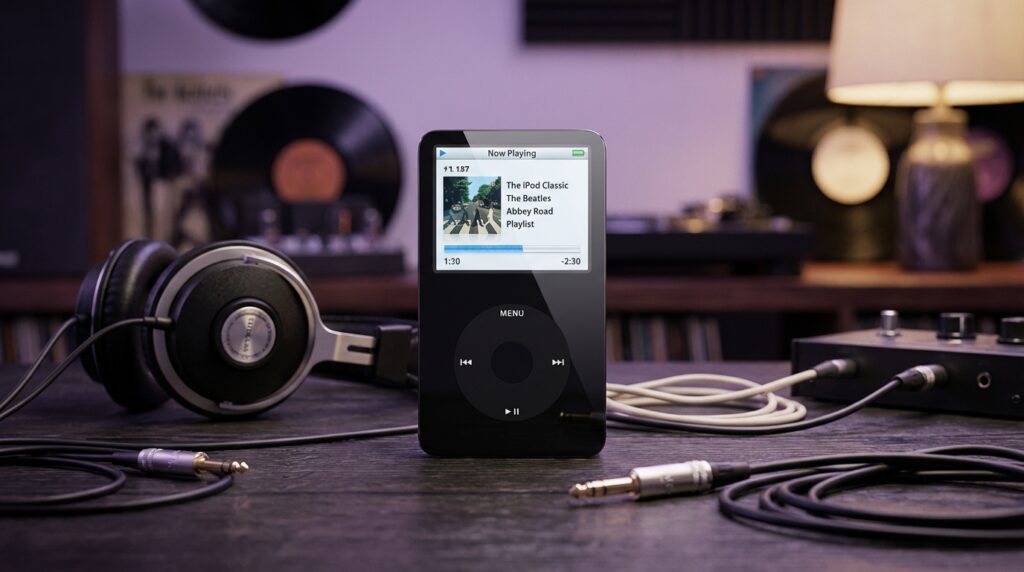
“That tiny click-wheel spin, the faint whir of a 1.8 inch hard drive waking up, and that bright blue backlight hitting your eyes in the dark bus ride home.”
You remember that little pause right before the music started, right? Not lag, just a half-second spool-up. Then the track kicks in, compressed at 192 kbps, and somehow it felt richer than anything your current streaming app throws at you on shuffle.
Fast forward to now: you pull up eBay and search “iPod Classic” just out of curiosity. Then your eyebrows go up. Wait. People are still paying hundreds for a device that is thicker than your phone, heavier than a modern mirrorless camera battery, and has a screen that looks like it is made of graph paper. Why are those chunky white-and-chrome bricks pulling in prices that rival new mid-range Android phones?
Maybe it is the nostalgia talking. Maybe it is the perception of better sound. Maybe it is the storage. Maybe it is just the way that little chrome back plate catches the light and the way the click wheel feels under your thumb.
The short version: the same things that made the iPod Classic feel “overkill” back then now make it a weirdly practical, collectible, and hackable music tank today. Locked-in storage, mechanical drive, giant capacity, clean DAC, no notifications, no algorithm, and a design that still looks like it belongs in a museum of modern gadgets. That all adds up to one thing on eBay: people are willing to pay.
The weight in your pocket: why the iPod Classic feels so different
Pick up a 5th gen iPod Video or a 160 GB iPod Classic today and you feel the difference right away. It is dense. The kind of 140 gram weight that makes your jeans pocket sag just a little. The front is smooth plastic with that soft rounded edge, the back is polished stainless steel that loves fingerprints and micro-scratches.
The screen is small by current standards. You are looking at 2 to 2.5 inches, with a resolution that feels closer to an old calculator than a phone. You can count pixels if you hold it close. The fonts have that clear, simple Apple style from the mid-2000s. No icons bouncing around, no ads, no push banners. Just a list: Artists, Albums, Songs, Playlists.
The click wheel is still the star. You do not tap; you slide. Your thumb traces that circle and you feel every little fraction of a millimeter turn into discrete clicks in the UI. Scroll speed accelerates as you spin quicker, so you can fly from AC/DC to Yeah Yeah Yeahs in one smooth ring.
“Retro Specs: 2005 iPod classic-ish experience: 2.5 inch 320×240 display, 30 or 60 GB hard drive, up to 15 hours of music playback, dock connector that looked like it could handle anything, and a body that could survive the floor of a school bus.”
The build has that “solid object” feel. Plastic and metal. You can feel the edges of the drive, the slight mass distribution. Set it on a table and it lands with a soft clack, not the hollow tap of many newer devices.
If you ever used one in a dark room, you remember the backlight. That cool, slightly bluish white that came on when you touched the wheel. Your hand knew the controls by feel: Menu at the top, Play/Pause at the bottom, Previous to the left, Next to the right. No learning curve. Your muscle memory wired itself around a circle.
Those physical traits are not just nice memories. They are part of why the iPod Classic still has a buyer base. It is a media player that feels like a media player, not like a small, needy computer.
Why eBay loves the iPod Classic: supply, demand, and weird tech value
So why does that old, chunky player still move on eBay for 200, 300, sometimes over 500 dollars if it has the right model number plus “upgraded SSD” in the title?
It comes down to a few overlapping groups of buyers:
1. Collectors who want pristine or rare models.
2. Audiophiles who want dedicated offline music.
3. Tinkerers who mod the hardware into something new.
4. Regular people who just want a big offline music box with a headphone jack.
These groups are not huge individually, but they overlap enough that clean, working units do not sit around for long. Meanwhile, supply is only going one way: down. Batteries age, drives fail, logic boards die. Apple does not make them anymore. Every working Classic that goes in the trash nudges the prices on eBay up by a few more dollars.
The model differences that actually matter on eBay
If you look closely at eBay listings, you see certain phrases over and over: “5.5 gen,” “Wolfson DAC,” “thin 80 GB,” “7th gen 160 GB,” “new battery,” “SSD mod,” “Rockbox installed.”
These tiny details change what a buyer will pay. A scratched 6th gen with a tired drive is a different thing from a clean 5.5 gen with a fresh battery and flash storage.
“User Review from 2005: ‘Just loaded 4000 songs and it still says I have space for 6000 more. I do not think I even know 6000 songs. This is ridiculous in the best way.'”
From a collector and modder perspective, the 5th gen iPod Video (especially the late 5.5 refresh) is a big deal. That one has:
– 30, 60, or 80 GB hard drive
– “Video” playback
– That famous Wolfson audio chip that some listeners swear sounds warmer
The later “Classic” branding, starting around 2007, gave us:
– 80, 120, and 160 GB capacities
– A slightly tweaked interface
– Longer battery life on music playback
– Different audio chipset, still good but with a different character
The last 7th gen 160 GB model is common on eBay because it was the final one Apple sold. But “common” does not mean cheap. Good condition units still fetch solid prices, especially if the seller includes “fully tested, no bad sectors” or “new 3000 mAh battery.”
Then vs now: a quick spec reality check
To really see why the iPod Classic has this weird staying power, it helps to compare it to a modern flagship phone. Not in a “which is better” way, just in raw spec tradeoffs.
| Feature | Nokia 3310 / iPod Classic Era | iPhone 17 (hypothetical modern flagship) |
|---|---|---|
| Primary use | Calls / dedicated music playback | Everything: calls, apps, streaming, photos, games |
| Local music storage | iPod Classic: up to 160 GB hard drive | 512 GB+ flash, but shared with apps, photos, video |
| Screen | 2-2.5 inch LCD, ~220-320p, no touch | 6+ inch OLED, 120 Hz, high resolution touch |
| Controls | Click wheel + physical buttons | Multi-touch screen, gesture-based UI |
| Audio output | 3.5 mm headphone jack, single DAC | USB-C / wireless, advanced DSP, no jack |
| Battery swap | Technically replaceable with tools | Also replaceable, but costlier and more complex |
| Distraction level | Music and maybe games like Brick / Solitaire | Notifications, social, video, messaging, everything |
| Secondary market price (used) | iPod Classic often $200-$500+ in good condition | Old iPhones often $150-$400, depending on model |
The iPod Classic is a weird case where “less” is part of the appeal. Less screen, less internet, fewer features. That focus turns out to be valuable. People are paying for a music object, not a tiny general computer.
Storage: when 160 GB still matters in a streaming age
Why would anyone pay for local storage when you can stream 100 million tracks on your phone?
Three real reasons:
1. Offline listening where signal is bad or data is costly (subways, flights, remote areas).
2. Large personal libraries with rare rips, live sets, and obscure tracks.
3. Control: no sudden album removals, no “sorry, this track is not available in your region.”
If you grew up ripping CDs in iTunes, you might still have a folder on a hard drive holding 200, 300, 400 GB of MP3s, AAC, FLAC, or ALAC. A cloud service can host it, but many people still like the feeling of carrying the whole thing in one pocketable device.
“User Review from 2005: ‘My hard drive crashed, but my iPod still had all my music. For a week, this thing was literally my music backup. Never letting it go.'”
That 160 GB number was wild at launch. Many laptops at the time shipped with that size or less. Putting that capacity in a pocket player around 2007 made the Classic feel almost absurd.
Now, yes, a phone with 512 GB storage technically beats it. But that space gets chewed up by 4K video, games, photos, app caches. People often do not want to fill half their phone with FLAC files. A dedicated box with, say, 512 GB of SD-card-modded storage feels cleaner.
On eBay, listings that mention “512 GB SSD” or “1 TB SD card + iFlash” are not rare anymore. Those modded units combine the original iPod shell and UI with modern flash storage. No moving parts, better battery life, shorter access times. And yes, they go for serious money.
Sound character and the Wolfson myth
If you hang out on audio forums long enough, you run into threads with titles like:
– “5.5g iPod Video Wolfson vs 7g Classic”
– “Is the old iPod really that good as a transport?”
– “Click wheel iPods still beat my phone for sound”
The reputation partly comes from the DACs. Early iPods, especially the 5th and 5.5 gen, used Wolfson Microelectronics audio chips. Some listeners describe the sound as “warmer” or “more musical.” Later Classics moved to Cirrus Logic and other solutions that measured very cleanly but had a slightly different signature to some ears.
Now, if you look at pure measurements, many current phones and dedicated audio players are excellent. But the iPod has a few practical sound perks:
– Consistent output level that works well with many wired headphones.
– Remarkably low hiss for sensitive IEMs for its time.
– Very simple path: file > DAC > amplifier > headphone jack.
There is also the mental side. When you hold a device that is built only to play your library, your brain gives the audio more attention. No pings, no multi-tasking, no split focus.
iPod as transport
Another niche: some buyers use the Classic as a digital transport by docking it to external DACs and stereos. The old 30-pin dock connector with line-out gave a relatively clean, fixed-level signal to home setups. Plenty of people still have speakers and car systems that expect that connector.
So when they see a listing that says “iPod Classic 160 GB, tested with car dock, line-out working,” they jump on it. Their use case is already wired around that specific form factor and connector.
Why modders keep the Classic alive
Now to the fun part: the hardware hacker crowd.
For this group, the iPod Classic is a small, friendly canvas. It has:
– A known, well-documented teardown process.
– Off-the-shelf replacement parts: batteries, screens, click wheels, cases.
– Adaptable storage bay meant for a 1.8 inch HDD, which happens to be perfect for mSATA, ZIF-to-SD, and iFlash boards.
So you get entire subcultures around phrases like:
– “Quad SD card iPod Classic build”
– “1 TB flash mod”
– “Rockbox installed, gapless playback, FLAC support”
“Retro Specs: Classic mod scene favorite: 7th gen iPod Classic shell, iFlash Quad adapter, four 256 GB SD cards for 1 TB total, 3000+ mAh battery squeezed inside the thicker back case. Result: more storage than some laptops from a few years ago, in a device first sold in 2009.”
The drive bay that once held a spinning 160 GB hard disk now accepts a tiny adapter board and one or more SD cards. That reduces weight, shortens track load times, and makes the device more drop-resistant. Pair that with a high-capacity battery, and you have a music brick that can run for longer than many phones on continuous playback.
Rockbox, an alternative open firmware, is another piece of the puzzle. On some generations, Rockbox:
– Adds native FLAC, OGG, and other codec support.
– Offers granular EQ.
– Supports gapless playback beyond what the original firmware did.
– Gives more control over how your library shows up.
When you see high bids on “modded Classics” on eBay, that often means the buyer values the build time and knowledge put into those parts swaps and firmware tweaks. They get a “new old” device that is ready for another decade of playback, as long as the logic board holds.
Collectors, colors, and the lure of mint condition
Some people buy iPod Classics not for daily listening but as retro artifacts. They want:
– Sealed units still in plastic.
– Special color runs.
– U2 edition iPods with band signatures etched on the back.
– Very clean first-gen or 5th gen units with minimal scuffing.
Those buyers care a lot about condition. Tiny scratches on the metal backplate that most users accept as normal wear become price arguments. The original box, earbuds, and cable can bump the price up. A totally sealed box from that era can reach numbers that make rational budgeting shake its head.
There is also the “museum shelf” effect. People who collect consoles, phones, and other classic gadgets want an iPod in the lineup. Few products shaped portable music culture as clearly.
Why condition is king
Look at two sample listings:
– “iPod Classic 160 GB, heavy scratches, battery weak, for parts, no returns”
– “iPod Classic 160 GB, refurbished, new battery, new SSD, minor cosmetic wear”
The second one can easily go for two to five times the price of the first. The buyer is not just buying an old device; they are buying assurance that it has a future.
For true collectors, original parts matter. For practical listeners and modders, upgraded parts matter more. That split fuels a healthy range of prices.
No notifications, no pings: the focus tax people are willing to pay
There is one quiet reason that keeps showing up in user comments: focus.
When you use an iPod Classic, this is what happens:
– You pick it up.
– You spin the wheel.
– You choose an artist or playlist.
– You hit play.
– That is it.
No banner slides down to tell you about a new message. No short-form video template begs for your attention. No random OS pop-up nags you for an update in the middle of a guitar solo.
You get music, audiobooks, maybe a few old podcasts synced via iTunes. That is all.
For some people, paying 250 dollars on eBay for that experience is not strange at all. They treat the iPod like a musical sanctuary. They keep their phone out of reach and carry the iPod when they commute, work, or read.
This is not about saying phones are bad. It is about separating tasks. A dedicated music tool encourages a dedicated listening session. That feeling is rare now, and rarity often has a price tag.
Why iPod Classics often outprice newer iPods
Apple has shipped many iPods: Mini, Nano, Shuffle, Touch. So why does the Classic frequently sit near the top of the resale chart, often beating newer iPod Touch models?
A few reasons:
– Storage: Nanos and Shuffles top out at much lower capacities. The Classic’s 120-160 GB stock config still looks strong.
– Interface feel: The click wheel gives a very distinct control scheme that later devices dropped.
– Form factor: The index-card shape with some thickness feels more like a small machine, less like a toy.
– Mod potential: That thick body makes battery and flash storage mods much more feasible than on thin Nanos.
– iPod Touch overlap: The Touch feels too close to an iPhone without the network piece. Many people just use an old iPhone as a Touch replacement instead.
The iPod Classic hits a sweet spot: old enough to feel iconic, but new enough to still handle long tracklists, metadata, and large libraries.
The iPod and the “owned music” crowd
Streaming services rewired how most people relate to music. You pay a monthly fee, choose from millions of tracks, and do not think much about file formats. You rent access.
There is still a sizeable group of listeners who prefer files they can back up, tag, and store. For them, an iPod Classic is a physical anchor for their digital library. It has:
– A finite capacity, like a bookshelf.
– A sense of “my collection” that streaming playlists sometimes lack.
– No remote kill switch from a catalog decision.
When songs vanish from streaming due to rights changes, the owned-files crowd shrugs. Their FLAC or MP3 files do not disappear overnight.
This mentality lines up perfectly with what the Classic was built to do. Load it with the albums that matter to you, sync occasionally, and carry that curated subset around. On eBay, buyers in this group hunt for “trusted sellers” who test drives, replace batteries, and do clean installs.
The aging hardware problem that actually lifts prices
All this demand runs up against a hard reality: hardware ages.
– Hard drives develop bad sectors.
– Batteries swell or lose capacity.
– Click wheels misread input.
– Dock connectors loosen.
So each year, more iPods quietly die. They sit in drawers, get recycled, or lose crucial parts. The ones that remain in working shape become more valuable.
This is where the refurb crowd steps in. Skilled repair folks:
– Open the shells without cracking the clips.
– Swap batteries for higher-capacity ones.
– Replace hard drives with SD or SSD storage.
– Clean boards, ports, and buttons.
Their work extends the life of an already out-of-production device. That extra labor, plus the parts, gets built into the eBay price. You are not only paying for Apple engineering from 15+ years ago. You are paying for the modern repair that keeps that engineering usable.
The risk factor: why “as-is” deals are cheaper
Scroll through enough listings and you see two worlds:
– “As-is, parts only, no charger, cannot test”
– “Refurbished, tested, warranty”
The first category is the cheap side. Buyers there are usually modders who plan to replace core components anyway. If the logic board works, they can swap everything else. If it does not, they might still get a good click wheel or shell.
Regular listeners, though, tend to shy away from those. That keeps working, tested units at a premium. Every iPod Classic that moves from “working” to “dead” shifts a little more attention toward the remaining ones.
Design that aged strangely well
Look at an original iPod photo: that rounded rectangle, white front, chrome back, centered screen, circle of controls. It is simple, easy to sketch from memory. That clarity is part of why it became a design icon.
Hold a Classic next to a current phone and it still looks clean. No huge bezels screaming “old.” Just a smaller display and physical controls. The fact that it is thick now feels almost retro-chic rather than outdated.
There is also something about that mirrored steel back, scratches and all. Every scuff tells a story. Bag rub. Jeans pocket with keys. That one time it slid off a dashboard. It ages more like a metal watch than a plastic gadget.
People buying on eBay see the photos and can often tell if a unit lived a gentle life in a case or bounced around without mercy. They factor that into what they bid.
Why you still see them on trains and planes
If you ride subways or long-distance trains in big cities, every so often you still spot someone with:
– Over-ear wired headphones.
– A white or black rectangle with a familiar wheel.
– A phone in another pocket staying mostly untouched.
That person is the reason eBay listings keep selling.
They might be a DJ traveling with lossless libraries. They might be someone with a carefully tagged collection going back decades. They might just like the act of pressing Play on a dedicated device that does not beg them to doomscroll between tracks.
You can think of the iPod Classic as the vinyl of portable digital players. Not because of any magical warm sound property, but because it invites a deliberate, somewhat slower ritual. Syncing via cable. Curating playlists by hand. Scrolling by album instead of letting an algorithm shuffle your day.
There is a cost to that ritual. Time, cables, software that Apple does not focus on anymore. But people are also willing to pay in cash to keep that ritual intact, which is why that old blue-backlit menu still holds its own in an auction listing.
From school lockers to glass display cases
Once upon a time, the iPod Classic lived in backpacks, cargo pockets, and gym bags, wrapped in silicone cases that turned yellow over time. The white earbuds were everywhere. That little click-wheel spin felt like part of the background noise of a bus or college campus.
Today, those same devices sit on:
– Tech YouTubers’ shelves behind their talking head shots.
– Audio hobbyists’ desks, docked to amps.
– Collectors’ glass cases, lined up by generation.
– Commuters’ pockets, still doing what they did on day one: play your songs, nothing more.
The shift from everyday object to semi-collector piece is exactly what you see reflected in those eBay prices. Years ago, people traded used Classics for lunch money. Now they look up model numbers, board revisions, and DAC chips before listing them. Buyers study serials instead of just clicking “Buy It Now.”
The story of the iPod Classic on eBay is really a story about how certain tech crosses over from “product” to “artifact” while still staying practical. That strange middle zone where you can both listen to it on a crowded train and also display it on a shelf next to your old Game Boy and first-gen smartphone.
