

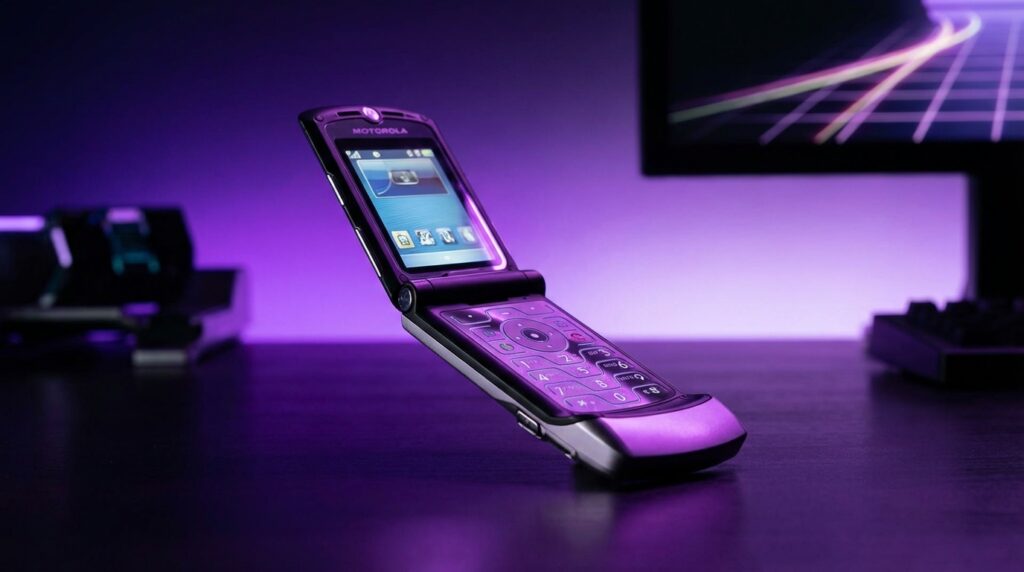
“That crisp snap when you closed a Motorola Razr V3… like hanging up on the world with a tiny plastic mic drop.”
You remember it, right? That thin metallic slice in your hand, the way the hinge felt when you flicked it open with one thumb, the tiny external screen glowing blue with a text from “Mom” in pixelated letters. Now compare that to how you end calls on your current phone: an awkward tap on a glass slab, hoping your cheek did not already hit the wrong button. It is a different kind of satisfaction.
The Razr V3 sat at this strange crossroads between style piece and communication tool. It was not just a phone. It was a pocket accessory, a status symbol that lived somewhere between fashion and hardware. Today, while phones keep getting bigger, flatter, and safer, brands are digging back into that feeling. We are seeing foldables, flip reboots, and compact devices that all quietly nod back to that razor-thin Motorola from the mid‑2000s. Maybe it is nostalgia. Maybe it is screen fatigue. Maybe it is just that humans still like objects that do something physical, not just digital.
The Razr V3 was not powerful by current standards. You had a 2.2 inch internal display, 176 x 220 pixels, and a VGA camera that smeared shadows and blew out bright skies. It weighed about 95 grams, felt like a metal credit card glued to a plastic spine, and yet when you held it, it felt intentional. This was not an accidental brick. This was designed to look good on a bar table next to your keys and your flip‑top Motorola car key fob.
Before smartphones swallowed everything into one glass rectangle, phones were allowed to have personality. Antennas stuck out, faceplates swapped colors, ringtones were bragging rights. The Razr V3 landed in that era but looked like it had time‑traveled from the future. Brushed aluminum, etched keypad backlight, an impossibly thin profile that still feels impressive when you hold one today. And that is exactly why flip phones are sneaking back into the conversation: not as relics, but as an answer to the “all‑screen, all‑the‑time” fatigue a lot of people quietly feel.
The Razr V3: When Hardware Had Swagger
“Retro Specs: 2.2 inch TFT screen, 176 x 220 pixels, 5 MB internal storage, VGA camera. That is not a typo. Five. Megabytes.”
The first thing you noticed with the Razr V3 was the hinge. Thick, rounded, and cold to the touch if it had been sitting on a glass table. When you picked it up, the weight was centered right at that point, so flicking it open felt natural, almost like a Zippo lighter. The body was about 13.9 mm thin, which at that time felt unreal. Every other phone looked bloated next to it.
That internal keypad was another character. It was a laser‑etched single metal plate, not individual plastic buttons. When you pressed a number, the feedback was more of a snap than a click. Each key lit up in a smooth blue glow that ran across the whole plate. If you texted under the covers at night, the light bounced off your hands and the roof of the blanket like a low‑budget sci‑fi movie scene.
The main display felt sharp to us back then. Colors were saturated, icons had this candy‑like charm, and the Motorola menu had that quirky, slightly awkward flow you either grew to love or quietly cursed. Your wallpaper was a big deal, often a grainy JPEG sent over Bluetooth from a friend who had “the good wallpaper pack.” The external display on the front was practical. You could see who was calling before deciding whether to flip open or let it ring out with that polyphonic ringtone you downloaded for $2.99.
Now stack that against the glass rectangles on your desk. Today, your phone wants to disappear into your hand. The Razr never tried to disappear. It wanted you to see it, flip it, play with it. And that physical play is a big piece of why flip phones feel fresh again. We lost that in the sprint toward higher screen‑to‑body ratios and edge‑to‑edge OLEDs.
Why That Flip Felt So Good
If we strip away the marketing and celebrity endorsements, the Razr V3 did one core thing right: it made every interaction feel physical. Answering a call was not just “Accept” or “Decline.” It was open or close.
There is something your fingers remember about repetitive actions. That open‑close motion became a tiny habit loop. Phone rings, you feel the vibration through that thin chassis, you grab it, flip, speak. Finish the call, snap shut. That sound cut the line in your mind more cleanly than any red on‑screen button ever could. The call is done. Conversation over. Time to move on.
Smartphones blurred that line. You hang up but you are still staring at the same screen, face‑to‑face with icons for email, chat, social apps, games. Ending a call no longer feels like closing something. It feels like switching tabs in a browser. With a flip phone, your brain gets a clearer “off” moment. Physically closing the device tells your mind the connection is done.
“User Review from 2005: ‘I bought the Razr because it looked like something from The Matrix. Now I end calls just to hear the snap when I shut it.'”
There is also the privacy angle. When the Razr V3 is closed, it feels locked in a very literal way. You are not worried about your pocket sending texts or starting calls on its own. With a touch slab, you rely on software to keep your clumsy hands in check. Face unlock, fingerprint, passcode. With a flip, the hardware gate is obvious. Closed means closed.
The new wave of flip phones, like the rebooted Motorola Razr line or Samsung’s Galaxy Z Flip series, tap into that same instinct. Yes, they pack folding OLEDs, fast processors, and cameras that would make your 2005 self cry. But the hooks that catch people are still very human: that satisfying fold, that half‑open “camcorder” grip, the quick‑glance external display that lets you ignore your doomscroll for a moment.
Then vs Now: Specs Tell One Story, Experience Tells Another
From a pure spec sheet perspective, the Razr V3 loses every match with a modern device. Yet people still hunt for them on eBay, mod them, and collect them. To see how far the hardware moved, and what we lost, it helps to stack old against new.
| Feature | Motorola Razr V3 (2004) | iPhone 17 (Hypothetical Modern Flagship) |
|---|---|---|
| Display (main) | 2.2 inch TFT, 176 x 220 pixels | 6.3+ inch OLED, ~2800 x 1320+ pixels |
| Secondary / External Display | 0.9 inch CSTN, caller ID & status | Always‑on widget area, high‑res panel |
| Camera (rear) | VGA (~0.3 MP), no autofocus | Triple or quad array, 48-200 MP, optical zoom, night mode |
| Front Camera | None | 12+ MP, 4K video, Face ID / biometric data |
| Storage | 5 MB internal, no microSD on early models | 256 GB to 2 TB internal |
| Connectivity | GSM, GPRS, EDGE, Bluetooth 1.2 | 5G, Wi‑Fi 7, Bluetooth 5.x, UWB |
| Battery | ~680 mAh, removable | 4500+ mAh, fast charge, wireless |
| Weight | ~95 g | ~200 g |
| OS / Apps | Proprietary Motorola OS, Java MIDP apps, no app store | Full smartphone OS, app store with millions of apps |
| Durability | Survived pockets, falls from desks, random abuse | Stronger glass, but vulnerable to drops without a case |
Looking at that table, the rational part of your brain laughs at the idea of “going back” to a Razr V3. But that is not really what this flip comeback is about. It is less “go back” and more “borrow what worked and bring it forward.”
Modern flip devices borrow the hinge, the satisfying closure, and the pocket size. Then they strap them to hardware that can run your banking app, your smart home controls, your streaming services. They are not trying to recreate 2004. They are trying to steal the best part of it.
Why Flip Phones Appeal In A Screen‑Heavy World
There is a quiet tension in our pockets: we want access, but we are drowning in it. Smartphones brought everything together: messages, work stuff, entertainment, navigation, payment. Over time, that “everything” turned into “always.”
Flip phones, especially smart flips, offer a physical way to limit that “always” without giving it all up. When the device is closed, your universe shrinks to a small notification window. Time, caller ID, maybe a music control. You get the ping, but not the full tidal wave of icons.
People are not just hunting Razr V3s because they miss polyphonic ringtones. They are craving a clear boundary. That is what the hinge gives you. Closed: life. Open: feed.
“User Review from 2005: ‘Battery lasts me three days. My friend charges his smartphone every night. Who is winning?'”
Battery life on the old Razr was strange by current standards. Because the phone did not push constant data or run heavy apps, that small 680 mAh cell could last days with light to moderate use. Calls, texts, a few pictures, maybe a short game of Snake or a Java game that loaded in 20 seconds.
Compare that to your current phone that juggles push notifications, location services, high refresh rate displays, and constant background sync. You get better features, no question. You also get another device you need to babysit with chargers and power banks. Younger users are starting to experiment with “dumb phone weekends” or using a flip as a companion device to step out of that loop sometimes.
The Razr V3 also made you deliberate. Typing on T9 was slower, but it made your messages more intentional. You did not spam texts. You crafted them. You remembered number‑to‑letter mappings in your fingers. Today, swiping a keyboard is faster and more flexible, but it does pull you into higher volume, lower friction communication. That is not always a win.
The Fashion Phone Era And Why It Matters Now
The Razr V3 launched in 2004. That period was full of “fashion phones.” Nokia, Siemens, Sony Ericsson, and others all pushed designs that showed up in music videos and celebrity photos. Phones were not just tools. They were style pieces.
The Razr V3 leaned hard into that. It came in hot pink, black, silver, blue, gold. The slim rectangle, metal surfaces, and bright backlit keypad fit with mid‑2000s culture: low‑rise jeans, big sunglasses, and belt clips. It slid into shirt pockets and tiny handbags without stretching them out.
We are seeing echoes of that now. Foldable flips are targeting color, texture, and accessories again. Cases that show off the hinge. External screens that act almost like digital badges. Companies learned that hell‑for‑leather spec races alone are not enough. People want devices that say something visually, not just when you read the settings menu.
The Razr V3 teaches a quiet lesson here: design can carry a device into cultural memory even when specs age out. The camera aged fast. The screen aged fast. But the shape, the way it opened, the feel in hand, those still land. That is why flip phones get so much attention every time a new one drops. The silhouette already lives rent‑free in our heads.
Ringtones, Keypads, And The Sound Of 2005
If you close your eyes and think of the Razr V3, you do not see a spec sheet. You hear it. Polyphonic ringtones, the subtle click of the keypad, the muted slap when the two halves met. Audio might be the most underrated part of why flip phones felt so fun.
On T9 keypads, each press had a clear mechanical feedback. Slight travel, then a stop. Over time, your thumb learned where “2” or “8” was without looking. When you typed fast, it turned into a rhythm. Tap‑tap‑pause, tap‑tap‑tap, space. That rhythm is gone with modern glass slabs. You trade it for haptic pulses and tapping smooth glass. Functionally stronger, but less distinct.
The Razr’s speaker lived under a small grille, and you could feel it buzz on a wooden table when a call came in. If you were out at a café, that little buzz and the backlit keypad were enough to spot your phone across the table. You grabbed it by the top half, flipped it in the air, and caught it open. Small, theatrical, unnecessary, and very human.
Modern flips bring that performance back, with better speakers, better mics, and far cleaner call quality. But the emotional script is similar. When a call comes in on a flip, you perform the action, not just tap a screen.
From Dumb Flip To Foldable Smart: The Razr DNA
When Motorola revived the Razr name for a modern foldable, they leaned heavily on nostalgia in the marketing. You see the same silhouette, the same flip motion, the same idea of a sleek pocket device that unfolds into something bigger.
The core difference is that the inside is not a small fixed screen anymore. It is a flexible OLED panel that bends along a hinge designed with far more engineering than the original V3 ever needed. We are talking multi‑layer displays, hinge cams, complex cable routing so nothing snaps after thousands of folds.
In a way, the original Razr was like concept art made real with early‑2000s tech. Thin, stylish, but limited by what you could cram into that frame: small battery, low camera performance, tiny storage. The new wave is trying to see what happens if you bring modern internals to that form factor. You get:
Better External Screens, Same Quick‑Glance Idea
The V3’s outer display was tiny, low resolution, and mainly there to show caller ID, time, and simple icons. Still, it changed behavior. You did not have to open the phone to decide if the incoming call was worth your time. That felt new then.
Modern flips push that further. The external panel can show widgets, full notifications, even full apps in some models. That gives you the choice: handle something at a glance, or open up and fully engage. The seed of that behavior sits back in the Razr V3’s tiny outer window.
Camera Placement And That “Camcorder Grip”
If you rotated a Razr V3 sideways with the screen open, it almost felt like an old mini camcorder. The VGA camera was above the screen, and your hand wrapped around the hinge. More style than substance, since the footage was grainy and low resolution, but the shape begged you to film.
Modern flips use this shape smartly. Half‑open modes let you sit the phone on a table and record without a tripod. Video calls can run with the phone in an L shape, laptop style. That “camcorder grip” idea lands fully now that cameras and apps caught up to the hardware.
Durability And The Myth Of The Indestructible Razr
People like to talk about the Nokia 3310 as the unkillable brick. The Razr V3 had a bit of that myth too. The metal shell could take scratches and scuffs, and the flip closed to protect the screen. Tossing it into a bag with keys did not feel risky.
Modern foldables are more complex. Flexible glass, moving hinges, more things that can fail. But the idea that your screen folds protected inside the shell still has value. It is the same philosophy, challenged by higher expectations for display clarity and touch sensitivity.
Why Some People Use A Flip Phone On Purpose In 2025
There is a small but real group of people who use classic or modern flip phones by choice, not just because they cannot afford a smartphone. The reasons might sound familiar if you remember your Razr years.
Digital Boundaries Through Physical Design
When everything is on one screen, saying “no” requires willpower. When your device folds shut and shrinks into a small notification window, the hardware helps you say “not now.” Some people pair a flip with a tablet or a laptop, spreading their digital life across devices with stronger context. Work lives on the laptop. Light messaging and calls live on the flip. Entertainment lives on a TV or tablet.
This mirrors the Razr years. Back then, you did not expect your phone to do everything. You used a PC for long emails, a camera for serious photos, and the phone for quick contact. There is a quiet movement back toward that kind of separation, even if the tools changed.
Battery, Simplicity, And The Freedom Of Fewer Choices
More features often mean more decisions. Which app to chat with this person? Which feed to scroll? Which video platform to open? That choice fatigue is real. A classic flip like the Razr V3 has fewer choices by design. You call or text. Maybe you play a game or two. That is about it.
Modern flips keep the features but provide friction through the fold. You are less likely to sink into a long scroll session if your screen is smaller or folded shut by default. You can still do it. You just have to decide to open the phone fully and live on the big internal display.
The Razr V3 In The Archive: What It Still Teaches Phone Designers
From the distance of 2025, the Razr V3 feels like a prototype for a certain philosophy of mobile tech: keep it thin, make it feel good in the hand, and give the user a physical action that sets the tone for how they use it.
A few lessons still matter:
1. Hardware Should Communicate State Instantly
Open means “on.” Closed means “off” or “away.” You did not have to guess. The position of the hinge told you what the phone was doing, even before the screen lit up.
Modern phones lean hard on software to show state: lock screens, notification badges, always‑on displays. Flip designs reintroduce physical state back into the mix. The shape signals intent without you needing to parse icons.
2. Pocket Comfort Matters More Than Diagonal Inches
Thin, light, and narrow. The Razr slid into front pockets, shirt pockets, and bags without that rectangular bulge you get from bigger modern devices. That changed carrying habits. You did not have to think about it as much.
As screens grew, some people accepted that pockets would stretch and cases would bulk things up. Flip designs respond by folding a larger screen into a smaller footprint. When closed, a flip can feel closer to an old Razr in pocket height, even if it is thicker. The comfort‑per‑screen‑inch calculation shifts.
3. Character Beats Raw Power For Long‑Term Memory
If you list the spec kings from 2004, a lot of them faded out of memory for most users. The Razr V3 was not the strongest camera phone or the fastest. It was the one that felt different. That feeling aged better than its physical hardware.
Modern phones that stand out in memory often do so through shape, color, and unusual features, not just speed. Think of devices with styluses, gaming triggers, or quirky camera bumps. The Razr sits in that lineage as one of the earliest “character phones” that broke out of pure tech circles into pop culture.
From Ringtones To Smart Homes: Where The Flip Fits Now
If we connect the Razr era to the smart home world we live in now, the biggest shift is where the “center” of your digital life sits. Back then, your phone was mostly your contact hub. Now it controls your lights, your thermostat, your cameras, your speakers.
Imagine using a classic Razr V3 to run a smart home. It would be impossible. The OS, the screen, the connectivity, none of it was built for that. But the feeling of flipping a device open to “do things” and closing it to stop is still relevant. Modern flips sit at that pivot point between our ringtones past and our smart homes present.
You can stand in your kitchen, flip open your device, adjust your lights or lock your smart door, then snap it shut and slide it back into your pocket. That clean physical end point matters. It tells your mind: task complete. Move on.
“Retro Specs: No Wi‑Fi. No app store. No smart home control. Just calls, texts, a basic WAP browser, and that iconic hinge doing all the heavy lifting.”
Looking back at the Razr V3 in a digital archive is not just about remembering old plastic and metal. It is about seeing which parts of that design still echo in modern hardware choices. When brands bring back flip phones today, many users feel something familiar before they can explain why. That tiny pause between ring and flip, the snap at the end of a call, the feel of the hinge under your fingers.
Maybe it is nostalgia talking. But maybe it is your hands reminding you that technology once came with more physical rituals. The Razr V3 was one of the clearest examples of that. And the new wave of flip phones, smart or simple, are proof that some of those rituals still have a place next to our glass rectangles and connected homes.
