

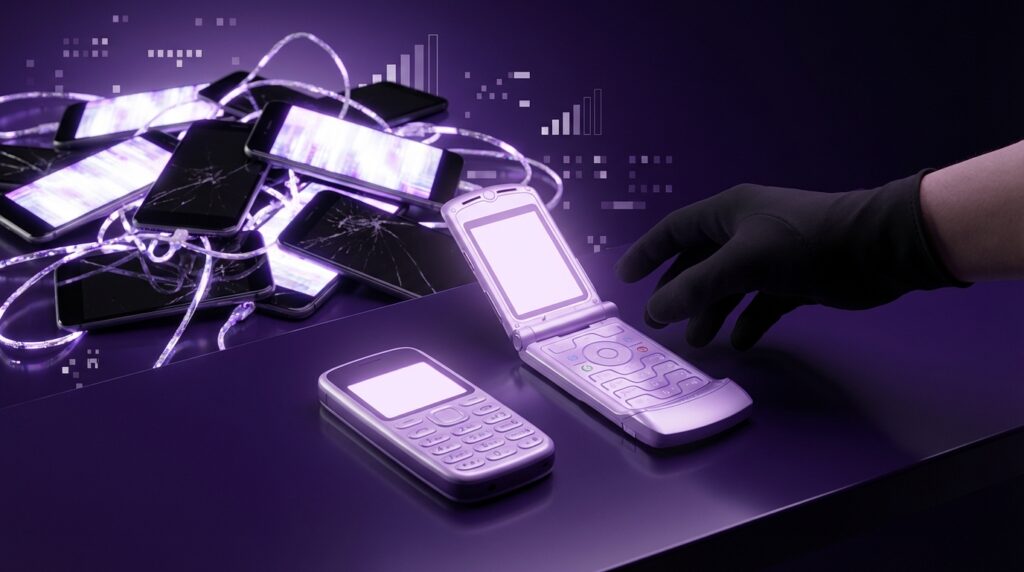
“The hollow clack of a plastic flip phone snapping shut used to say ‘conversation over’ with more force than any swipe to end a call today.”
You remember that sound, right? That sharp little snap, the weight of the hinge, the way the antenna stub brushed your cheek. Now compare that to the flat, glass rectangle in your hand, where ending a call feels like tapping on a piece of silent, indifferent glass. That gap, that missing feeling, is right at the center of why people are suddenly looking back at “dumb phones” and thinking, maybe that was not such a bad idea.
The funny part is, on paper, this whole “downgrade” trend makes no sense. We have phones that can shoot 4K video, run console-level games, translate languages on the fly, run a whole business from an airplane seat. Yet some of the most tech-literate people I know are going on eBay hunting for old Nokia bricks, candybar Motorolas, or brand new minimalist devices that do little more than calls and texts. It is not just nostalgia. It is a reaction to what our phones became.
Go back to the early 2000s for a second. Picture a Nokia 3310 in your hand. The plastic shell is slightly curved, the rubber keys have that springy give when you press down, and each keypress gives a soft “beep” under the backlight of a 84 x 48 pixel monochrome screen. That thing felt like it could survive a fall from the second floor and laugh about it. You did not worry about battery. You charged it once every few days, not once before lunch and again at 5 pm.
Flip phones had their own personality. The Motorola RAZR V3 felt impossibly thin at 13.9 mm. That metallic clamshell had just enough heft that when it sat in your pocket, you knew it was there without even touching it. The tiny external screen glowed a soft blue with the caller ID. Inside, the 176 x 220 pixel display looked perfect at the time, glossy and bright under a sheet of plastic you could scratch if you were careless with your keys.
Back then, your phone was not your entertainment center, your bank, your photo studio, your therapist, your calendar, and your personal surveillance device all rolled into one. It was this focused little gadget that did a few things, and it did them in a straightforward way. You called. You texted with that clumsy but oddly satisfying T9 keypad. You might play Snake while waiting for the bus. That was about it.
So when people talk about “dumb phones” rising again, they are not just saying “I miss old phones.” They are reacting to a world where the thing in your pocket feels less like a tool and more like a slot machine mixed with a leash. The downgrade is not really a downgrade. It is a trade: power for control, features for peace, pixels for presence.
The Original Dumb Phones: What We Really Used Them For
“Retro Specs: Nokia 3310 (2000) – 84 x 48 px screen, 2G GSM, around 133 g, 900 mAh battery, talk time up to 4.5 hours, standby up to 260 hours.”
Look at how narrow the job description of a phone used to be.
You slid a Nokia 3310 out of your pocket. The plastic was slightly rough, almost matte, gripping your palm instead of threatening to slide out like modern glass backs. You pressed the physical power key, held it for a second, and the tiny screen lit up with that old Nokia logo. No animation, no bootloader message, no biometric authentication. Just: on.
Most people used:
– Calls
– SMS
– A couple of pre-installed games
– Maybe a built-in ringtone composer if they were bored on the couch
Your text inbox had a hard limit. Sometimes you would get that “Inbox full” message and quickly scroll through to delete old messages. Every SMS took space. That constraint made each text a bit more deliberate. You picked what stayed.
Mobile internet existed, but it sat in the background like some weird menu item you rarely clicked because GPRS or WAP meant slow, expensive loading and clunky pages that did not fit those pixelated displays.
Then there were flip phones. They added one big sensory feature: the hinge. That snapping close to end a call had a physical pleasure you can still feel in your wrist memory. The keypad usually glowed a uniform color, soft blue or white, each key slightly domed. You could learn the layout so well you could text from your pocket without looking.
Camera phone era started with low-resolution VGA sensors. You remember that grainy photo of your friend in a dimly lit room, pixels swimming, yet it felt like magic that your phone could do that at all.
The key thing: this hardware forced boundaries. You could not scroll infinitely because there was almost nothing to scroll. The phone did not keep pulling you into one more notification because there were maybe three things that could notify you.
When Phones Got Smart: The Always-On Problem
The shift came in steps: color screens, polyphonic ringtones, then smartphones built on Symbian, Windows Mobile, BlackBerry OS. Then came the iPhone and Android, and that is when the phone stopped being just a phone and started trying to be everything.
The glass slabs grew thinner yet heavier. You could feel the density when you picked up an iPhone compared to a plastic Nokia. The curved edges moved toward flatter, sharper lines. Screen resolution leapt from a few thousand pixels to millions. You could no longer see individual pixels unless you pressed your face against the glass.
This is the point where the device changed roles:
– From portable communication tool
– To pocket computer with a phone app
Your thumbs shifted from pressing physical keys, each click a tactile confirmation, to gliding across smooth glass. No mechanical feedback, only vibration and sound. Typing got faster, but also more detached.
Notifications multiplied. Email, then social apps, then messaging apps, then games, then every app asking for permission to ping you. The little buzz in your pocket went from “someone is calling or texting” to “this app thinks you have not opened it today.”
The design of the software leaned on infinite feeds and tiny red dots that lean on your curiosity. That meant more screen time, but less control.
People started noticing side effects:
– Checking your lock screen dozens or hundreds of times a day
– Reflexively reaching for your phone during any pause
– Struggling to focus on long texts or books
– Feeling tired but still refreshing apps late at night
Maybe it was just nostalgia talking, but those older, “dumber” phones started looking smarter.
The New Dumb Phones: Not Just Old, But Intentionally Limited
Here is where the story gets interesting. When people talk about the rise of dumb phones now, they are not just talking about dusting off that old Motorola from a drawer. We are seeing two streams:
1. True retro phones: actual old devices or reissues like the remade Nokia 3310.
2. Modern minimalist phones: new hardware that looks sleek but strips features down.
On one end, you have someone buying a used Nokia 6310 or a classic flip phone. The keypad is physical, the display is tiny, and the operating system does almost nothing beyond calls, text, and maybe a very basic browser.
On the other end, you get devices like the Light Phone series, Punkt phones, or minimalist feature phones offered by carriers in some regions. These often come with:
– E-ink or small LCD screens
– No app store in the usual sense
– Core features like calls, SMS, maybe navigation, maybe a music player
– No social media apps, no addictive feeds
You pick one up and the first thing you notice is weight and material. A Light Phone with its e-ink display feels almost like a small, matte card, not a shiny slab. The texture is more like a Kindle than a smartphone. You notice the lack of color, the slower refresh, which quietly nudges you to use it less.
The operating system menus feel almost boring, and that is the point. Boredom is a feature here, not a bug.
“User Review from 2005: ‘Got this Nokia on a cheap plan. Battery lasts me almost a week. I only charge it on Sundays while watching TV. Reception is better than my friend’s fancy color phone. Snake is still the best game though.'”
Compare that with phones now where a 2-day battery life is something manufacturers brag about. People who switch to dumb phones often cite battery simplicity as one of the side benefits. You charge less, worry less, and notice the device less. The phone fades into the background until you actually need it.
Then vs Now: What Downgrading Really Means
Let us put the nostalgia and the modern slab face to face for a minute.
| Feature | Nokia 3310 (circa 2000) | iPhone 17 (hypothetical modern flagship) |
|---|---|---|
| Display | 84 x 48 px monochrome, around 1.5 inches | ~6.3 inch OLED, 2778 x 1284 px or higher, 120 Hz |
| Weight | Approx. 133 g, chunky plastic body | Approx. 190 g to 210 g, glass and metal |
| Battery | 900 mAh removable, several days of use | 3000+ mAh sealed, around 1 to 2 days of mixed use |
| Connectivity | 2G GSM, SMS, voice calls | 5G, Wi-Fi 6/7, Bluetooth, NFC, satellite messaging |
| Camera | None | Triple or quad camera system, multiple lenses, 4K/8K video |
| Apps | Built-in tools only, no app store | Millions of apps, games, social networks, banking, everything |
| Durability | Survives drops, user-replaceable shell and battery | Fragile glass, needs case, repair often expensive |
| Attention Pull | Low: calls, SMS, maybe a game notification | Very high: constant notifications, feeds, content |
So when someone “downgrades” from a modern flagship to a dumb phone, from a specs sheet perspective they lose a lot. From an attention and control perspective, they gain quite a bit.
Why People Are Downgrading: The Real Reasons
Different groups are walking away from smartphones for different reasons, but there are some common threads.
1. Attention and Focus
Phones today are very good at fragmentation. Ten minutes of focused reading becomes:
– Two DMs
– A group chat ping
– A news alert
– A random scroll on a social app because your finger knows the map from lock screen to feed better than your conscious mind
Some people get tired of fighting that battle every day. Screen time reports feel like a small guilt report on Sundays. So instead of wrestling settings, they change the hardware.
A dumb phone short-circuits a lot of these loops:
– No addictive feeds
– No app-jumping
– No sudden rabbit holes because a notification dragged you in
You get:
– SMS and calls
– Maybe a basic calendar
– Possibly alarms and notes
That is it. You can still get distracted, but it takes more effort.
2. Mental Health and Anxiety
Continuous connection can trigger a sense of constant comparison and low-level stress. Every scroll can lead to someone else’s success, crisis, or outrage. Even if you think you are above it, your brain still takes in the signals.
People who move to dumb phones talk about:
– Lower anxiety
– Feeling less rushed
– Sleeping better because they do not scroll as much in bed
– Feeling present with family or friends, because there is less temptation to glance down
There are also people who keep a smartphone but treat it more like a laptop, leaving it at home or on the desk, and carry a dumb phone when they go out. That small separation gives their brain permission to rest.
3. Parents and Kids
Parents are a big part of this trend. They want their kids reachable without opening a door to the entire internet. A simple phone that can call home and text is a compromise.
Some schools respond to smartphone distraction by recommending or allowing only basic phones during school hours. That way a kid can still call a parent, but will not spend math class on YouTube.
From the kids’ side, some actually like the idea of less pressure. Social media can feel like a 24/7 performance review. A device that reduces that pressure can feel like a relief.
4. Privacy and Control
Modern smartphones collect a lot of data: locations, app usage, contacts, patterns of behavior. Even with privacy settings, there are many moving parts.
Feature phones and minimalist devices usually have:
– No major app store
– Limited tracking
– Simpler operating systems with fewer ad SDKs built in
For someone wary of being tracked, a simpler phone offers a more contained footprint. It is not perfect, but it is less porous.
5. Design Fatigue and Tactile Cravings
Then there is just the pure physical craving: keys you can press, hinges that move, sliders that click.
You remember the feel of a T9 keypad: each button raised, some with tiny rubber nubs. You could almost type by sound. Pressing “2” three times to get the letter “c” created a certain rhythm. On a smartphone, you lose that mechanical symphony and get a silent grid.
Some people want to feel their devices again, not just tap glass. Flip phones add ritual: you open them to talk, you close them to hang up. That little motion gives a clean sense of starting and ending.
6. Cost and Longevity
Smartphones can be expensive. A high-end flagship often costs as much as a good laptop. Repairs add more. Screens crack, batteries swell, ports wear out.
A basic phone:
– Costs far less upfront
– Often survives abuse
– Has a battery that can be swapped easily
– Can last years as long as 2G/3G/4G support exists
For some users, this is not a lifestyle statement. It is just pragmatic.
The Modern Dumb Phone Experience: What Using One Feels Like Now
Imagine you switch your SIM from a new smartphone to a minimalist phone.
The first thing you feel is lightness. Not metaphorically, physically. The new device is smaller, often narrower. You wrap your whole hand around it without stretching. The screen looks tiny; you can see all of it without shifting your eyes.
You press a side key to wake it. No face ID. No complex lock screen. Maybe a PIN, maybe a simple unlock key combination. The home screen shows the basics: “Call”, “Messages”, “Contacts”.
You type an SMS. The T9 keypad starts to train you again. The first messages feel slow and clumsy. By day three, your speed improves. You start to notice how T9 predicts whole words from just a few taps. It is oddly satisfying to watch it guess “coffee” on the first attempt.
Then, something quieter happens. There is a gap in your day. You stand in a line, sit on a train, wait for a friend at a cafe. Your hand reaches for the phone, out of habit. You unlock it. There is nothing mindless to open. No feed full of endless content. You skim your messages, check missed calls, maybe open the basic tools. Then you hit a wall.
You look up.
There is boredom. It feels strange. You might even feel a bit uncomfortable. That is the part many people are trying to get back to, even if they would not have used that word. Boredom is where the brain resets. It is where you notice small details again: sounds, people, your own thoughts.
“User Review from 2005: ‘Switched from a smartphone to a basic flip for work. I miss the fancy stuff but I am getting so much more done. When the phone rings, I answer. When it does not, I forget about it. Feels like having my own head back.'”
Of course, there are friction points:
– Navigation: Many dumb phones do not have good maps. You might need a separate device or printed directions.
– Group chats: Some messaging apps do not work, or work poorly, on feature phones.
– Two-factor codes: Some services expect smartphone apps for verification.
This is why a lot of people end up with hybrid setups: keep a smartphone at home, use a dumb phone outside. Or keep a smartphone with all social apps removed, used mostly as a tool, not a constant companion.
The Tech Industry Response: Minimal Modes Inside Smart Phones
Hardware is one way to simplify. Software is another.
Phone makers noticed people were turning to digital detox methods. That led to features like:
– Focus modes
– Gray-scale displays
– App timers
– Notification digests
These are attempts to build a “dumb phone” inside your smart phone. You can set up a mode where:
– Only calls and SMS come through
– Only a small set of apps are visible
– Your home screen is stripped down
On paper, this gives similar benefits. In practice, the other apps are still there, one or two taps away. Some people can self-regulate with these tools. Others prefer a hard barrier: physical devices that simply cannot do the things that eat their time.
Nostalgia vs Strategy: Is This Just Looking Back, Or Planning Ahead?
It is easy to dismiss the dumb phone trend as retro romanticism. Yes, there is a nostalgic glow when you hold a device that reminds you of your first text or your first late-night call under the covers.
But a lot of people choosing simpler phones today are not anti-tech. They are power users elsewhere: fast laptops, smart homes, high-res monitors. They just want their pocket device to serve a narrower purpose and stop trying to be everything.
You could see this as a kind of “tech diet.” Instead of letting the most addictive, engaging form factor dominate every moment, they pick tools for specific tasks:
– Laptop or tablet for deep work and browsing
– Dumb or minimalist phone for communication
– Maybe an e-reader for books
– Smartwatch for limited notifications or fitness
From that angle, dumb phones are not a throwback. They are one piece of a more deliberate stack.
Where This Might Go Next
You can already see hints of where this path could lead.
Manufacturers test the waters with:
– Foldables that bring back hinges in new ways
– Compact phones that buck the trend of huge screens
– Rugged phones that value durability over sleekness
– Reissue models like old Nokias with updated internals
Some carriers offer simple phones marketed directly as “detox” or “kids first phone.” Accessory makers sell cases that hide screens, or that only show a tiny notification window.
At the same time, app ecosystems push in the opposite direction: more engagement, more video, more live features. That tug-of-war is not going away.
Somewhere between those forces sits the user, deciding what kind of relationship they want with the object in their pocket.
“Retro Specs: Motorola RAZR V3 (2004) – 176 x 220 px screen, around 95 g, VGA camera, 680 mAh battery, quad-band GSM, iconic 13.9 mm thin clamshell design.”
Picture that phone in your hand again. You flip it open and feel the hinge reach its stop with a tiny thud. The keypad lights up like a little runway of metal and light. It does not ask you to check five feeds. It waits for you to tell it what to do: call, text, maybe take a crude photo.
Maybe that is why the rise of dumb phones feels less like a fad and more like a quiet correction. Not everyone will trade in their smartphone. Many never will. But enough people reached a point where more power did not feel like more freedom, and they started looking backward to move forward in a different way.
The history looped: the simpler device became the advanced choice for people who know exactly what they want from their tech, and what they do not want anymore.
