

“That faint high-pitched whine from your old Nokia charger, the one that stayed warm for hours even after you unplugged your phone.”
You remember that sound, right? That cheap little brick, yellowed plastic, always plugged into the wall, always hot, always sucking a bit of power whether your phone was charging or not. Now jump to today: a credit card sized laptop that charges from a tiny wall cube that feels almost toy-like, but pushes enough power to feed a gaming laptop, a tablet, and a phone at the same time. Same idea, same wall socket, but a completely different class of charger. That is the jump from those old-school silicon chargers to the new GaN chargers you keep seeing on Amazon and in every “travel tech” YouTube video.
So when you hear “GaN” in product titles, you are not just looking at marketing fluff. You are looking at the quiet replacement for the clunky blocks we grew up with. That tiny cube that came with your phone, the surprisingly heavy charger that shipped with your first netbook, the old 65 W power brick for that ThinkPad with the squeaky fan. Every one of those chargers was built around silicon. GaN, or gallium nitride, rips out that core ingredient and swaps in a different semiconductor that flips current faster, wastes less energy as heat, and lets engineers cram a lot more power into a lot less plastic.
Maybe it was just nostalgia talking, but I still remember the weight of my first “fast” charger. It felt serious. You could feel the transformer inside. It hummed if you put your ear close. It got warm enough that you wondered if it was safe to leave on a carpet. Compare that to a modern 65 W GaN charger that feels dense, but not oversized, with almost no warmth at idle and only a gentle temperature rise even during a MacBook charge from 5% to 80%. Same wattage, smaller footprint, way better behavior.
Before we get into the specs and the “should you buy one” angle, it helps to zoom back for a second and see where these little blocks came from. Chargers used to be simple: a big iron core transformer, some diodes, a basic regulator if you were lucky. They were heavy, they buzzed, and they wasted power. Then came switch‑mode power supplies, where transistors chop current at high frequency so you can use tiny transformers. That brought the first wave of compact phone chargers. Silicon was the hero there. For about two decades, we asked silicon to switch faster and run hotter. You saw the result: phone chargers went from huge and slow to smaller “fast chargers” that felt a bit aggressive, often borderline hot, and sometimes failed earlier than they should.
GaN starts where silicon was running out of breath. It can handle higher voltages, switch faster, and lose less energy during each switching cycle. That is the quiet revolution sitting between your wall socket and your battery right now.
“Retro Specs: 5V, 500 mA. That was a ‘good’ USB power adapter spec in 2005. You plugged in your phone and waited. And waited.”
What GaN Actually Changes Inside the Charger
Let’s pull the plastic cover off without getting too lab notebook about it.
Traditional silicon chargers use MOSFETs made from silicon. These are the switches that turn power on and off millions of times per second. Every switch wastes a bit of energy, shows up as heat, and limits how small the transformer and other parts can be. You want higher power in a smaller space, but heat builds up, and silicon starts to struggle.
GaN devices can:
– Handle higher voltages than silicon at similar sizes
– Switch faster, so the charger can run at higher frequencies
– Waste less power as heat while they do that switching
The effect feels pretty direct when you hold one.
You pick up a 65 W silicon-based charger and it is about the size of a bar of soap, with chunky edges and a long case. You pick up a 65 W GaN charger, and it looks like someone compressed it from all sides. Shorter, narrower, sometimes almost square. Same wattage rating on the label.
With higher switching speeds, engineers can shrink the transformer, capacitors, and inductors inside. Those are the bulky parts that used to decide how big your charger had to be. Less heat also means less plastic shell used for safety clearance and fewer thermal compromises.
You end up with chargers that:
– Pack more watts per cubic centimeter
– Run cooler at the same power output
– Hit higher peak power ratings without melting down your wall socket
“User Review from 2005: ‘This 1A charger is awesome, my phone charges in just over 2 hours now! Way better than the one in the box.'”
From Nokia Bricks to GaN Cubes: Then vs Now
You can feel the story of GaN by comparing your mental image of an old charger to something you can buy today. So let’s stack something legendary like the Nokia 3310 era power setup against what an iPhone-class user touches now.
Devices Then vs Power Now
Here’s a simple way to see how everything around chargers changed too:
| Feature | Nokia 3310 Era (early 2000s) | Modern Flagship (iPhone 17 class) |
|---|---|---|
| Typical Battery Capacity | ~900 mAh | ~4300-4800 mAh |
| Charger Output | 5V, 350-500 mA (2-2.5 W) | 20-35 W USB‑C PD, often GaN |
| Charge Time (0-80%) | About 1.5 hours | 30-40 minutes with fast charge |
| Charger Size | Large, tall AC plug, fixed cable | Tiny USB‑C brick, detachable cable |
| Heat Output | Noticeably warm, always warm when plugged | Cool at idle, warm only under heavy load |
Notice the disconnect: batteries got about five times larger, but charge times dropped instead of ballooning. That is the story GaN helps tell on the charger side, along with smarter battery controllers in the device.
Now let’s make a simpler wall‑charger oriented comparison.
Charger Then vs GaN Charger Now
| Spec | Classic Silicon Charger (circa 2010, laptop) | Modern GaN Charger (2025, multi‑port) |
|---|---|---|
| Rated Power | 65 W | 65-100 W |
| Physical Size | Long brick with cable, ~120 x 45 x 30 mm | Compact cube, ~60 x 40 x 30 mm |
| Ports | 1 proprietary barrel jack | 2-4 USB‑C / USB‑A |
| Standby Power Draw | Higher, often warm when idle | Low, usually cool at idle |
| Heat Under Load | Hot brick territory | Warm but manageable in palm |
| Travel Convenience | Bulky, dedicated to one laptop | One charger for laptop, phone, tablet |
This is why tech people get excited about GaN chargers. They are not just niche lab toys. They change how many bricks you need in your backpack, how long you stay plugged into the wall, and how flexible your charging setup can get.
How GaN Chargers Get Smaller And Faster
“Smaller and faster” sounds a bit like a marketing slide, so let’s ground it in actual behavior.
Higher Switching Frequency
Classic silicon chargers often switch somewhere in the tens or hundreds of kilohertz. GaN chargers can comfortably operate at much higher frequencies. When switching frequency goes up, transformers can shrink. Inductors and capacitors can shrink too. These are the chunky bits on the PCB that take up most of the space.
Think of it like this: if a transformer handles power in shorter, faster bursts, it needs less iron and copper to do the job. That is where a lot of volume disappears.
Lower Losses, Less Heat
Every transistor has some resistance and some losses when it flips states. GaN FETs tend to have lower conduction and switching losses than silicon at the same voltages. Less wasted energy = less heat.
Less heat means:
– You do not need as much air volume inside the case
– The plastic does not need to insulate you from a mini space heater
– Components live longer at a given wattage
Engineers can push designs closer to the power envelope without entering “scorched fingers” territory.
Power Density: More Watts Per Cubic Centimeter
This is the core metric you feel in your hand. A 65 W GaN charger is often half the volume of a 65 W silicon brick. Some 100 W GaN chargers are not much bigger than older 30 W USB‑C chargers.
It is not that GaN magically writes new physics. It just plays nicer with the constraints:
– Higher voltage tolerance
– Faster switching
– Lower losses
That combination opens new layouts and lets companies cram more into less.
“User Review from 2005: ‘Charger came with my PDA, but I bought a second one because it feels fragile and gets really hot. Not sure how long it will last.'”
Unboxing The Latest GaN Chargers: What You Actually Get
Let’s walk through the experience you would have with a current GaN charger on your desk. No marketing sheet, just what your senses pick up.
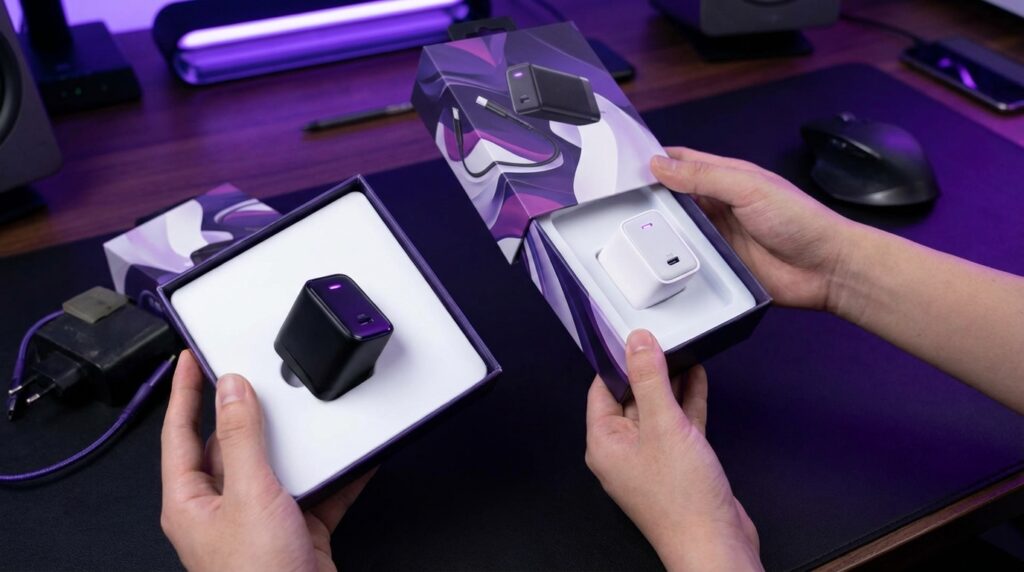
You cut the seal on a new 100 W GaN brick. The box is smaller than old entry-level routers. Inside, the charger itself almost disappears in one hand. It feels dense, like a power bank, but not heavy in the old “bulky” way. There is no built-in cable for most of these; instead you get at least one USB‑C port, sometimes three or four, plus maybe a legacy USB‑A.
The plastic has that smooth matte texture. You can feel slight seams where two halves of the case meet, but no flex. On the label in small print: “Input: 100-240 V, 50/60 Hz. Output: up to 100 W USB‑C PD, PPS.” That is the modern fast charge alphabet.
You plug it into the wall and connect:
– A laptop on USB‑C
– A phone on another USB‑C
– Wireless earbuds through a USB‑A cable
Within seconds, the charger negotiates power with each device. USB Power Delivery (PD) and PPS (programmable power supply) let each port talk to each device. Your laptop asks for 65 W, your phone peaks at 25 W, your earbuds sip 5 W. The charger juggles these in real time, deciding where to send current and when to ramp down as batteries reach higher charge levels.
Instead of three wall warts, you have one. That is the real-world upgrade.
Specs You Will See On The Box
On most current GaN chargers, you will spot numbers like:
– 30 W: good for phones, tablets, maybe small laptops
– 45 W: thin and light laptops, tablets, phones
– 65 W: mainstream laptops and everything smaller
– 100 W: bigger laptops, multi‑device setups
– 140 W or more: USB‑C PD 3.1 class, for higher‑end machines
Alongside:
– USB‑C PD 3.0 or 3.1
– PPS support for smoother charging curves on certain phones
– Multi‑port layouts with dynamic power sharing
The magic is that a 65 W GaN charger can be the size of some older 20 W silicon chargers, and a 100 W GaN unit can still slide into a shirt pocket.
Why Your Phone And Laptop Charge So Much Faster Now
It is tempting to credit only GaN here, but the full story is a tag team between charger and device.
Battery Chemistry And Controllers
Modern lithium‑ion packs have:
– Better electrodes that handle higher charge currents
– Smarter battery management systems that monitor temperature and voltage per cell
– More aggressive fast‑charge curves that push hard to about 50-60 percent, then taper off
Your phone might advertise “50% in 30 minutes.” That is not just raw wattage. It is a carefully shaped flow: high current at first, then stepping down in stages.
GaN chargers with USB‑C PD and PPS let the device request very precise voltage and current levels. Instead of only 5 V or 9 V, PPS can ask for small steps like 3.3-21 V in tiny increments. So while the battery controller is monitoring temperature and cell voltage, the charger is adjusting in near real time.
The Old Linear Wall Wart vs Smart GaN PD Charger
Old chargers were basically “dumb.” They pushed out a fixed 5 V at some capped current. The phone or gadget had to deal with it.
New GaN chargers:
– Map multiple power profiles
– Listen to requests over a digital protocol
– Switch between modes faster than your eyes can see
So when you see a phone jump from 5 V / 3 A to 9 V / 2.2 A, then down again, that is the kind of dynamic behavior GaN chargers are built to handle cleanly at high power levels.
Safety, Heat, And That Not-So-Quiet Anxiety
If you have ever held a third‑party charger and thought, “Is this thing going to fry my laptop?” you are not alone. Smaller does not automatically mean safer, and the early waves of tiny high‑wattage chargers made a lot of people nervous.
GaN itself is not the weak point. In fact, its lower losses help reduce stress inside the charger. The real questions come down to:
– Quality of the design
– Proper isolation between the high‑voltage and low‑voltage side
– Thermal design under worst‑case load
– Compliance with real safety standards, not fake stickers
The better GaN chargers from known brands feel boring in the best way under stress:
– Warm but not painful to touch
– No coil whine or high‑pitch noise under light load
– Stable voltage levels under load changes
The sketchy ones often reveal themselves through:
– Noticeable high‑frequency chirps
– Plastic that flexes or creaks
– Odd behavior like phones disconnecting and reconnecting during charge
That is not a GaN problem. That is a cheap hardware problem. Same story as early no‑name “fast chargers” years ago.
GaN Chargers As Travel Hubs
One of the best real‑world use cases for these new chargers is travel. Think about what used to be in a laptop bag:
– A laptop brick with a proprietary connector
– A phone charger with a USB‑A cable
– Maybe a tablet charger
– Possibly a camera charger
Every device expected its own little brick.
Now you can walk through an airport with:
– One 65 W or 100 W GaN charger
– Two or three USB‑C cables and maybe one USB‑A
You grab a seat at a gate, plug one brick into a crowded power strip, and charge:
– Laptop on USB‑C
– Phone daisy‑chained through another port
– Earbuds or watch on a third port
That multi‑port design is where GaN’s power density really changes your habits. You do not need multiple wall sockets. You do not have to decide which gadget deserves the one free outlet. The charger itself becomes a mini power strip.
How Multi‑Port GaN Chargers Share Power
If you have ever wondered why a 100 W GaN charger says things like “65 W + 30 W” on the box, here is what is going on.
Inside that charger is one power stage that can deliver a total wattage, like 100 W. The ports then share that total.
For example:
– One USB‑C alone: up to 100 W
– Two USB‑C ports used: top port up to 65 W, second up to 30 W
– Add a USB‑A: remaining budget shrinks a bit more
The charger firmware decides how to slice the pie:
– Plug in just your laptop: it gets the full 100 W profile
– Add your phone: laptop may drop to 65 W, phone gets 30 W
– Add a third device: laptop might drop further once it hits a certain battery level
You can feel this when you plug your laptop first and see a high wattage on a USB‑C power meter, then plug in a phone and watch the laptop’s intake drop while total output stays near max.
GaN helps these designs stay small and stable at those higher combined loads.
Are GaN Chargers Better For The Grid And Your Bill?
From a pure geek angle, power supply efficiency curves are satisfying to look at. From a practical angle: yes, GaN chargers tend to waste less energy, especially at higher power levels.
That means:
– Less heat loss in your bag or on your desk
– Slightly lower power bills in heavy-usage situations
– Less constant warm idle draw when nothing is plugged in
For a single user at home, the savings from one charger are not life‑changing. Multiply that across millions of chargers worldwide and the story gets more interesting. Every few percent of loss shaved away by GaN tech means less total wasted energy.
Where GaN Chargers Still Need Work
Everything sounds positive so far, but these chargers are not perfect.
Thermal Limits In Tiny Shells
Manufacturers keep pushing toward smaller and smaller cases. At some point, thermal reality bites. There are tiny 65 W GaN chargers that heat up more than larger 65 W units from more conservative brands. Same GaN tech, different thermal design.
So smallest is not always best. A slightly bigger GaN charger with more surface area can run cooler and last longer.
Price And Brand Confusion
Type “GaN charger” into any shopping site and you get thousands of hits, all roughly similar in photos:
– Same matte plastic
– Same cluster of USB‑C and USB‑A ports
– Same bold wattage printed on the side
Prices, though, can differ by 2x or more. That gap often reflects:
– Better components (capacitors, controllers, GaN FETs)
– Real testing and certification
– Tighter quality control
A cheap 100 W GaN charger that fails after six months is not an upgrade over a solid 65 W unit that runs for years. The tech inside may be the same type of semiconductor, but the overall design matters.
GaN Beyond The Wall Charger
If you like this stuff, GaN is starting to show up beyond the tiny blocks in your backpack.
You already see it in:
– Laptop chargers shipped in the box from some brands
– High‑power USB‑C docks that can charge and connect monitors
– Compact power bricks for gaming laptops and mini PCs
Soon you will see more GaN in:
– Power stages inside high‑end power supplies
– Home energy systems and compact inverters
– Fast‑charging stations for larger battery packs
For our little corner of gadget history, the fun part is that this tech started showing up first in the most familiar object: the charger you toss into a bag without thinking.
“Retro Specs: ‘Input: AC 100-240 V, 50/60 Hz, 0.1 A.’ That tiny Droid charger looked harmless, but under stress it ran hot enough to scare you away from overnight charging on the pillow.”
The Feel Of Charging: Past vs Present
Think back to that warm plastic block on your bedroom floor, the curled cable with kinks, the feeling that you were borrowing power from the wall in a clumsy way.
Now picture:
– A compact GaN cube on a desk power strip
– One braided USB‑C cable going to a laptop
– Another thin cable reaching to your phone
– LEDs on both devices jumping percentages faster than your brain expects
You pick up the charger after two hours of heavy use. It is warm, not alarming. Silence. No hum, no whine. If you unplug everything, the charger cools quickly because there is not much mass or loss inside.
This is where the “smaller and faster” part becomes more than a spec line. It changes how visible your charging gear feels in your life. Less plastic, fewer bricks, more sharing.
GaN Chargers As Everyday Infrastructure
Walk through a modern coworking space or a university library. On tables you will see:
– USB‑C GaN bricks from different brands
– Laptops from multiple manufacturers, all drawing from that same standard
– Phones from different ecosystems plugging into the same ports
Old-school chargers were tied to one device. Barrel jacks, proprietary tips, and fixed cables locked each brick to one gadget. GaN arrived just in time for a USB‑C world where power and data share one connector.
That pairing is the real move here:
– GaN makes higher power practical in small shells
– USB‑C PD and PPS make higher power manageable and negotiable
– Multi‑port designs make that power shareable
It is the same wall socket your Nokia used, but the brains and materials in the middle have changed completely.
