

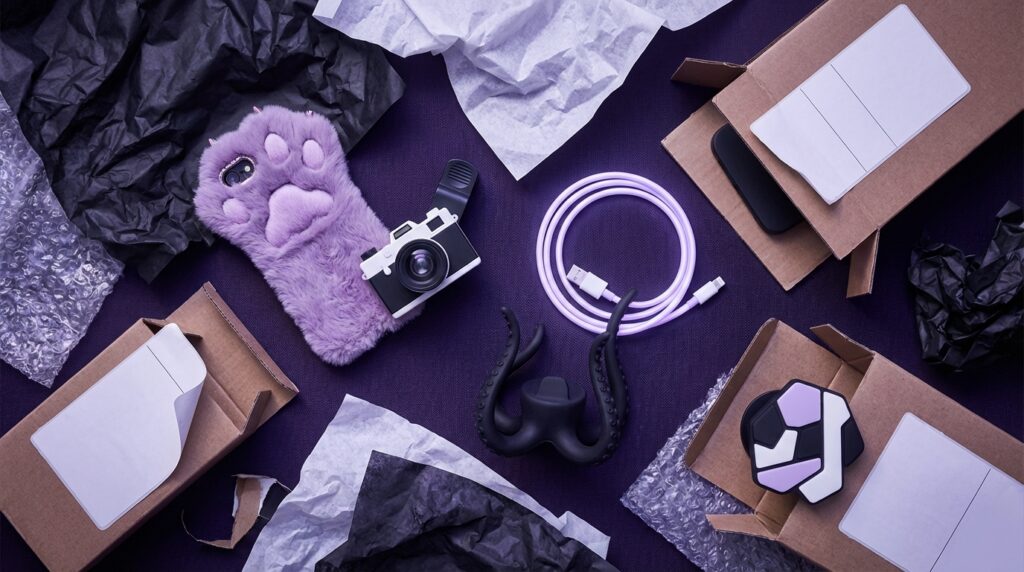
“The crinkle of that thin plastic, the smell of cheap rubber, the tiny static shock when you snapped a neon antenna onto a phone that never needed one.”
You remember that rush, right? Peeling some no-name accessory out of a plastic sleeve, holding it in your hand, and thinking, “This is either genius or the dumbest thing I’ve ever bought.” Back then it might have been a clip-on LED that made your Nokia light up every time you got a text. Today, it is a package from AliExpress that took three weeks to arrive, containing a phone case shaped like a carton of fries that smells faintly like a tire shop.
Different decade, same impulse.
We keep dressing up our phones, even when those phones already feel like tiny glass spaceships. That urge to tweak, mod, or joke around with our devices has not gone anywhere. It just moved from mall kiosks and carrier stores to a feed filled with “99 cent free shipping” bargains that feel both suspicious and irresistible.
Maybe you scroll through AliExpress late at night, half curious, half bored, and you see it: a smartphone holder shaped like a tiny toilet. You stop. You zoom in. You picture it on your desk. That moment, right there, is the same feeling we had when we saw a glowing antenna on someone’s flip phone in 2004 and thought, “I kind of want that.”
The weight of nonsense in your hand
Before we get to the strangest AliExpress accessories, let me ground this in a physical memory.
Think about the first phone you really “decorated.” Maybe it was a Nokia 3310 with a transparent blue shell that made the silver keypad shine through like a cheap toy. You remember the weight: a little brick, dense in your palm, with a battery that sat under a creaky plastic back cover. The rubber buttons had that soft “thup” sound when you pressed them, and the tiny green backlight bled around the edges of the numbers.
You slid a vinyl sticker under the transparent case. You clipped a lanyard to a tiny loop in the corner. Maybe you attached a dangling charm with a bell that annoyed everyone except you. None of these things changed how the phone worked. They just changed how it felt to you.
Fast forward to now. Your phone is a slab of glass and metal, almost too thin. It has no charm loop. The tolerances are tight. The screen is all you see. You tap, swipe, pinch on a display that has more pixels than the monitors used in big studios when the Nokia 3310 was popular.
Yet AliExpress is full of accessories that try to bring back that “extra” feeling: rubber bands, weird clips, fake buttons, plastic animals glued to silicone cases. The nostalgia is not just for the devices, but for the idea that your phone could be a little bit silly.
Retro specs vs modern monsters
To really appreciate how odd some of these accessories are, it helps to compare what we used to accessorize with what we accessorize now.
Back in the early 2000s, the wildest add-ons were sometimes the most low tech things: a glow-in-the-dark cover, an antenna blinker, maybe a snap-on camera for phones that did not ship with one.
Retro Specs: Nokia 3310 (circa 2001)
Screen: 84 x 48 pixels, monochrome
Weight: About 133 g
Ringtone storage: A handful of monophonic tones you probably remember by heart
Battery: Around 900 mAh, but felt like it lasted forever
Accessories: Clip-on covers, LED antennas, belt holsters with squeaky plastic clips
Contrast that with a modern flagship, where the base spec sheet already sounds overloaded.
Modern Specs: iPhone 17 (fictional but you get the idea)
Screen: High refresh rate OLED, thousands of pixels across
Weight: Around 180-200 g
Storage: Enough to carry your entire teenage MP3 library and still have room
Battery: Multi-day if you do not game too much
Accessories: MagSafe stands, external lenses, gaming grips, AI-powered camera trackers
Now let us put some of this side by side.
| Feature | Nokia 3310 Era | iPhone 17 Era |
|---|---|---|
| Typical Screen | 84 x 48 mono LCD | 3200+ x 1440 OLED |
| Main Use | Calls, SMS, Snake | Everything from banking to 8K video |
| Accessory Focus | Looks and ringtones | Protection, charging, novelty |
| Popular Weird Accessory | LED antenna blinker | Cat paw MagSafe grip with built-in perfume |
| Average Price per Odd Gadget | Phone shop impulse buys | AliExpress sub-$5 “why not” items |
The tech advanced, but the impulse purchase remains about the same: something small, fairly cheap, and slightly unhinged.
The AliExpress factor: why the weirdness exploded
Here is where AliExpress comes in. AliExpress is like the global version of those glass display cases in old phone stores, only dialed up, filtered by an algorithm, and shipped from warehouses thousands of kilometers away.
You are not at the mercy of whatever the local kiosk decided to stock. You are at the mercy of search terms like “funny phone holder” and “weird phone accessory cheap.” You type that, and suddenly you are in a catalog that looks like someone fed a phone parts warehouse into a random idea generator.
Part of the charm is that many of these products look homemade, even when mass produced. The plastic feels light, the paint may be slightly off, and the product photos often use that unmistakable, harsh LED lighting that makes everything look slightly surreal.
Maybe it is just nostalgia talking, but there is something comforting about that slightly cheap feel. It reminds you of buying a transparent Game Boy shell from some shady site in the 2000s, then holding the thin, squeaky plastic in your hand and thinking, “This can not be original, but I sort of love it.”
Odd category 1: Accessories that cosplay as other objects
One of the strangest threads on AliExpress is phone accessories that pretend to be something else entirely. Your phone case is no longer a case. It is a snack, a tool, or a household item that has no business being near sensitive electronics.
Food-shaped phone cases
You have probably seen them: cases shaped like milk cartons, bubble tea cups, instant noodle packs, or full-on fried chicken drumsticks. They are huge, bulky, and they turn your slim phone into a rubber sculpture.
The weight is not like a solid battery pack. It is this odd, hollow heaviness from foamed silicone. You hold it, and the edges squish a little, but the back feels dense. The texture is strange: slightly sticky at first, like those rubber toys from vending machines.
User reviews from AliExpress often sound like they came out of 2005 message boards, written in a mix of awe and regret.
User Review from 2005 (fictional, but you know the tone)
“Got this fake burger phone case from some site in China. Phone does not fit in my jeans anymore but everyone in class keeps asking where I got it. Kinda smells weird.”
Food cases do one simple thing: they break the visual pattern. Every slab phone looks the same lying on a table, but a phone that looks like a fries box stands out. It is not practical. It is not slim. It is not “sleek.” It is just fun, in the same way a blinking antenna was fun on a Nokia.
Phone holders that are tiny toilets, beds, and hands
Another rabbit hole: stands and docks shaped like toilets, bathtubs, miniature beds, or tiny hands that seem ready to grab your device.
You slide your phone into a tiny plastic toilet, and suddenly your expensive smartphone is sitting where no gadget should proudly sit. The stand itself often weighs almost nothing, made from thin ABS plastic that would probably crack if you dropped it from desk height. The bottom might have four little foam pads badly aligned.
The gag here is visual: you join a video call while your phone is “parked” in a miniature bathroom fixture. You watch TikTok while your device rests between two plastic hands that look halfway between helpful and creepy.
This urge to miniaturize everyday stuff and connect it to phones is not new. Think back.
Retro Specs: Novelty Stands (circa mid 2000s)
Common forms: Mini office chairs, plastic lips, random cartoon animals
Materials: Hollow plastic, suction cups that lost grip in a week
Phones supported: Flip phones with external antennas and chunky backs
Primary purpose: Desk decoration first, stand second
The modern AliExpress version just scaled that to everything: toilets, full-body figures, realistic shoes, fake bricks, and more.
Odd category 2: Accessories that add fake “tech”
The second category is my favorite: add-ons that pretend to add extra tech, even when they barely do anything, or their purpose is still unclear after you read the product description three times.
Clip-on “AI” camera covers and lens rings
You have probably seen those AliExpress listings that promise better portrait photos with a ring of plastic that sticks around your camera hub. The pictures show dramatic, soft light and dreamy bokeh, but the product shipped is often a simple colored ring or tiny snap-on “hood.”
There is something oddly familiar here. In the early 2000s, many phones did not have a camera at all, so companies sold clip-on camera modules that connected through a weird port or even the headphone jack.
Retro Specs: Clip-on Phone Cameras (circa 2003)
Resolution: VGA, if you were lucky
Connection: Proprietary bottom port or side connector
Image quality: Grainy, blown-out highlights, but magical back then
Use case: Sending tiny MMS pictures to the few friends who could receive them
Modern AliExpress camera accessories sometimes doodle around the edges of that idea. You get magnetic or clip-on lenses advertised as “4K macro” or “fisheye pro,” but the mount is wobbly and the glass shows smears or reflections. Still, the idea feels the same: “I can upgrade my phone camera myself, no full phone upgrade needed.”
The oddest ones are camera “covers” that are more cosplay than tech. Some add a fake DSLR-style housing with plastic ridges and pretend dials. Your flat phone suddenly sprouts a fake viewfinder hump that does nothing but turn your pocket device into a toy camera prop.
Signal boosters and antenna stickers
This is where nostalgia meets pure superstition.
On AliExpress, you still find paper-thin metallic stickers that claim to boost your phone signal. They look like tiny printed circuit boards on gold foil. You are supposed to slide them under your case or behind your battery.
If that sounds familiar, it is because mid-2000s malls were packed with similar “antenna boosters” sold at kiosks next to screen cleaning spray and leather cases.
User Review from 2005 (fictional, but close to reality)
“Bought this golden sticker for my Nokia 6600, they said I would get more bars at home. Stuck it under the battery. Phone feels the same, but now it looks kinda sci-fi when I open the back.”
The modern stickers use the same vague promises, only now they sprinkle in words like “5G” and “radiation protection.” In practice, they mostly add psychological comfort and one extra thing to show your friends when they ask, “What is that under your case?”
Odd category 3: Accessories that blur toy and tool
Then there are the items that sit in the weird middle ground between useful tool and straight-up toy. They do something, but the way they do it, or the way they look while doing it, makes you smile and shake your head at the same time.
Selfie remotes hidden in plush toys
AliExpress is filled with Bluetooth selfie remotes, but some of the strangest ones hide the electronics inside plush keychains: cartoon bears, cats, or completely unlicensed characters with suspiciously familiar faces.
You press the belly of a small plush, and somewhere inside, a tiny PCB clicks a tactile switch. The battery is usually a coin cell. The feel in your hand is soft, but you can sense the small hard circle inside. It is this mix of childhood and tech: stuffed toy outside, camera shutter remote inside.
From a design angle, this is not far from those early 2000s charms with blinking LEDs triggered by incoming calls. Back then, the charm loop on your phone held a plastic star or heart that would light up from RF interference.
Now the charm is smarter, but the spirit is similar: the accessory reacts to what your phone does.
Finger grips with hidden tools
AliExpress ring grips are a category on their own, but some take it to impressive extremes. There are grips with built-in bottle openers, SD card holders, or tiny kickstand legs that fold out from inside the ring structure.
The metal feels cheap but sturdy enough. When you unfold a hidden function, there is that soft “clack” of a small hinge that was stamped and riveted in some factory far away, designed for a person who wants one more trick on their phone case.
The more absurd examples combine three or four functions in a single plate: ring grip, magnetic plate, cable winder, and card holder. Your phone becomes a Swiss Army slab, thicker and heavier, with moving parts that catch on your pocket.
This is not new either. Early smartphone holsters, especially for BlackBerry-style devices, had belt clips with rotating mechanisms and sometimes little card slots. Again, AliExpress just stretched the idea to its limit and asked, “What else can we pack under someone’s fingertips?”
Odd category 4: Accessories that try to change how you hold your phone
One thing that has not changed since T9 days is how personal the grip on a device feels. You remember the firm two-handed grip around a Nokia while speed-typing SMS, thumbs tapping rubber keys that had concave shapes for each number. The phone sat securely in the curve of your fingers. You could text without looking.
Today’s flat, wide devices are harder to hold one-handed for some people, so AliExpress sellers keep creating stranger solutions.
Elastic strap grips and glove-style holders
You might have seen the basic version: a simple elastic band that sticks to the back of your phone or case, so you can slide a couple of fingers under it. AliExpress expands that into full hand harnesses, glove-like straps with Velcro that make your phone feel like a fitness accessory more than a pocket computer.
There are cases with integrated finger sleeves, as if your phone expects you to wear it like a partial glove. The materials range from soft fabric that feels like a cheap wristband to synthetic leather that creaks a bit when you move your fingers.
The weirdness peaks when the strap grips are shaped like cartoon faces or animals, so your fingers seem to slide into the mouth of a frog or the arms of a tiny bear while you scroll.
Anti-fall “parachute” cords
Another trend is overbuilt lanyard systems: thick ropes, bungee cords, even harnesses that clip to your clothes. The phone hangs from your neck or shoulder like a piece of camping gear.
In a way, this is just the return of the simple neck straps from early camera phones, only upsized for larger devices. You might remember walking around with a candybar phone dangling from a bright lanyard, occasionally smacking against your chest or bouncing off your keys.
The AliExpress upgrade adds more hardware: metal clips, rotating joints, and adjusters that feel like they were borrowed from backpack straps. Some listings show people riding bikes, climbing, or even skateboarding with their phones swinging from these cords.
The oddest accessories in this subcategory attach with suction cups instead of cases, as if that is a reliable anchor point. A big plastic suction base on the back of your glass phone, with a rope tied to it. You can almost feel the tension and hear the quiet voice in your head saying, “This will let go the second I trust it.”
Then vs now: how we judged “weird” accessories
Let us pause and compare how our standards shifted. What we called weird twenty years ago vs what we scroll past on AliExpress today.
| Aspect | Then (circa 2000s) | Now (AliExpress era) |
|---|---|---|
| Main “Weird” Factor | Flashing lights, polyphonic ringtones, bright shells | Novel shapes, meme references, over-functionality |
| Where You Shopped | Mall kiosks, carrier shops, small gadget stores | Online marketplaces, AliExpress, sibling platforms |
| How You Discovered Them | Friends at school or work, magazine ads | Algorithmic recommendations, social media hauls |
| Price Expectation | Several local currency units, cash from pocket | Often under $5, free shipping after coupons |
| Risk Level | Walk back to the kiosk if broken | Wait weeks, argue in a dispute form if needed |
| Lifespan | Until the next phone upgrade in 1-2 years | Sometimes a few weeks, often replaced by the next impulse buy |
The core emotion stayed: “Let me personalize this pocket thing that everyone else has too.” The weirdness just scaled with global shipping and a flood of small factories able to spin up any shape you can think of.
AliExpress showpieces: bought for the meme, kept for the story
Some of the oddest accessories are never meant to be practical or long-lasting. They exist for that first reaction when you open the package, or when you show a friend.
Think about fake retro phone receivers you can plug into your smartphone. AliExpress has dozens of them: huge plastic handsets in pastel colors, sometimes with glossy finishes, sometimes textured like old Bakelite.
You hold one up to your ear and it feels like a full-size landline receiver from the 80s, but a thin cable trails down to your sleek modern phone. The weight is all wrong by modern standards: the handset is bulky but almost hollow, and your actual smartphone sits almost weightless on the table, flipped screen up.
The practical angle is weak. You are adding more plastic between your voice and your phone mic. But the visual story is strong: “Look at me, using a landline with my 5G phone.”
This echoes earlier mashups. People once snapped fake car steering wheels over their thin console controllers, or plugged mini “old style” keyboards into PDAs. Why? Because mixing old shapes with new screens is fun.
The feel of cheap plastic and why it still hooks us
Here is something many people do not say out loud: sometimes the cheap feel of an AliExpress accessory is part of the draw.
When you unbox a flagship device, everything is premium. Tight tolerances, smooth glass, polished aluminum. No creaks when you twist it, no rough edges on your fingers. It is great, but it can also feel distant, like it came out of a clean room laboratory.
Then you wrap it in a case that squeaks when you squeeze it, with seams you can feel under your nail. You add a stand that slides a bit on your desk because the rubber pads are too small. You stick on a grip whose paint might chip next month.
Suddenly this perfect object feels more “yours.” It is not precious glass anymore. It is a slightly ridiculous gadget that can sit on a tiny plastic toilet while you watch YouTube.
Maybe it is just nostalgia talking, but that mix of high-end phone and low-end accessory hits the same part of the brain that loved putting glowing antennas on serious business phones back in the day. The contrast is the point.
What old reviews can teach us about today’s odd buys
To see how similar the thought process is, you can read old forum posts from the mid 2000s and compare them mentally to AliExpress review sections.
User Review from 2005 (imagined from countless threads)
“Picked up this transparent blue housing for my 3310. It does not fit perfectly near the battery latch and there is a bit of dust under the screen window, but everyone at school thinks it looks sick. Might grab the green one next month.”
Now compare that idea to a modern review:
User Review from AliExpress (modern style, paraphrased)
“Case is thicker than expected and buttons are a bit stiff, paint has some small defects, but looks very funny and my friends keep asking link. Shipping took 20 days.”
The pattern is unchanged: small compromises accepted in exchange for personality and amusement. The device is no longer only about function; it is a tiny, handheld canvas.
When odd becomes normal: the accessory lifecycle
One trend that shows how our perception shifts: some accessories start as “weird” impulse buys and slowly become normal.
Think about pop-out grips. Early on, these looked strange: a small accordion-like disc glued to the back of a phone. People joked about them. Then they became everywhere, then vendors of all levels started making them, including AliExpress sellers with thousands of designs.
The line between gadget and joke blurred. At first they were novelty. Later they were just “how people hold big phones.”
Today, some of the oddest AliExpress accessories might follow that path. Maybe the glove-style phone harness never will, but other ideas might get refined, standardized, and adopted by big brands.
It happened with magnetic mounts. Before they were built into high-end phones, AliExpress was full of thin metal plates you could slip under cases, plus cheap dashboard magnets. Clunky at first, then normal.
Where nostalgia meets the scroll
When you look at an AliExpress cart full of strange phone accessories, you are not just buying plastic objects. You are replaying a pattern from older tech eras in a new setting.
You once stood in a cramped mobile shop staring at a wall of blister packs. Now you stare at a scroll of bright product photos with oddly translated captions. The environments changed, but the friction is familiar:
“Do I really need this?”
“No.”
“But will it make my phone feel uniquely mine, at least for a while?”
“Probably.”
The digital archive in your mind holds both memories:
The soft click of a Nokia keypad echoed in a quiet room as you changed a cover for the third time that semester.
The faint glue smell from an AliExpress case as you slide your modern flagship into it, hearing the first squeak of rubber on glass and feeling that tiny moment when the device turns from “factory perfect” to “mine, and a little bit weird.”
