

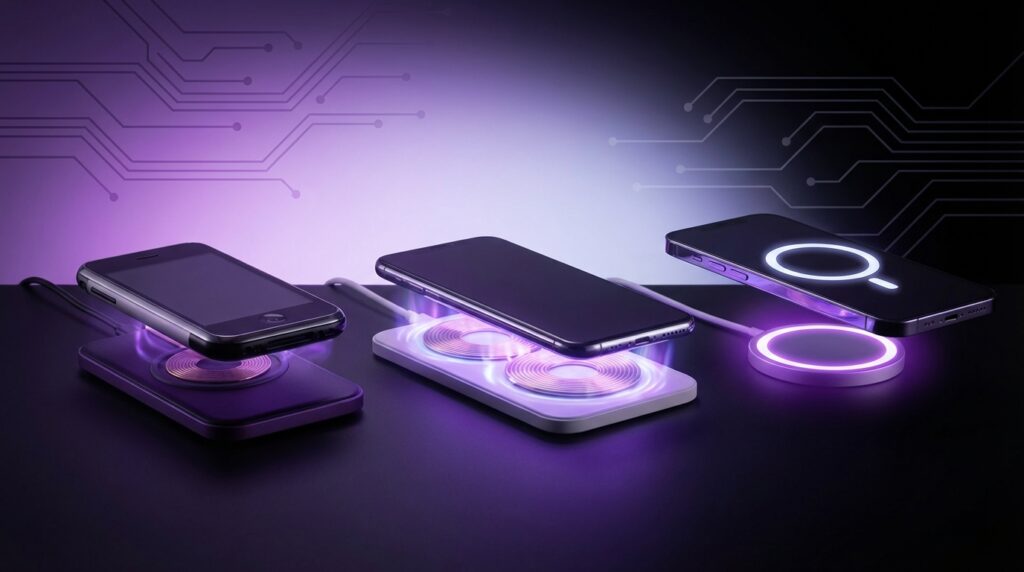
“The first time I put my phone on a wireless charging pad, nothing happened. So I nudged it. Then rotated it. Then picked it up and placed it back down like I was cracking a safe.”
That tiny moment of awkward shuffling is the heart of wireless charging’s early story. You remember that, right? The cheap plastic pad on your nightstand, the subtle hum from the wall adapter, the little LED that glowed one color when it worked and another when it did not. You would wake up in the morning, grab your phone, and sometimes find 100 percent. Other days, you would find 27 percent and a silent apology from the universe.
The funny part: that fussy, slightly unreliable slab of plastic is what leads us straight to MagSafe and the modern “just snap it on” experience. Same core idea: power without plugging in. Same Qi heritage under the hood. Different attitude entirely. Back then, it felt like a neat party trick. Now, phones cling to chargers with magnets, charge faster, double as wallets, and hang off car vents like they are glued there. Wireless charging went from “please don’t move or it will stop” to “click, done, next.”
For a lot of people, the story starts with Qi pads for Android phones and late-night Amazon orders. For Apple fans, it shifts sharply in 2017 when the iPhone finally joined the Qi world. But the root goes deeper than shiny glass backs and polished marketing. It begins with coils, with standards committees, with people trying to convince phone makers that killing the cable was not insane.
And if you pick up a chunky early Qi pad and then snap an iPhone onto a modern MagSafe puck, you can feel that entire shift in your hand. The cheap, hollow plastic vs the cool metal ring. The guessing game vs the magnetic “thunk.” Same core physics. Very different user story.
The clumsy beginning: early Qi and the art of lining it up
“Retro Specs: First-gen Qi pads often hovered around 5W output, paired with phone receivers that were not exactly power-hungry to begin with. Translation: overnight charging only.”
Qi wireless charging is grounded in a simple principle: electromagnetic induction. Put a coil in the charger, a coil in the phone, throw some current through the first one, and you get power in the second. Sounds clean on paper. In real life, early Qi was more like trying to toast bread on a camping stove.
Early pads had:
– Loose alignment tolerances
– Very limited power levels (think 3.5W to 5W at first)
– Heat issues if you pushed things too much
– A talent for pretending they were charging when they were not
The plastic felt light, almost toy-like. The pad would slide around your desk if you brushed it. The surface often had a rubber ring or a soft-touch coating to keep your phone from sliding off, and that coating usually wore off or attracted dust like velcro.
Many phones did not even have built-in Qi. You needed a special case or a receiver card that slotted under your battery cover or plugged into micro-USB. That card added a bit of thickness, made the phone sit oddly in your hand, and sometimes broke after a few months.
“User Review from 2012: ‘Works… if you place the phone just right. Bumped my nightstand and woke up with 9% battery. Cool idea though.'”
The experience felt magical for the first three minutes. Then you realized:
– You could not pick up the phone and keep it charging.
– If you wanted to use it comfortably in bed, wired was better.
– It was usually slower than the cheap 1A or 2A wall brick you already owned.
So why did people buy it?
Because no cable meant less wear on the port. Because it looked futuristic. Because that soft little blink of an LED felt like a tiny “welcome to the future” for your desk. And maybe it was just nostalgia talking, but that gentle hum from a cheap switching power supply and the glow of a blue LED in a dark room still feels like the gadget era that raised a lot of us.
The Qi standard grows up: from slow novelty to daily habit
Qi is managed by the Wireless Power Consortium (WPC). Think of it as the crew that convinced multiple phone makers to agree on one language for power over coils. That agreement mattered. It is why a generic Qi pad from a random brand could charge a flagship phone from a big brand.
As time passed, a few things changed the story:
1. **Power increases**
Qi moved from 5W to 7.5W, 9W, 10W, and beyond. Phone makers started doing fast wireless variants: 15W, 30W, even higher in some ecosystems.
2. **Coil design improvements**
Multi-coil pads tried to solve the alignment problem. Instead of one coil, you got several overlapping ones. The pad’s controller picked which coil to fire based on where the phone sat.
3. **Integration into phones**
Once phones started shipping with Qi built in, adoption accelerated. No more weird cases. No more sticker coils inside your back cover.
4. **Furniture and cars join the party**
Qi pads appeared in cars, coffee shops, airport lounges, and built into IKEA furniture. The experience was still hit or miss, but it was there.
Wireless charging shifted from “gadget you show your friends” to “thing your phone just quietly supports.” The friction point that never really disappeared though was alignment. If you plopped the phone down off-center, charging slowed, stopped, or heated up more than it should.
And for many users, the math was simple: “If I have to think about exactly where to put it, I might as well plug in a cable.”
Apple joins the Qi party: glass backs and slow pads
When Apple added wireless charging to the iPhone 8, 8 Plus, and X, it did not create a new standard. It tapped into Qi but put its spin on the experience. Glass backs came not just for aesthetics, but because Qi coils do not like metal in between.
The first official Apple wireless pad was… delayed. AirPower was announced with huge promises: multiple devices placed anywhere on the mat, each detected and powered individually. The pitch was bold. The product never shipped. Those coils and the heat they created were not easy problems.
In the meantime, Apple:
– Endorsed third-party Qi chargers.
– Capped iPhone wireless charging at 7.5W with its own tuning.
– Focused on reliability and safety more than raw speed.
So users did what users always do: they bought Belkin and Mophie stands, cheap Amazon pads, car mounts with Qi coils behind plastic jaws. And they learned the usual Qi dance:
– Tilt the phone a bit until the charging chime plays.
– Watch for the icon to confirm.
– Try not to bump it.
The iPhone glass sandwich had a certain weight in the hand. Solid, cold around the edges, warm in the middle when charging. On a Qi stand, the soft glow from the base, the gentle angle, the tiny “ding” when the magnets in the case clipped to the stand (if you had a metal plate for car mounts) all built a sort of daily ritual.
But for Apple, that middle chapter was not the final stop. It was a training stage. It taught users that:
– Wireless charging is allowed behavior.
– Putting your phone down to charge is normal.
– You do not always need to hunt for a cable.
The real twist came later.
Enter MagSafe: magnets, alignment, and a click you can feel
“Retro Specs: The original MagSafe on MacBook chargers used magnets to keep the plug in place and pop off if you tripped on the cable. It felt like a safety feature. The iPhone version felt like a lifestyle feature.”
In 2020, the iPhone 12 line introduced MagSafe for iPhone. This was not the old MacBook power connector just stapled to a phone. It was:
– A ring of magnets around a central charging coil.
– NFC and other trickery for accessory identification.
– A way to lock accessories into the perfect spot, every time.
Underneath, iPhone MagSafe still speaks Qi. But because the phone and the charger snap together into a precise alignment, Apple can safely push power to 15W on compatible hardware. Less guesswork, cleaner thermal control, more predictable performance.
The sound and feel are the key. When you:
– Hold the phone in one hand,
– Bring the MagSafe puck close with the other,
– And feel that final “thunk” when it seats itself,
you get a tactile confirmation that early Qi never offered. You do not squint at a tiny LED on the pad. You do not tap the screen to check the icon. Your fingers feel the magnets grab, and your brain relaxes.
The plastic and metal on MagSafe pucks usually feel dense, with a bit of weight that stops them from flopping around on the desk. The cable strain relief is thicker than a micro-USB cable ever had. The back of the iPhone has a subtle magnet ring under the glass. Put two compatible phones back to back and you sometimes feel the magnets arguing with each other.
Why MagSafe changed the wireless charging story
1. **Alignment solved at the user level**
The magnet ring does the thing alignment guides, rubber rings, and textured pads tried to do. It does it reliably, with no thinking required.
2. **Accessories beyond charging**
Because magnets provide a stable, known position, Apple and accessory makers can attach more than chargers:
– Wallets
– Battery packs
– Car mounts
– Tripods and grips
Power becomes one use case of a standard magnetic interface.
3. **Charging while using is practical**
With early Qi, picking up your phone meant interrupting power. With MagSafe, a puck hangs from the back like a wired charger with a flat, circular head. It is not perfect for gaming sessions, but typing a message or checking notifications feels natural.
4. **Speed without chaos**
MagSafe sticks closer to rated output because alignment is guaranteed within tight tolerances. Thermal behavior is more predictable. The iPhone manages charging intelligently, slowing when needed, protecting the battery.
There is still heat. There is still some power loss. But the story moves from “wireless charging is cute, but unreliable” to “wireless charging is now the default on my nightstand and desk.”
Then vs now: Nokia bricks, Qi pads, MagSafe snaps
Before wireless, our relationship with charging was pure cable. Think about a Nokia 3310 or similar candy bar phone. You had:
– A cylindrical barrel plug charger
– A tiny port on the bottom of the phone
– Charging speeds that felt acceptable because the battery was small and the phone sipped power
Modern iPhones run entire smart home dashboards, high-refresh displays, multiple camera feeds, and constant background sync. Their charging needs and user expectations are very different.
Here is a simplified “then vs now” snapshot.
| Feature | Nokia 3310 Era | Modern iPhone with MagSafe |
|---|---|---|
| Charging Method | Wired barrel connector, single vendor style | Wired USB-C + MagSafe wireless (Qi-based) |
| Typical Battery Size | ~900 mAh | ~3200 to 4500 mAh, depending on model |
| Power Draw | Low, monochrome screen, simple radios | High, OLED screen, 5G, constant background tasks |
| Wireless Charging | None | Qi support with MagSafe up to 15W |
| Alignment | Mechanical plug only fits one way | Magnetic snap locks phone in optimal spot |
| Use While Charging | Full mobility, cable attached | Wired: full mobility, MagSafe: usable but puck stays on back |
| Accessory Ecosystem | Chargers, maybe docks | Stands, wallets, power banks, car mounts, docks built around MagSafe ring |
| Charging Habits | Plug in every few days | Top up multiple times a day via pads and pucks |
From 3310-style plug charging to Qi to MagSafe, the trend moved toward:
– Less effort
– Less mechanical wear on ports
– More casual top ups rather than one big nightly refill
And while wired charging is still faster at the high end, the daily groove for many people is now: drop on pad, snap to MagSafe, unplug only when needed.
MagSafe vs classic Qi: what actually changed?
If you strip away the magnets, many MagSafe chargers are still Qi chargers at heart. The coils still talk the same power language for compatibility. So what is different in practice?
1. Alignment and power delivery
Classic Qi:
– Single coil or multi-coil with a wider target zone
– User places phone manually
– Misalignment leads to lower effective power, heat, or failure
MagSafe Qi:
– Magnet ring pulls coil center to coil center
– Phone knows it is on a certified MagSafe charger
– iPhone can allow higher power (up to 15W) with better control
In day-to-day life, that means:
– Less time nudging your phone on the pad
– More confidence that you will wake up to a full battery
2. Experience design
Classic Qi pads often felt like accessories. MagSafe feels like part of the phone’s personality. Apple leaned hard into:
– Visual animations when the phone snaps on
– Customization, like MagSafe wallet color showing on screen
– Strong third-party accessory support with a clear design guide
The tactility is the part that sneaks up on you. You start to expect that small tug when the magnets catch. Put your phone on a non-MagSafe Qi pad again and it feels loose, like parking a car without any lines.
3. Accessory stackability
With MagSafe, you can dream up layers:
– Phone + MagSafe case + MagSafe wallet + MagSafe car mount
– Phone + MagSafe battery pack + wireless earbuds case on top while plugged in
– Phone attached to MagSafe tripod for video shooting
Qi by itself aimed at power delivery. MagSafe sits on the same physics but turns that into a position anchor for entire workflows.
Beyond MagSafe: Qi2 and the magnet circle goes global
MagSafe did something interesting for the wider phone world. It proved that magnets plus Qi is not just a cute trick; it is a meaningful quality upgrade. The WPC paid attention.
Qi2 is the next step. It:
– Takes cues from MagSafe’s magnetic ring system
– Standardizes magnetic alignment in the Qi spec
– Opens that magnet-plus-coil approach to more brands
Wireless charging for non-Apple phones is starting to pick up that magnet story too. You get:
– Magnetic Qi2 mounts that feel sort of like MagSafe
– Accessories that promise faster, more stable charging because the phone cannot sit crooked
– A path where the “snap” experience is not locked to one vendor
So we move from:
– Early Qi: “Place carefully, hope”
– MagSafe: “Snap, done” in one ecosystem
– Qi2: “Snap, done” across more ecosystems
“User Review from 2025: ‘I didn’t realize how much mental energy I spent lining my phone up on pads until I got a magnetic charger. Now I just throw it near the mount and let the magnets do the rest.'”
Wireless charging trade-offs: speed, heat, and battery health
Even with all this progress, physics still has opinions. Wireless charging:
– Loses more energy as heat than a direct cable
– Tends to be slower at peak than the most aggressive wired fast charging
– Can warm both charger and phone noticeably at high power levels
MagSafe and refined Qi pads try to balance this:
– The phone monitors temperature and scales power down when needed.
– Software manages charging curves to protect long-term battery health.
– Pads improve thermal design: metal bodies, vents, better coils.
Compared to those early 5W pads that took all night just to limp to 80 percent, a modern MagSafe puck feels lively. But the fastest path from 0 to a high charge is still often a wired fast charger. The MagSafe play is about convenience, integration, and habits, not raw numbers.
For many users, the pattern quietly changed from:
– “Charge from 10 percent to 100 percent overnight”
to:
– “Top up multiple times: desk, car, couch, nightstand”
Wireless charging, especially with magnets, supports that micro-charging lifestyle very well.
A tactile history: how the hardware felt in the hand
Think about three objects:
1. An old hard plastic Qi pad from early 2010s
2. A generic fast Qi stand from the late 2010s
3. A modern MagSafe puck or stand
The old pad:
– Very light, almost hollow
– Matte or glossy plastic that creaked if you squeezed it
– Often a bright LED that felt too strong in a dark room
The fast Qi stand:
– Slightly heavier base
– Angled cradle so you could see your screen while charging
– More rubber, less sliding
The MagSafe puck:
– Dense, cool to the touch before charging
– Minimalist look, small footprint
– Cable strongly attached, not some flimsy add-on
Each era echoes its design priorities. The first gave you the feature at the lowest possible cost. The second tried to make it less frustrating. The third turned alignment into a physical feature you could feel, not just a design brief.
Maybe that is what sticks most about MagSafe: the moment it erases that tiny daily question of “am I on the pad correctly?” After years of people carefully nudging phones into place at night, the click of magnets felt almost luxurious.
Wireless charging as part of a bigger gadget story
Wireless charging did not evolve in a vacuum. It arrived alongside:
– Glass backs that made radio signals and coils happier
– Larger batteries that pushed companies to make charging more convenient
– Smart home setups where people wanted drop zones for their devices
– Wearables and earbuds that also needed easy top ups
The desk that once held a single brick charger for a dumbphone now often has:
– A MagSafe stand for your iPhone
– A secondary coil or area for your earbuds case
– Occasionally, a spot for your smartwatch
That physical layout tells the story better than any spec sheet. Early on, charging was an afterthought. Now, surfaces are designed around it.
Wireless charging moved from a weird side gadget to an expectation in the modern tech stack. You buy a phone and just assume there is a coil in there. You look at a new desk lamp and half-expect a little charging pad at the base. You get into a rental car and glance at the center console, waiting to see if it has the familiar wireless tray.
The step from slow Qi pads to MagSafe was not only about speed bumps and magnet rings. It was about sealing the idea that charging should feel effortless and predictable, not finicky and fragile. That click when the phone snaps into place is the sound of that shift.
