

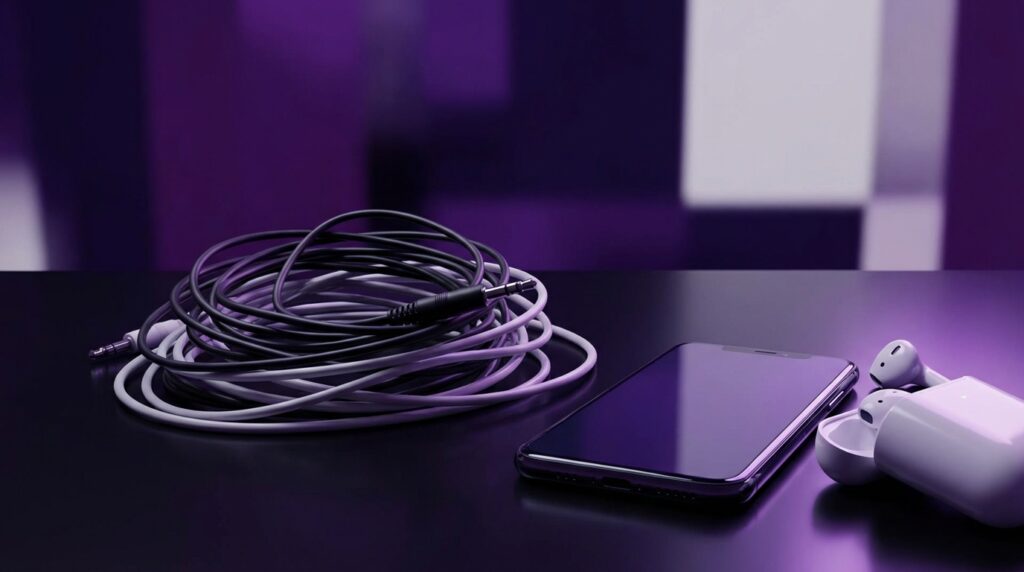
“That tiny ‘click’ when the 3.5 mm jack finally seated into place. Music went from tinny speaker to private universe in half a second.”
You remember that sound, right? You could be on a crowded bus, in a noisy cafeteria, or walking down a street full of traffic, and the moment that plug snapped into the port, the world shrank to just you and your playlist. Fast forward to the iPhone 7 keynote. Suddenly, the port that had followed us from cassette players to MP3 devices was gone from Apple’s flagship phone. In its place: courage. Or at least, that is what Apple called it.
That old click is exactly what sits at the center of the question: was Apple right to kill the headphone jack?
Because this is not only about a round metal hole on the bottom of a phone. It is about how we listened to music, how we shared videos, how we recorded audio, and how a whole accessory market hung off that single 3.5 mm ring of plastic and metal. It is also about how comfortable we feel when a company rips out something that “just worked” and tells us the future will be better on Bluetooth.
Before wireless earbuds became as normal as car keys, that missing port felt like a glitch. And yet, you are probably reading this with a pair of wireless buds in your ears, or a Bluetooth speaker somewhere nearby, wondering why your wired headphones are in a drawer you never open.
The Old Ritual: Plug, Click, Play
The 3.5 mm jack is one of those parts of tech that felt invisible. Always there, always working, almost boring. But it did a lot of heavy lifting.
Picture a chunky 2005 iPod in your hand. The brushed metal back picks up fingerprints. The plastic front has hairline scratches that catch the light just right. The wheel feels loose but reliable. At the top edge, that small round cutout waits for your headphones. You slide the plug in. Resistance. A faint scrape of metal on metal. Then the little click. Signal locked.
Instant connection. No pairing. No lag. No menus. Just copper touching copper.
Retro Specs: Generic 2005 MP3 Player
Screen: 1.5 inch, 128 x 128 pixels
Storage: 512 MB flash memory
Battery: 10 hours playback
Audio output: 3.5 mm stereo jack, line out
Devices back then felt dense. You could feel the weight of the battery, the drive, the casing. The headphone jack sat there like a tiny anchor point that turned a cold gadget into a personal companion. Your earbuds were like a physical extension of the device.
Maybe it was just nostalgia talking, but there was something reassuring about a connection you could see and touch. No firmware, no codecs, no negotiation. The plug either fit or it did not.
The Standard That Refused To Die
The 3.5 mm jack came from a very old family. Its ancestor, the quarter-inch phone connector, dates back more than a century. Telephone switchboards, early audio gear, all used some variation of that same geometry.
By the early 2000s, the 3.5 mm jack was everywhere:
– Phones
– Laptops
– Portable CD players
– Game consoles
– Radios
– Voice recorders
This created a quiet but powerful effect. You could take basically any headphones and plug them into almost any audio source. No license, no logo, no handshakes between chips. It was simple analog audio.
That simplicity built habits. Friends could share earbuds and listen to the same track. Audio mixers could plug into any phone with the right cable. Car aux ports turned old stereos into Spotify machines. The internet was full of “life hacks” around the headphone jack: remotes, microphones, even card readers that piggybacked on the audio channel.
So when Apple removed it in 2016 with the iPhone 7, it felt like someone had quietly unscrewed a foundational brick from the gadget wall.
Apple’s Argument: Space, Water, Wireless
When Phil Schiller stood on stage and said Apple was removing the headphone jack because of “courage,” it sounded like marketing spin. But behind the slogan, there were three core claims:
1. The jack took up valuable internal space.
2. Removing it helped with water resistance.
3. The future of audio was wireless.
Internal Space: The Tiny Hole With A Big Footprint
Inside a smartphone, every cubic millimeter counts. The 3.5 mm jack might look small from the outside, but its internal housing, shielding, and clearance people need for the plug length all occupy volume.
That space could go to:
– A larger battery cell
– A haptic motor
– Sensors
– Extra speakers
Was that trade worth it? This is where a Then vs Now view helps.
| Feature | iPhone 6s (With Jack) | iPhone 7 (No Jack) |
|---|---|---|
| Headphone jack | 3.5 mm analog port | Removed |
| Main audio path | Analog via jack | Digital Lightning / Wireless |
| Water resistance rating | No official IP rating | IP67 |
| Battery capacity | 1715 mAh | 1960 mAh |
| Weight | 143 g | 138 g |
Apple did manage to fit a slightly larger battery and advertise a water resistance rating. Removing a physical opening definitely made sealing the shell easier. Rubber gaskets and glue are only as strong as the weak point they surround. Fewer holes means fewer weak points.
Was the headphone jack the only thing standing between us and IP67? No. Other phones kept their jack and still got water resistance ratings. Engineers can seal around ports. But if you are Apple and you like clean lines and fewer variables, that port becomes a candidate for removal.
Water And Dust: The Holes Add Up
Think about all the cutouts on a phone:
– Charging port
– Speaker grilles
– Microphone ports
– SIM tray
– Buttons
– Headphone jack (in older models)
Each opening increases the chance of ingress. Each one needs a gasket, a mesh, glue, or some mechanical trick. From Apple’s point of view, if they could route audio through existing ports (Lightning or later USB-C) and radios (Bluetooth), that jack became redundant.
The practical effect for users: dropping your phone in the sink or taking calls in heavy rain felt less risky. Water resistance went from “hidden benefit” to bullet point, even if people still handled phones with care around pools.
The Wireless Push: From Weird To Normal
When Apple removed the jack, the Bluetooth headphone market was still split between early adopters and people who laughed at the idea of charging their headphones almost every day. Bluetooth had a reputation:
– Audio lag when watching videos
– Pairing problems
– Chunky designs
– Inconsistent controls
At the same time, chipsets were getting more capable, and batteries were squeezing more time out of tiny cells. Apple used the removal of the jack to push AirPods from “interesting accessory” into “default audio device.”
In effect, the missing port forced many iPhone users to confront Bluetooth in a serious way. Once people had a decent wireless experience, going back to cables felt awkward.
The Transition Pain: Dongles, Latency, And Lost Mics
From the consumer side, the first few years after the jack removal were messy.
The Dongle Era
Apple put a Lightning-to-3.5 mm adapter in the box for a while. It was tiny, easy to lose, and became one of those objects you always needed at the worst possible time.
You had one in your pocket, one on your desk, one in your backpack. They cost just enough to be annoying when they vanished, and they turned a single, solid plug into a two-part chain with a weak link.
For people who used their phone for serious audio work, the pain was sharper:
– Wired headphones with inline mics behaved differently or not at all.
– Line-level connections to mixers or car stereos picked up noise through cheap adapters.
– You could not charge and listen wired without another dongle or hub.
User Review from 2017
“I bought two of these adapters and both stopped working in a month. My wired headphones sound worse now and sometimes the phone does not detect the dongle. I miss the jack.”
The removal did not break audio, but it inserted friction where none existed. That friction nudged people toward full wireless, which is exactly where Apple wanted them.
Gaming And Latency
Bluetooth audio has improved a lot, but physics still matter. When audio data goes from phone to earbud, it gets encoded, transmitted, received, decoded, and finally played. Each step adds time.
Most people playing Spotify do not notice. But:
– Mobile gamers feel the delay between tap and sound effect.
– Musicians feel latency when using apps that turn phones into instruments or effects.
– People editing video on phones notice lip sync drift.
Wired connections keep latency low because the signal path is simpler. No compression step. No radio layer.
Gamers learned this the hard way on early AirPods. Taps in Fortnite did not line up with gunfire in their ears. Over time, faster Bluetooth codecs and better hardware shrunk the delay, but wired audio still holds an edge for instant response.
Creators And The Lost Line-In
Before the jack went away, creators used it in some clever ways:
– TRRS cables to feed clean audio from mixers into phones for live streams.
– Compact microphones that relied on the headphone jack standard.
– Aux cables for recording from DJ mixers or instruments.
Removing the jack forced creators to buy:
– Lightning or USB-C audio interfaces
– More expensive microphones
– Multi-port hubs
None of this made it impossible to get good sound on an iPhone. It just raised the floor cost. For Apple, that is okay. For users who had a bag full of gear tuned to 3.5 mm, it was a reminder that ecosystems can shift under your feet.
Then vs Now: The Headphone Jack In Context
To see how big this shift is, you have to zoom out. The headphone jack is not the first port Apple has killed.
| Era | Old Port | New Standard | Outcome |
|---|---|---|---|
| iMac G3 (1998) | Serial, ADB, floppy | USB | USB became universal, old peripherals faded |
| iPod / iPhone 4 era | 30-pin dock | Lightning | Smaller devices, accessory market reset |
| 2016 iPhone 7 | 3.5 mm audio jack | Lightning + Bluetooth | Wireless headphones surged, wired declined |
| USB-C iPhones | Lightning | USB-C | Aligns with laptops, tablets, chargers |
Apple has a pattern: remove, endure backlash, wait for the industry to follow once the new way feels normal.
The Industry Followed: Was It Just Copying?
For a while, Android users mocked iPhones for losing the jack. Then one flagship after another quietly dropped it:
– Google Pixel line
– Samsung Galaxy S and Note
– OnePlus
– Most newer midrange devices
Certain brands kept the jack longer on gaming phones and budget devices. But at the high end, the jack became rare.
Why? A mix of reasons:
– Thinner designs
– Water resistance marketing
– More space for bigger batteries or extra cameras
– Accessory sales, including wireless buds from those brands
This does not prove Apple was morally “right.” It shows that once a big player breaks a norm, it gives others cover to make similar moves.
The Benefits Users Actually Got
Strip away the keynote language and you are left with outcomes people can feel.
Wireless Everywhere
Look around a gym, an office, a bus. Wireless earbuds dominate:
– No cable getting caught on door handles
– No wire noise rubbing against jackets
– Easy single-ear listening for calls
The sound quality of wireless buds is now good enough for most people, with strong bass, stable connections, and fast pairing. The friction that used to make Bluetooth annoying is much lower. Open the case, they connect. Close the case, they disconnect and charge.
Apple did not invent Bluetooth audio, but removing the jack poured fuel on it. AirPods turned wireless earbuds into a social signal and a default choice rather than a geeky accessory.
Better Water Resistance And Durability
Modern phones survive:
– Bathroom drops
– Heavy sweat
– Rainy runs
Holes in the chassis are fewer and better sealed. Speakers use membrane protection. Charging ports have water resistance designs. Removing one more analog audio port made the mechanical design simpler.
Again, plenty of older phones with jacks handled wet conditions well enough, but we now have a generation that expects “your phone can fall into shallow water and live.”
Cleaner External Design, More Internal Flexibility
Removing a port simplifies the external layout. Less visual clutter, fewer mechanical failure points. Inside, designers gain just a bit more flexibility to route antenna lines, enlarge battery pockets, or rearrange controllers.
Users do not see that directly, but they feel it in:
– Slightly better battery life
– More complex camera modules
– Haptic engines that feel stronger and more precise
The headphone jack was not blocking all that on its own. It was one of many tradeoffs engineers wrestled with.
The Real Costs People Paid
To decide whether Apple was right, you also have to weigh what we lost.
Universal Compatibility Took A Hit
Before: one pair of wired headphones worked with almost everything:
– Your phone
– Your laptop
– Your old iPod
– Airplane seats
– Game controllers
After the jack removal:
– iPhone used Lightning, then USB-C
– Laptops used 3.5 mm and USB-C
– Some game consoles stayed on 3.5 mm
– Wireless buds worked, but each had pairing quirks
The humble analog jack used to be the “any device, any time” answer. Now, you switch between:
– USB-C
– Lightning (older iPhones)
– Bluetooth
You can still buy wired headphones and plug them into many devices, but that “I know this will just work” feeling is weaker.
Audio Quality And Reliability Tradeoffs
Analog jacks are simple. Wired earphones do not need firmware updates. They do not suddenly stop working because of a software glitch or a dead battery.
Wireless earbuds bring a lot of good but also:
– Battery degradation over time
– Occasional connection drops
– Codec mismatches between devices
– Charging case issues
Audiophiles still prefer wired setups for critical listening:
– No lossy compression stage from source to ear
– Good external DACs and amps beat most phone internals
– Latency stays very low
For everyday streaming, modern Bluetooth codecs sound great to most ears. But people who care deeply about audio chain control do not see the lack of a jack as an improvement.
Waste And Lifespan Questions
Wired headphones, especially simple analog ones, can last for many years. If the cable frays, you can often replace or repair it. The 3.5 mm standard made it easy for small repair shops and tinkerers to keep gear alive.
Wireless earbuds tend to have:
– Tiny glued batteries
– Compact, sealed shells
– Shorter practical lifespans
When batteries lose capacity, many users replace the buds instead of repairing them. That means more e-waste and a faster accessory churn cycle.
The removal of the jack pushed more people toward that model. You trade fewer cables for more devices with built-in obsolescence.
Then vs Now: From Nokia 3310 To Modern Portless Dreams
To really feel the shift, compare a classic device with a modern flagship.
| Feature | Nokia 3310 (2000) | Modern High-end Phone |
|---|---|---|
| Headphone jack | None (later variants added 2.5 / 3.5 mm) | Usually none |
| Main audio output | Mono speaker, accessory port on some models | Bluetooth, USB-C/Lightning |
| Ports | Charging barrel jack | 1x USB-C or 1x Lightning |
| Battery access | Removable by user | Sealed, glued |
| Durability | Physical toughness, no water rating | Glass sandwich, IP rating for water / dust |
| Audio accessories | Simple wired headsets | Wireless earbuds, smart speakers, car integration |
Funny twist: the original 3310 did not even have a 3.5 mm jack. The modern reboot that played on nostalgia added one. Meanwhile, current flagships move toward as few openings as possible.
You can feel a design direction: fewer holes, more radios, more sealed parts. The headphone jack is a casualty of that trend.
How The Death Of The Jack Changed Behaviors
Beyond pros and cons, there is the everyday stuff: how we act around our devices.
Sharing Audio Changed
Remember giving one earbud to a friend on the bus to watch a clip on a tiny screen? That split-cable sharing depended on simple, analog connections.
Without a jack:
– People use built-in “audio sharing” features to connect two pairs of wireless buds.
– Car rides have turned into each passenger in their own audio bubble.
– Spontaneous “here, listen to this” moments happen through screens held up on speaker more than shared cables.
The social texture of listening shifted from physical sharing of cable branches to digital pairing and isolation.
Workflows For Creators And Professionals
For content creators, the missing jack meant:
– Investing in USB audio interfaces
– Learning about bit rates, sample formats, driver quirks
– Dealing with app permissions for connected devices
You now see a wave of smartphone-focused audio gear:
– USB-C condensers
– Compact digital mixers that plug directly into phones
– Wireless mic systems tied into camera and phone ecosystems
The old model of “plug any mic with a TRRS connector into the headphone jack” gave way to more specialized, pricier tools. On one hand, the quality bar rose. On the other, the entry bar rose too.
Retro Specs: The Last Jacked iPhone
Before the port vanished, the headphone jack on iPhones reached a polished peak.
Retro Specs: iPhone 6s Audio
Audio output: 3.5 mm TRRS
Dynamic range: around 93 dB
THD+N: low, clean signal
Use cases: headphones, line out, mics via TRRS
Users praised:
– Strong, clean output for most headphones
– Low noise floor
– Reliable detection of inline controls
User Review from 2015
“I plug my 6s into a DJ mixer and it sounds clean enough for parties. No extra hardware. Just a cable. That is what I like.”
From that peak, Apple went all-digital on the phone side and pushed analog conversion into dongles, headphones, and speakers.
Was Apple Right?
To judge this, you have to separate emotion from outcomes, while still respecting that emotion is part of how tech lands in our lives.
From a pure trajectory angle:
– Wireless audio is now standard.
– Most flagships lack a headphone jack.
– Ecosystems of wireless earbuds and smart speakers are huge.
– People are buying, using, and enjoying this gear at scale.
From a user freedom angle:
– The removal reduced universal compatibility.
– It pushed people toward products that wear out faster.
– It made certain creative workflows more expensive and complex.
From an engineering angle:
– Apple gained design freedom inside the phone.
– Water resistance and simplicity of ports improved.
– They could double down on integration with their own wireless ecosystem.
If you judge “right” by whether the market accepted the move and moved in the same direction, then yes, Apple read the future fairly well. They anticipated that wireless would catch up in convenience and quality fast enough that most people would not miss the jack after a few years.
If you judge “right” by the values of openness, repair, and universal standards, then the move looks more like a controlled narrowing of options dressed up as progress.
The honest answer lives in between. Apple was right about where audio was going. They were also willing to accelerate that shift in a way that caused friction for users who valued simple, robust, analog connections.
The tiny click of a 3.5 mm plug locking in is becoming an archiving project now, something for digital museums and gadget drawers. At the same time, the double chime of wireless earbuds pairing has become the new start of the listening ritual.
Maybe it was just nostalgia talking, but that old sound still feels like the most satisfying part of pressing play.
