

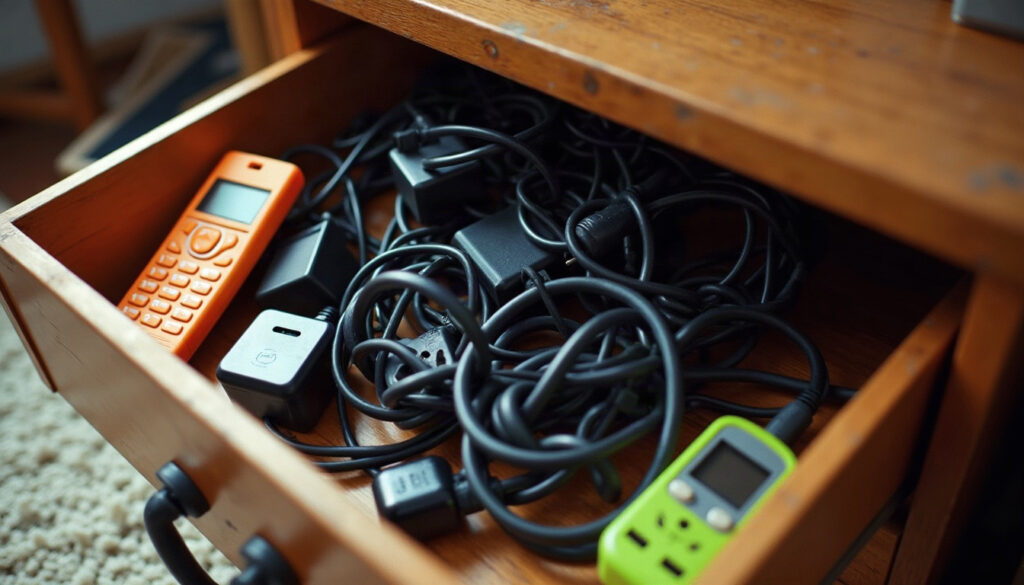
Rattle, scrape, rattle. That’s a drawer full of black bricks sliding around. Every house I knew had one: a junk drawer of chargers, each with a different plug, each belonging to a gadget that retired years ago. I kept mine anyway. You never know when the flip phone will want a comeback.
These days the drawer is down to a few USB cables, and the serious power questions have moved to the garage and the wall. Planning an EV charger or new lighting raises a fair one: what should a homeowner ask before hiring an electrician Salt Lake City UT? I’ll get to that. First, the drawer.
The charger drawer had a system, sort of
Then
Each gadget came with its own wall adapter, the black plug-in brick collectors call a wall wart, with a cable stiff enough to hold its shape. The plug end was always a slightly different size, so nothing swapped. Behind the desk, one power strip fed another power strip, a habit we all had and nobody should have kept.
Retro vault
Before USB charging became common, most gadgets shipped with their own wall adapter, and the plugs differed from one maker to the next. That is why a drawer of mismatched chargers became a fixture in so many homes.
My fix was a strip of masking tape on every cable. Tape peels. Then you’re back to guessing which brick feeds which gadget, and guessing was how gadgets died.
Now
One USB-C style charger now feeds most of the household, and the drawer has gone quiet. The bricks are smaller, but the pile of things to charge keeps growing, and it all hangs off the same few wall outlets.
I keep chargers healthy the way I keep my collection healthy. Give them air. Coil cables loosely instead of wrapping them tight around the brick. Retire any cable that’s frayed, kinked near the plug, or hot to the touch. Don’t bury a warm charger under a cushion or a pile of papers.
Chargers aren’t repair projects, so replace a bad one with a reputable one instead of opening it up. Anything wired into the wall, such as outlets or fixtures, is a different matter and belongs to a licensed electrician. The outlet itself is the one part that hasn’t shrunk. If a room keeps running short of outlets, or a plug feels loose or warm, that’s a sign to call a pro rather than add yet another strip.
The car charger lived in the dashboard
Then
On road trips the phone charged through a car adapter pushed into the dash socket, a round hole originally meant for a cigarette lighter. It had a spring-loaded grip you could feel click into place. The cord always ended up wrapped around the gear stick, and the phone always sat in the cup holder, tilted at an angle that said “please don’t fall.”
Retro vault
Early mobile phones could charge from a car’s dashboard power socket, the round one built for a cigarette lighter, using a plug-in adapter. It let people top up a phone on the road long before USB ports showed up in dashboards.
Charging was a trickle, and it was never in doubt. The wall at home handled everything else without anyone thinking about it.
Now
Now it’s the car that needs charging, and a car is a different animal from a phone. An EV charger in the garage is a long, steady draw rather than a quick top-up, so it needs proper planning and often raises a question about the home’s electrical panel. That’s licensed-electrician territory. Someone qualified looks at the panel, the circuit and the route to the garage, and the local building department can say whether a permit applies. Salt Lake City has real winters and a garage charger works year-round, so it’s also fair to ask how the equipment copes with the cold.
Here are the questions I’d bring to that conversation:
- Are you licensed, and will you handle any required permits?
- Will you check my panel’s capacity before recommending a charger?
- Where will the charger mount, and how will the circuit reach it?
- Who do I call if something trips later?
A good electrician will answer in plain words and explain what they found, not just what they’d like to install.
The wall switch clicked and that was the whole feature
Then
A wall switch had two settings and a satisfying clack. Lamp on, lamp off. If you were fancy, there was a dimmer dial that hummed a little. In the computer-room era the lighting plan was one overhead bulb and a desk lamp on a bendy neck, aimed at the keyboard and slowly cooking your knuckles.
Nobody asked the lights to know what time it was. You walked in, you hit the switch, and you lived with the shadows. Honestly, there was something solid about it. The click told you the job was done. Simple things lasted, too. Fewer parts meant fewer ways to fail, and plenty of those old switches and lamps outlived the gadgets they lit.
Now
Smart lighting turns the same room into scenes: bright for work, low for a movie, porch lights that come on at dusk without anyone touching a thing. Indoors and out, it still comes down to boxes in the wall. Older wall boxes were built for plain switches, and not every smart switch fits without changes, so a professional checks what’s behind the plate before anything gets chosen.
Outdoor fixtures face rain, snow and sun, so they need parts built for the weather. A cold-winter climate like Utah’s makes that more than a detail. An electrician knows what suits each spot and can tell you what’s worth doing now and what can wait. Ask what happens when the Wi-Fi drops, too. A good setup still lets the wall switch do its job. The gadget got friendlier. The wall behind it did not.
What we kept, what we lost
| Then | Now |
|---|---|
| A drawer of one-off adapters | One shared charger and a couple of cables |
| Power strip feeding a power strip | Outlets planned where the desk really goes |
| Phone charged from the dash socket | Car charged from a garage circuit |
| Clacky switch, one overhead bulb | App-controlled scenes inside and out |
| A panel nobody ever opened | A panel checked before big new loads |
We lost the satisfying clunk of a drawer full of hardware and the thrill of finding the right brick. We kept the main lesson: every gadget needs power, and the power comes from somewhere with limits.
Hit save
The old habit worth keeping is caring for what you own: labeling, storing, checking before you plug in. Today’s nudge is simple. Before you add a charger or a new lighting plan, have a licensed electrician look at the panel and the circuits. Label the cables you keep, and write down what’s on each circuit once a pro has traced them. Keep the flip phone. Hire the electrician.
